Diversity language in job descriptions attracts talent from underrepresented groups. And encourages them to apply. So, how do you describe diversity in your job descriptions?
The World Economic Forum’s Future of Jobs Report 2025 found that 83% of global employers now report having active DEI initiatives, up from 67% in 2023. Similarly, the National Association of Colleges and Employers (NACE) Job Outlook 2026 survey revealed that 70% of employers now use skills-based hiring (up from 65% in 2024), replacing traditional educational requirements such as GPA or a specific university “pedigree” to broaden the talent pool.
Here are 18 examples of “diversity language” I find in JDs. Some are more obvious than others.
1. Diversity Statement and EEO Statement
Both diversity statements and EEO (Equal Employment Opportunity) statements demonstrate your company’s commitment to inclusion and signal to candidates from underrepresented groups that they’re welcome to apply. While they serve similar purposes, they can vary in length and specificity.
Diversity Statements
A diversity statement in your JD shows a company’s commitment to inclusion and its impact on various communities. Including underrepresented groups in your diversity statement directly engages with candidates from those groups.
The best diversity statements in job descriptions use culturally sensitive terms that encourage candidates from ethnic groups to apply regardless of physical limitations, identity, or cultural differences.
Ziff Davis uses this diversity language in job postings:
“Spiceworks Ziff Davis is a safe, inclusive workplace for people of all backgrounds and walks of life. We strongly encourage you to apply if you are from a marginalized or underrepresented group, particularly in the technology industry. Some candidates may see a long list of job requirements and feel discouraged because they don’t match every single bullet point – we suggest, please apply anyway. We’re flexible on location wherever possible – we are a Work From Anywhere company. We don’t believe in a “perfect” candidate because we believe in our core value, “Evolve and Adapt Quickly”. If you believe this is a role that you’ll be excited to work in every day, want to be a part of a culture like ours, and will be relentless about pushing boundaries to succeed, please apply.”
Ziff mentions “underrepresented groups” specifically.
Other companies go into even more detail. Curology, for example, names specific groups to show their commitment to diversity:
“Curology encourages applications from people of all races, religions, national origins, genders, sexual orientations, gender identities, gender expressions, and ages, as well as veterans and individuals with disabilities. Pursuant to the San Francisco Fair Chance Ordinance, we will consider qualified applicants with arrest and conviction records Notice to Applicants under the CCPA.”
EEO Statements
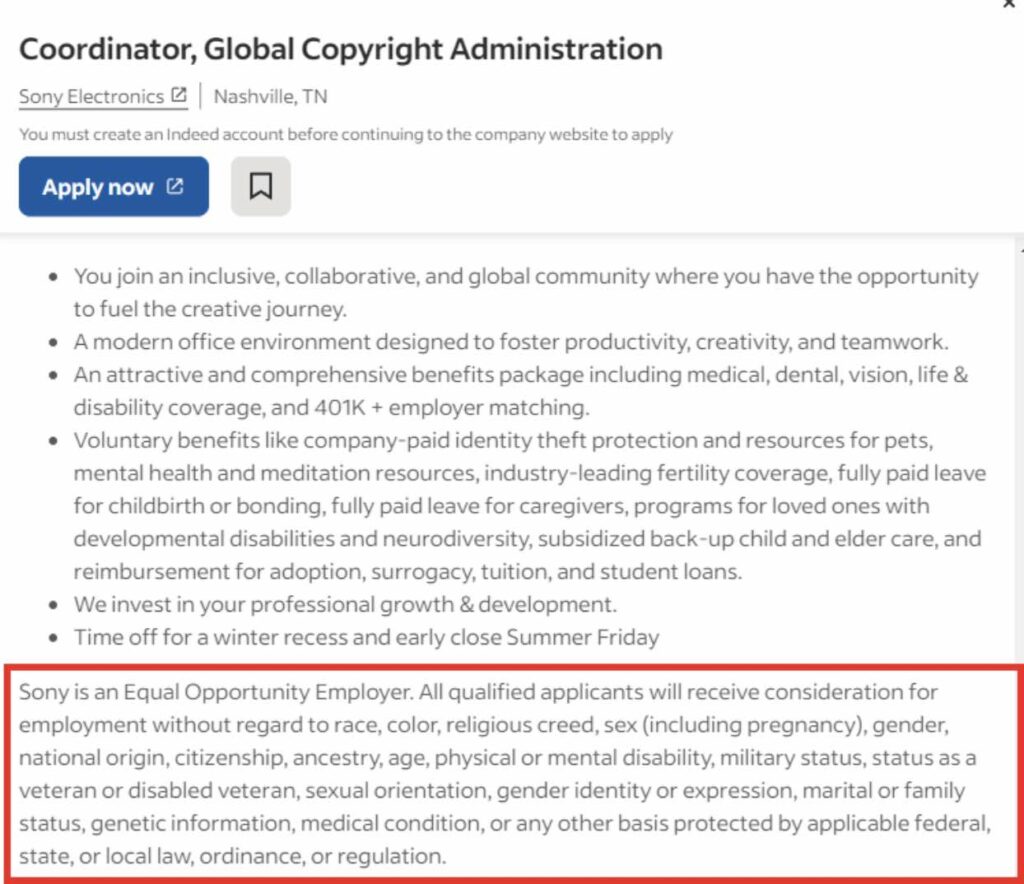
It’s not required by law (except in certain circumstances) but many companies include an EEO statement in their job postings. The words in your EEO statement are words that candidates measure you by, especially candidates from underrepresented groups.
Some companies (like SurveyMonkey) use short and sweet diversity language in their EEO statements:
“SurveyMonkey is an equal opportunity employer. We celebrate diversity and are committed to creating an inclusive environment for all employees.”
Others use a longer version with more detailed diversity language about specific underrepresented groups. Like Dell:
“Dell is an Equal Opportunity Employer and Prohibits Discrimination and Harassment of Any Kind: Dell is committed to the principle of equal employment opportunity for all employees and to providing employees with a work environment free of discrimination and harassment. All employment decisions at Dell are based on business needs, job requirements and individual qualifications, without regard to race, color, religion or belief, national, social or ethnic origin, sex (including pregnancy), age, physical, mental or sensory disability, HIV Status, sexual orientation, gender identity and/or expression, marital, civil union or domestic partnership status, past or present military service, family medical history or genetic information, family or parental status, or any other status protected by the laws or regulations in the locations where we operate. Dell will not tolerate discrimination or harassment based on any of these characteristics.”
If you want more examples for inspiration, check out these 16 Samples of an Effective EEO Statement.
2. Age Inclusive Diversity Language
As of early 2025, approximately 37.7 million workers aged 55 and older are in the U.S. labor force. Workers aged 55+ made up about 24% of the total U.S. workforce in late 2024 to early 2025.
Combining these dynamics helps drive your company to new heights. To avoid deterring valuable talent of all ages, be sure your JDs omit biased language or derogatory terms based on age. Avoid non-inclusive language and statements that allude to energy levels or experience if the role doesn’t require these prerequisites.
For example, you might want to replace or remove terms like “athletic,” “youthful and energetic,” or “ideal for second careers” to avoid trimming down the list of qualified candidates.
Instead, if a role doesn’t require a specific type or amount of experience, use inclusive terms like “open to candidates of all ages” or “new graduates and experienced career seekers are welcome” to attract candidates of all ages.
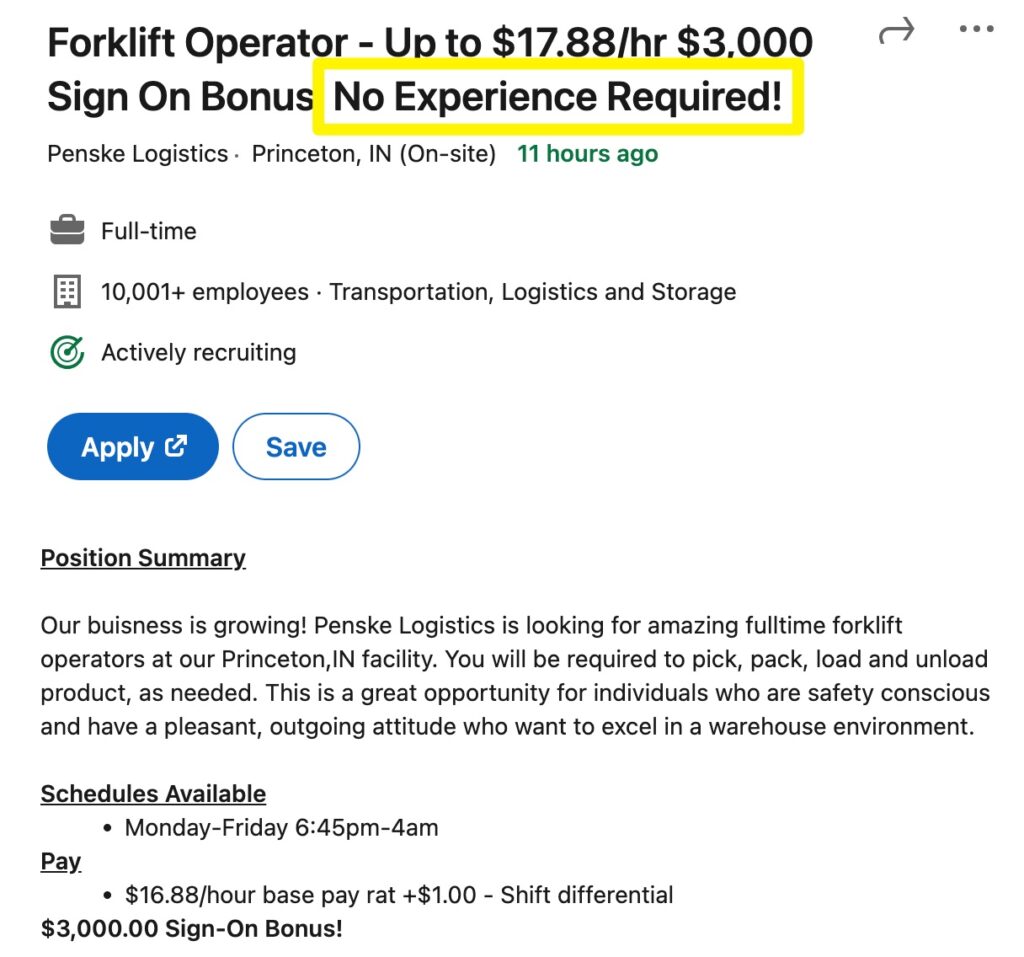
Another effective way of creating age-related diversity is to say there’s “no experience required,” like this example for a forklift operator:
Age is just one example of the types of diversity language you can use in your JDs.
3. ERGs as Employee Benefits
According to Glassdoor surveys, 80% of modern hires prefer additional employee benefits over salary.
Employee resource groups (ERGs) are a strategic addition to job benefits that help fuel your DEI initiatives and attract top talent.
ERGs are usually employee-led groups that provide community, support, and resources for specific groups, fostering a sense of belonging at work.
Mentioning the types of ERGs you have (LGBTQ+, Latinx, BIPOC, and others) in your job postings shows your support for underrepresented groups and attracts diverse talent.
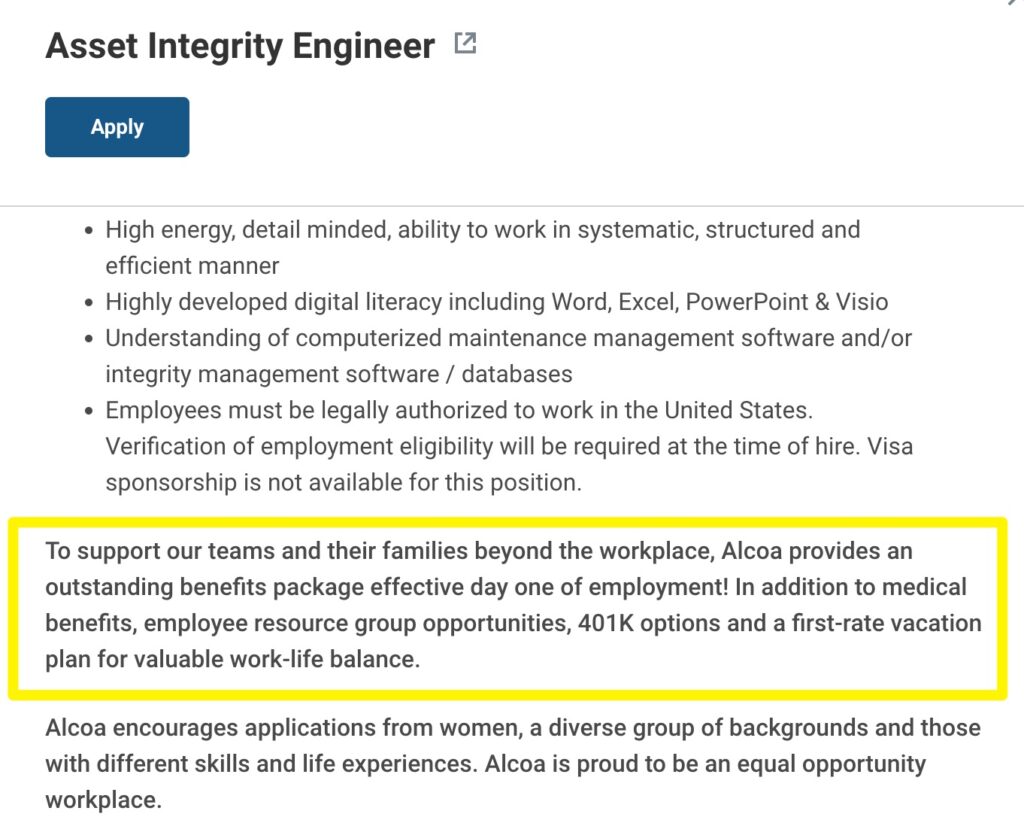
Alcoa lists “ERG opportunities” in their benefits section along with traditional benefits like 401k options, medical benefits, and vacation:
Recently, there have been emerging ERG categories such as:
- Caregiver ERGs – foster a supportive, inclusive environment for employees juggling work and caregiving
- Mental health and wellness ERGs – create a supportive, inclusive workplace, reducing stigma, and promoting mental health awareness
- Generational diversity groups (Gen Z-specific) – recognize the importance of generational diversity and the advantages it brings to the company.
- Climate/sustainability-focused ERGs – designed to promote environmental responsibility, reduce corporate carbon footprints, and foster a culture of sustainability
4. A Short List of Requirements
Employers constantly seek efficient workers with an endless set of skills and abilities. But, extra-long lists of requirements in a JD could do more harm than good.
A lengthy list of job requirements can discourage even qualified candidates, especially if they meet only some requirements. This can lead to a smaller pool of applicants and potentially exclude some talented individuals.
Confidence levels vary across genders. And some studies say that women will only apply for a job if they meet 100% of the requirements (compared to men, who only need to meet 60%). It’s best to write JDs with the absolute necessities instead of sticking to a list of 8 or more traits, skills, and abilities for the perfect hire.
If you prefer candidates with specific abilities or knowledge, consider reducing the rigidity of requirements (e.g., say “a plus if you have” or “bonus points if you can.”). This helps you win the confidence of talent regardless of their previous work experiences.
When listing qualifications, differentiate between “must-haves vs nice-to-haves”. ‘Must-haves’ are the non-negotiable knowledge, skills, and experience required to perform the job correctly. Nice-to-haves are the ideal or desirable competencies that are not strictly required in the job.
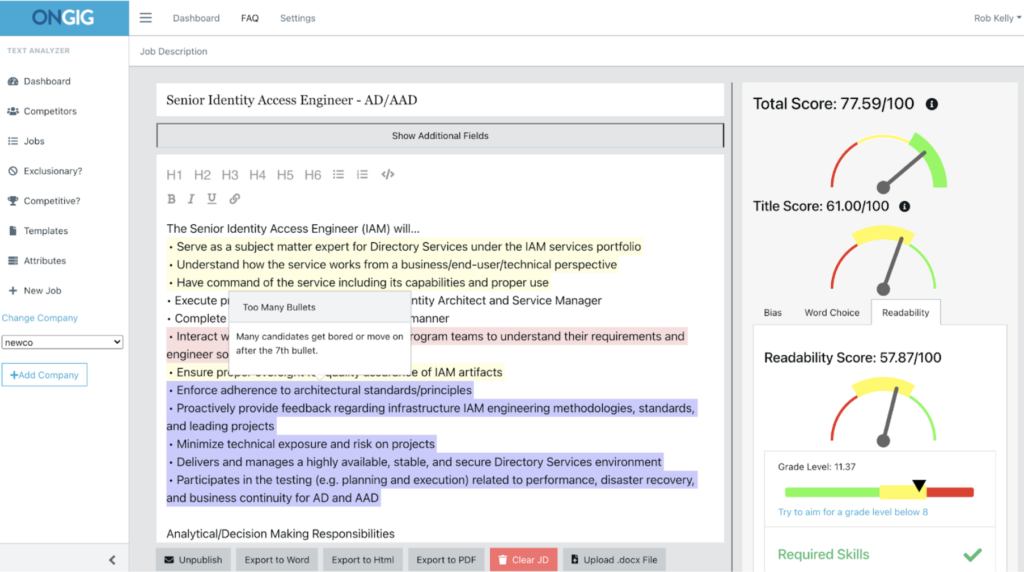
Ongig flags long lists of requirements prompting you to start a new section, so your candidates don’t get bored or move on:
5. Gender-Neutral Titles
Another type of diversity language is found in job titles. Many employers accidentally use gender-biased job titles in JDs.
For example, you name a position “chairman,” “policeman,” or “cameraman”…
when you could opt for gender-neutral alternatives like “chairperson,” “police officer,” and “camera person.”
Other gender-neutral roles across industries include server, salesperson, crew person, chairperson, flight attendant, developer, and engineer.
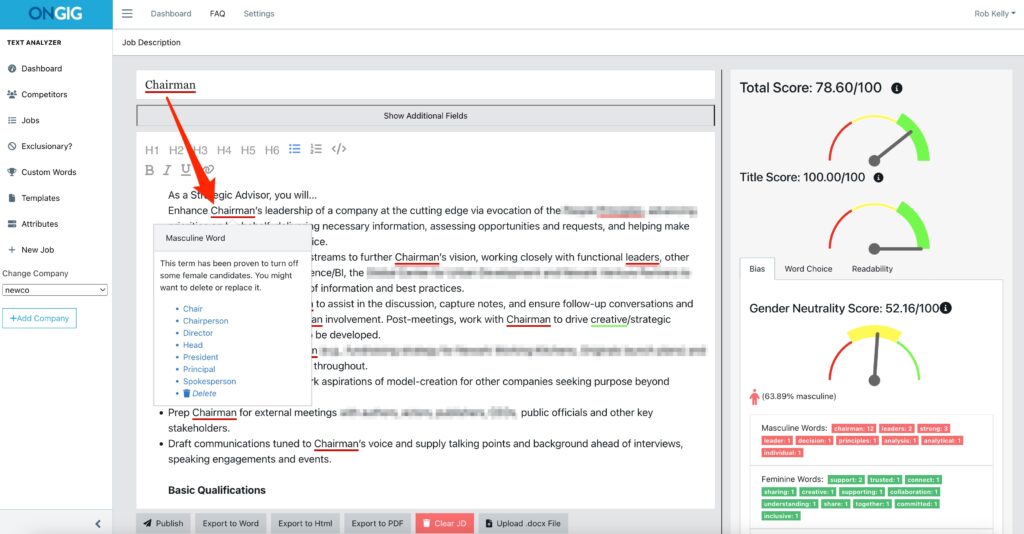
You can find more examples in our post, Gender-Neutral Suggestions for the Top 25 Job Titles That Still Use the Word “Man.” And, Ongig flags any job titles (or other JD language) that aren’t gender-neutral so you can delete or replace them:
6. Salary Information and Pay Transparency
This example of diversity language in job postings is a little less obvious. But. many co.s are including salary information to show their support of pay equity (and also to be compliant with state-level pay equity laws). Organizations must offer equal pay to male and female employees performing the same duties and responsibilities.
Including salary ranges based on qualifications and experiences can prevent gender and racial pay gaps. A salary range indicates the lowest to highest salary an employer can offer the applicant during the hiring process.
When you post a range from lowest to highest, you can reach more candidates with varying skills and years of experience. The highest range attracts top talent, while the lowest range gives people with fewer qualifications more confidence in applying.
If you are unsure of the exact salary for your roles, listing a range is fine. There’s also research showing that:
salary is the #1 part of a job ad that is “helpful”, “appealing”, and makes candidates “more likely to apply”.
As of 2026, pay transparency laws expanded to other states. California, New York, Washington, and Colorado now require employers to include salary ranges in their job posts. Alongside salary information, employee benefits should also be disclosed, such as:
- Remote work options
- Wellness and health benefits: mental health support, HMO, gym memberships
- Financial wellness and compensation: retirement like 401(k), bonuses, annual performance bonuses
- Family and lifestyle: paid parental leave, pet insurance, paid time off
- Professional development: tuition reimbursement, L & D stipends
7. Disability Inclusion
Why hire people with disabilities? Studies show they are often reliable, have a high work ethic, and positively impact the workplace. Tax credits and other financial incentives may also be available to businesses that hire people with disabilities.
So, if you have decided to employ people with disabilities in your organization, here are some specific phrases to encourage their application:
- Clearly state your organization’s commitment to inclusivity and equal opportunity.
Ex: We are committed to creating an inclusive environment for all employees and welcome applications from candidates with disabilities.”
- Encourage people with disabilities to apply.
Ex: “We encourage applications from qualified individuals with disabilities and are committed to providing support throughout the hiring process.”
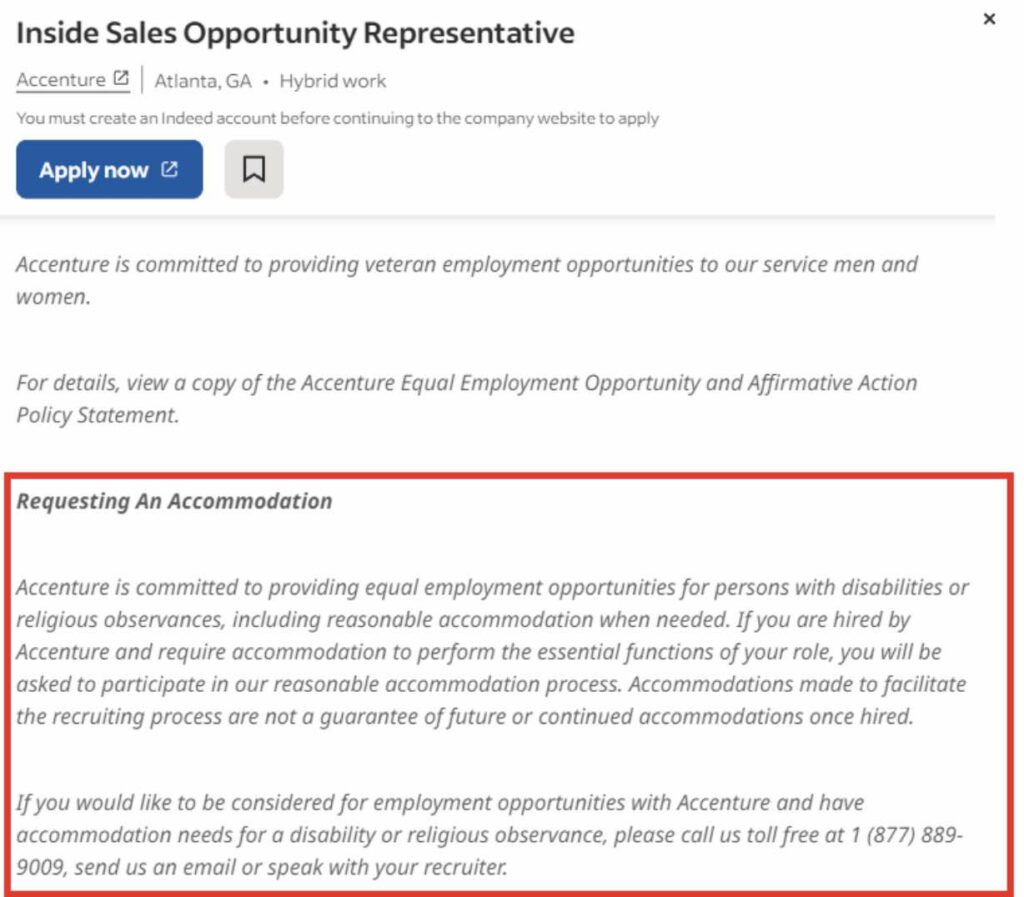
- Mention the company’s willingness to provide reasonable accommodations
Ex: “If we hire you and require accommodation to perform the essential functions
of your role, you will asked to participate in our reasonable accommodation
process.
- Include a clear non-discrimination policy
Ex: “We are committed to providing equal employment opportunities for persons with
disabilities”.
- Emphasize the company’s commitment to accessibility.
Ex: “Our workplace is accessible, and we are committed to providing any necessary accommodations to support our employees.”
- Emphasize that the company values diverse perspectives, including those from individuals with disabilities.
Ex: “We value the unique perspectives and contributions of individuals with disabilities and strive to create a workplace where everyone can thrive.”
8. Neurodiversity Inclusion
Consider employing neurodiverse candidates to increase your talent pool. Neurodiverse people often think in different ways, which leads to a broader range of ideas and solutions. This is especially beneficial when you operate in a highly competitive industry like tech. So hiring neurodiverse people is not only the right thing to do but also good for the business.
Here are some phrases that you can use to encourage neurodiverse candidates to apply:
- Welcome neurodiverse candidates
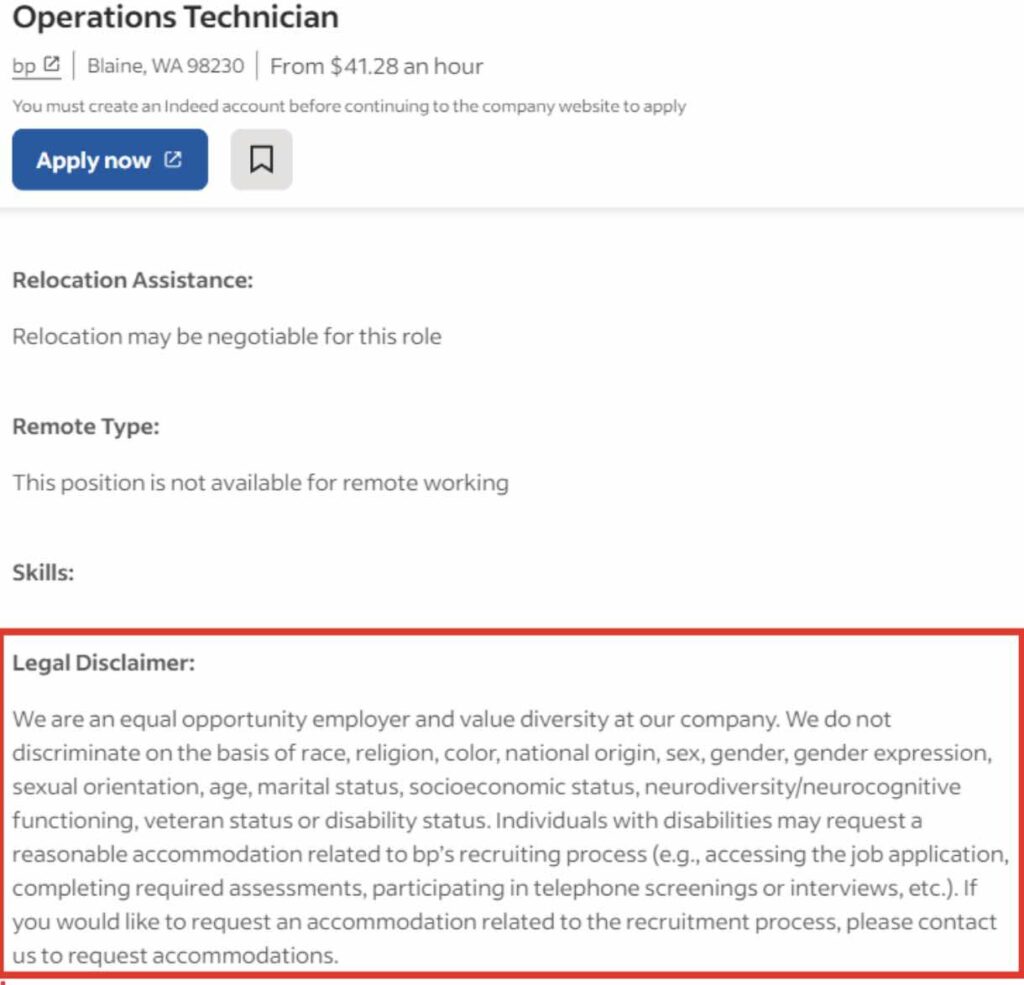
Ex: “We encourage applications from neurodiverse/neurocognitive individuals, including those with autism, ADHD, dyslexia, dyspraxia, dyscalculia, Tourette’s syndrome and other neurological conditions.”
- State your support and willingness to provide accommodations
Ex: “We offer support and accommodations to meet the needs of neurodiverse employees. Remote and hybrid work arrangements available.”
- Mention your commitment to an inclusive work environment
Ex: “We strive to create an inclusive workplace that respects and values neurodiversity.”
- Show your transparency about the hiring process:
Ex: “Our recruitment process is designed to be inclusive and accommodating to neurodiverse candidates, including sensory-friendly interview options.”
9. Hiring People for Second Chances
Hiring those with criminal backgrounds is an essential step towards inclusivity. Here’s how to offer second-chance employment in your job description:
- Explicitly state your commitment to give second chances to ex-con applicants.
Ex: “We are an equal opportunity employer and welcome applicants from all backgrounds, including those with criminal records.”
- Explain how background checks are used in the hiring process and emphasize that a criminal record will be considered in context.
Ex: “A background check will be conducted, but a criminal record does not automatically disqualify you from employment.”
- Mention any support programs for rehabilitation and growth within the company, such as mentorship, training programs, or partnerships with rehabilitation services.
Ex: “We offer support programs and training opportunities to help all employees succeed, including those with criminal backgrounds.”
Additionally, ensure compliance with “Ban the Box” laws, which prohibit employers from asking about criminal history on job applications. To comply with Fair Chance Hiring Laws, adhere to local and state regulations that support fair chance hiring practices.
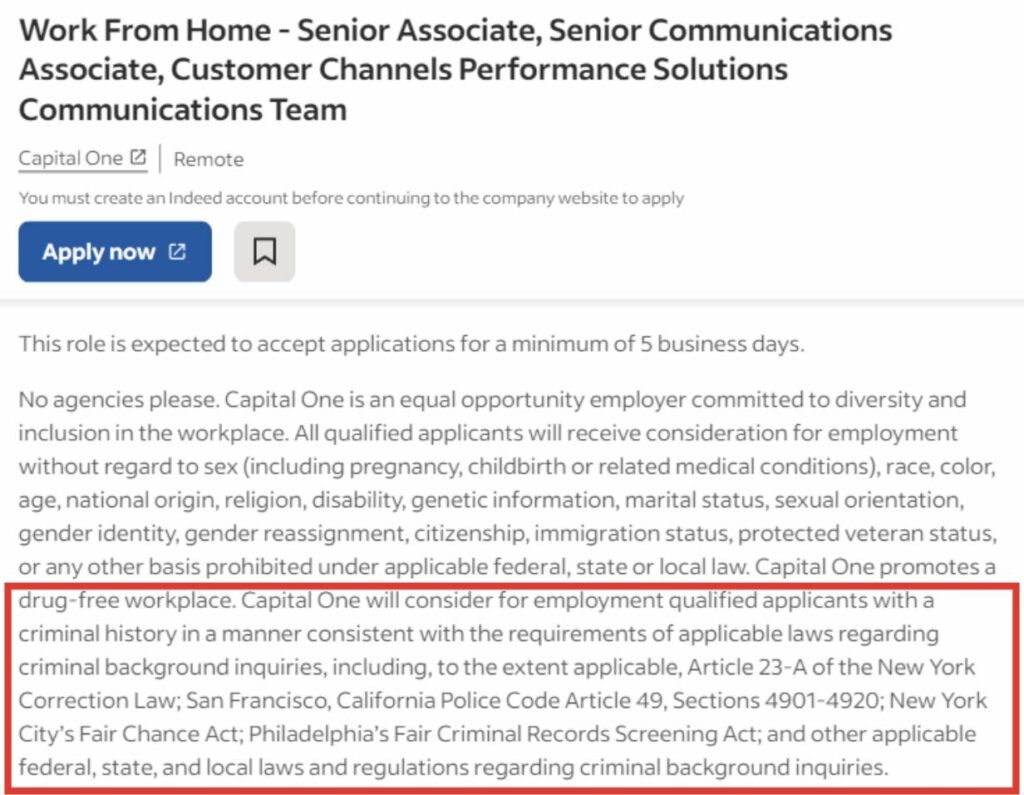
More states and cities have enacted Fair Chance Hiring laws. Check your local regulations, as requirements continue to expand, particularly regarding the timing of background checks and disclosure.
10. Parents or Soon-to-be Parents
Hiring pregnant women or candidates who may have children in the future is essential to an inclusive environment.
Here are some examples of how to incorporate inclusive language related to parental responsibilities into job descriptions:
- Encourage all applicants, including those who are pregnant or may become pregnant
Ex: “We welcome applications from candidates of all backgrounds, including those who are pregnant or may become pregnant.”
- Specify your company’s commitment to non-discrimination based on pregnancy
Ex: “We are an equal opportunity employer and do not discriminate based on pregnancy, childbirth, or related medical conditions.”
- Mention policies that support pregnant employees and those with families
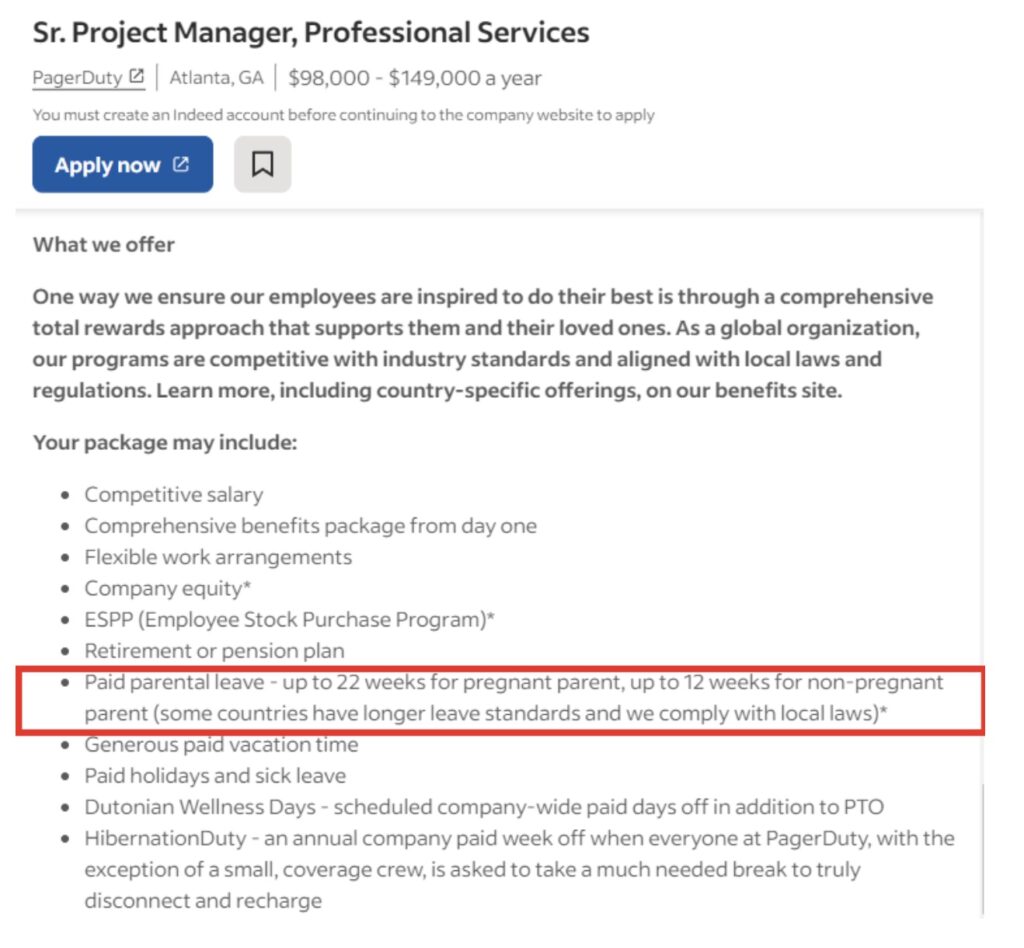
Ex: “We offer comprehensive parental leave policies and flexible working arrangements to support our employees during and after pregnancy.”
- Highlight benefits like maternity leave, paternity leave, and childcare support.
Ex: “Our benefits package includes maternity and paternity leave, as well as childcare support to help balance work and family life.”
- Emphasize the company’s flexible working arrangements that can support pregnant employees.
Ex: “We are committed to providing flexible work arrangements to accommodate the needs of our employees, including those who are pregnant.”
11. Recruiting Veterans
Military veterans are known for their influential work ethic, discipline, and commitment to excellence. They are well-trained and have solid experience in various technical skills, such as mechanics, logistics, cybersecurity, and leadership.
Here are some phrases that you can use to welcome veteran candidates to send their applications:
- Clearly state your company’s commitment to hiring military veterans
Ex: “We are committed to supporting military veterans and encourage veterans to apply for our open positions.”
- Highlight that the company values the skills and experiences gained through military service
Ex: “We value the unique skills and experiences that military veterans bring to our team.”
- Mention the company’s support system for veterans
Ex: “We offer support programs and resources to help military veterans transition to civilian careers.”
- Include a clear non-discrimination policy
Ex: “We are an equal opportunity employer and welcome applications from military veterans.”
12. Remote Work & Geographic Inclusion
Geographic inclusion aims to attract and hire qualified applicants regardless of their location. Instead of hiring candidates based on ‘culture fit,’ they are chosen based on ‘culture add. Employers are seeking the variety and creativity that candidates from diverse backgrounds can bring to the company.
Geographic diversity language in job descriptions appears as:
- “Open to candidates nationwide/globally”
- “Remote-first positions available”
- “We don’t require relocation”
Also, using terms like “native speaker” or requiring “unaccented English” creates barriers to geographic diversity. To be inclusive, replace them with phrases like “proficient in English” or “strong written and verbal communication skills.”
13. Skills-Based Hiring Language
Many companies are moving away from degree requirements. TestGorilla reported that 85% of companies use skills-based hiring. On the same note, recruiters on LinkedIn are 5x more likely to search by skills than by degrees. This shift marks a move from traditional credentials to demonstrable skills as evidence of a person’s ability to perform the job well.
Recruiters can adopt skills-based hiring in their job descriptions with phrases such as:
- “Skills and experience valued over formal degrees”
- “We welcome candidates with non-traditional backgrounds.”
- “Alternative credentials and certifications are accepted.”
Additionally, replace degree or years of experience with skill requirements and measurable outcomes. Add a ‘how you’ll be evaluated’ section in your job post, explaining that job seekers will undergo skills assessments, structured interviews, or be asked to provide work samples.
14. AI & Automation Transparency
Research says that 66% of Americans would not apply for a job that uses AI to help make hiring decisions. They believed AI is biased because the people who designed it built in biases based on race or socioeconomic status, as one respondent said.
Since AI is increasingly used in hiring, disclosing it in the job post sets the right expectation, such as:
- “We use AI tools ethically and transparently in our hiring process.”
- “Our AI screening tools are regularly audited for bias”
- “Human reviewers make all final hiring decisions”
In line with EU AI Act standards, Copenhagen-based companies now include a “Swift & Objective Evaluation” clause in their JDs, explicitly stating that AI handles the first pass to ensure speed for candidates.
15. Socioeconomic Diversity
Socio-economic diversity addresses the barriers that people with lower incomes face, such as lack of professional networks, “unpaid work” hurdles, and geographic immobility.
Some job posts specifically require graduates from ‘reputable Ivy League institutions’, discouraging well-qualified applicants who have the necessary skills or are trained in alternative educational modes like boot camps or community colleges.
Similarly, phrases like “Previous internship experience required” are often socioeconomic filters, as only students with significant financial safety nets can afford to work for free. The BBC has scrapped the requirement of prior unpaid media experience for many entry-level roles, acknowledging that it was a barrier to working-class talent entering journalism.
Relocating involves financial risk. People with limited financial resources, or those in lower-income households, cannot afford to relocate for a job, even if they are well qualified.
To make your job posts accessible to candidates from varied economic backgrounds, include language such as:
- “First-generation college students encouraged to apply”
- “No unpaid internship requirement”
- “Relocation assistance available“
16. Mental Health Support
In 2026, companies providing mental health support to their employees focus on structural support. Employers are now promoting employees’ work-life integration by acknowledging the fluidity of modern life and allowing for midday appointments or school runs without the “productivity guilt.” Likewise, ‘mental health days’ are offered so employees can ‘psychologically rest’ from the daily work grind.
Modern job descriptions describe Employee Assistance Programs (EAPs) as “Confidential, 24/7 access to specialized counseling.” Counselling is a crucial safety net for life crises (grief, financial stress, legal issues) that inevitably affect work performance.
To demonstrate mental health support, recruiters can write job descriptions to include:
- “Mental health days included in PTO”
- “Employee assistance programs available”
- “We support work-life integration”
17. LGBTQ+ Specific Language
In 2026, LGBTQ+ inclusive language in job descriptions is moving away from the “generic non-discrimination statements.” To attract LGBTQ+ job seekers, mention in your job descriptions:
- “Gender-affirming healthcare covered” – traditional health insurance often excludes expensive, transition-related care (hormones, surgery, mental health). Explicitly stating coverage reduces the “medical anxiety” of a career move. According to the Human Rights Campaign (HRC), over 90% of Fortune 500 companies now offer at least one trans-inclusive health care plan.
- “Chosen name and pronouns respected from day one” – it creates immediate psychological safety for LGBTQ+ employees when employers agree and use their chosen name internally within the company
- “All-gender restrooms available” – communicates that the company’s physical infrastructure was designed (or modified) to be inclusive
18. Immigration Status Inclusivity
With many countries tightening visa rules and introducing massive new fees (like the $100,000 H-1B surcharge for certain petitions), the language used in job posts serves as a critical “filter” for global talent. To hire qualified international candidates, state in your job posts:
- “We sponsor visas for qualified candidates” – signals that employers view overseas hires as long-term investments and are willing to provide legal support to ensure their lawful employment.
- “DACA recipients welcome” – DACA recipients often fear that “Citizens Only” requirements in JDs are firm rules. Explicitly inviting them removes “status-based” anxiety and helps fill critical infrastructure and professional roles
- “Work authorization support available” – indicates the company has an internal team or external counsel dedicated to keeping the employee’s status secure.
Why I Wrote This?
Ongig’s mission is to create effective and inclusive job descriptions. This includes giving you in-app tips and best practices for using diversity language in job descriptions to attract top talent. Please request a demo to learn more.
Shout-outs:
- Why Women Don’t Apply for Jobs Unless They’re 100% Qualified (by Tara Sophia Mohr)
- Salary vs employee benefits: which is better to offer? (by Coann Labitoria)
- The U.S. Essential Workforce Ages 50 and Older: A Snapshot (by Jennifer Schramm, Carlos Figueiredo)
- Job Ad Content: How Benefits Impact Candidate Attraction (by Appcast)
- Future of Jobs Report (by World Economic Forum)
- Job Outlook 2026 Survey (by NACE)
- The State of Skills-Based Hiring (by TestGorilla)
- Fewer Job Posts Now Require Degrees. How Has That Changed Hiring? (by LinkedIn)
- AI in Hiring and Evaluating Workers: What Americans Think (by Pew Research Center)
- AI Act – (European Commission)
- BBC sets goal of hiring staff from working class areas; media outlets aim for more diversity (by Inquirer)
- US Workforce is Aging, Especially in Some Firms (by United States Census Bureau)
- Corporate Equality Index 2023-2024 (by Human Rights Campaign)
