Quick Summary
A job posting with a salary range states the minimum and maximum pay for the role. It may also include other optional benefit details like bonus, commission or equity, where candidates can see it right away. Put the range near the top or in a clear “Compensation” section. Use specific figures instead of phrases like “competitive” or “DOE,” and check which locations require it before you post.
Below are three real postings with pay ranges, clearer terms to replace vague phrases, and how Indeed and LinkedIn show pay.
Why a salary range is now part of job postings
Listing a pay range is now a legal requirement, part of HR compliance. As of July 2026, 17 U.S. states plus Washington, D.C. have pay range disclosure laws, and the EU Pay Transparency Directive adds requirements for employers hiring in Europe. See our guide to pay transparency laws by state for the current list, and why job descriptions became the compliance pressure point.
Even where a range isn’t required, candidates increasingly expect one. When it’s right there, they can decide right away whether to apply. For the candidate side, see why candidates won’t apply without salary transparency, or run your own test with Testing Salary Ranges on Job Postings.
What to include in a posted salary range
A posted range should show what someone can actually expect to earn, not just a base number. Include:
- The pay range: a minimum and a maximum, in the same unit (per year or per hour).
- Base pay vs. on-target earnings (OTE): OTE is the base salary plus the commission or bonus someone earns for hitting their targets. The base is the guaranteed part; the rest depends on performance. If the role has variable pay, show both.
- Bonus, commission and equity: indicate whether they exist and if possible, the amount
- Hourly extras: shift differentials, sign-on bonuses or relocation help, if they apply.
- Benefits: health insurance, retirement plans and time off, as a short list.
- How pay is set: one line on whether location, level or experience moves the number.
For more on explaining how pay is set, see Pay Transparency Without Pay Clarity.
3 job posting examples with salary ranges
Each of these posts shows pay up front, so a candidate can decide right away whether to apply.
1. Example 1: Salaried role with equity (When, HR Generalist)
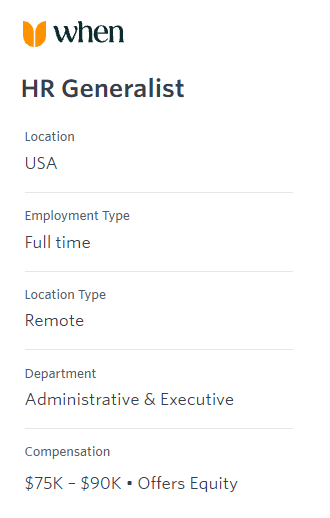
When lists $75,000 – $90,000 plus equity in the sidebar, next to location and job type, so candidates see it before reading the description. That sets expectations immediately. One gap: it’s a single range for a remote role, and it doesn’t say whether location changes the pay. One added line would cover that.
Example 2: Role with on-target earnings (Traversal)

3. Example 3: Hourly role with extras (Kaiser Permanente)
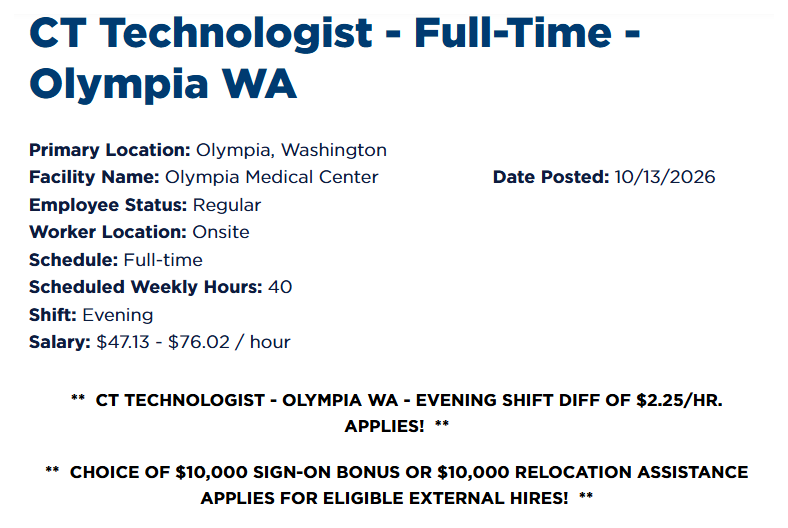
Kaiser lists $47.13–$76.02 per hour in the header block, right with the job details. It then spells out a $2.25 per hour evening shift differential and a choice of a $10,000 sign-on bonus or $10,000 relocation assistance for eligible external hires. Even for an hourly role, a candidate sees the whole picture at a glance. The range is wide, so it helps to explain what moves someone within it; see Pay Transparency Without Pay Clarity.
Wording to use instead of “competitive” or “DOE”
Vague phrases leave candidates guessing, so replace them for specific figures.
| Phrase | Why it’s unclear | Replace with |
| “Competitive salary” | Says nothing a candidate can compare or act on | “$75,000–$90,000 per year” |
| “Salary based on experience” or “DOE” | No range, so candidates can’t tell if the role is worth applying for | “$75,000–$90,000 per year, based on experience and skills” |
| “Commensurate with experience” | Same problem, in a more formal wording | Give the range, then name the factors that set it |
| “Up to $90,000” | Hides the floor, so candidates assume the worst | “$75,000–$90,000” |
| “$75,000+” | Open-ended, with no ceiling | “$75,000–$90,000” |
| “Negotiable” | Reads as if the number is being hidden | Give the range, and add “final offer based on skills and experience” if needed |
| “Market rate” | Candidates don’t know whose market or which rate | State the range and the factors that set it, as Traversal does (location, level, role) |
| “Earn $200K+” | Mixes guaranteed and variable pay | “OTE $200,000 – $275,000 (base [low]–[high], plus variable pay at target)” |
| “Competitive benefits package” | Benefits aren’t pay | Keep it, but add the pay range separately, with a short list of the benefits |
| “Pay varies by location” | Gives no range for any location | “Pay by location: [Region A] $[low]–$[high]; [Region B] $[low]–$[high]” |
Where pay range laws apply, phrases like “up to,” “competitive” or “DOE” usually don’t meet the requirement on their own, so check the rules that apply to you.
Where to put pay in your posting
On your own careers page, there’s no single right spot; what matters is that pay is clearly labeled and easy to find. That can be a sidebar (When), the header block (Kaiser) or a “Compensation” section (Traversal).
On job boards, pay usually sits near the top of the posting. On Indeed, Lincoln Public Schools’ $26.29 per hour, full-time status and location appear together in the job details, matching the school’s own careers page.

Indeed’s guidance adds a few things worth knowing:
- Indeed may add an estimated range when a posting has no pay, or when it can’t read the salary because of formatting. Employers can replace the estimate with their own details.
- Where pay isn’t required, a posting without it may get less visibility and fewer applicants.
- In many states with pay transparency laws, Indeed may not display jobs without salary information.
LinkedIn works similarly when pay is provided. 7Seventy Recruiting’s remote role shows $32.50/hr–$37.50/hr as a chip beside “Remote” and “Full-time.”

A full-time recruiting role listed in Illinois on the same platform shows only “Full-time,” so a candidate has to open the posting to learn anything about pay. In this case the description lists health insurance, a 401(k) and flexible PTO, but no pay.

One practical tip: fill in the job board’s pay field instead of leaving the figure in the description, and write it cleanly (“$75,000–$90,000 per year”) so the platform can read it.
Posting across states and remote roles
Remote roles are the common trap: a posting open to candidates in a covered state or city may be covered even if your office isn’t there. Coverage rules vary by law, so check the pay transparency laws by state guide and the remote workers section of our salary transparency guide before you post.
Employers usually handle this in one of three ways:
- One range, when pay doesn’t vary by location, and say so in the posting.
- A range per location or region.
- The strictest requirement applied everywhere, to keep things simple.
Whichever you choose, the range should reflect what you actually expect to pay, and it’s worth rechecking when laws or pay bands change. This isn’t legal advice, so if you’re unsure whether a role is covered, ask your legal team.
HR takeaways
If a posting could reach a covered state or city, include the pay range, and treat it as a compliance step.
- Show the full picture: base, bonus, commission, equity and key benefits.
- Use specific figures instead of “competitive” or “DOE.”
- Say how pay is set, such as location, level and role. A short pay philosophy is optional; see Pay Transparency Without Pay Clarity.
- Fill in the job board’s pay field, and keep pay consistent across your careers page and every board.
- Recheck your ranges when laws or pay bands change.
Job Posting With Salary Range FAQs
1. How do you list a salary range in a job description?
State the minimum and maximum pay in the same unit, near the top or in a labeled “Compensation” section, for example “$75,000–$90,000 per year.” Add any bonus, commission, equity or key benefits, and say what moves someone within the range, such as location, level or experience.
2. How should you word “salary based on experience”?
Give the range first, then name the factors: “$75,000–$90,000 per year, based on experience and skills.” Phrases like “DOE” or “commensurate with experience” on their own don’t tell candidates what to expect, and where pay range laws apply they usually don’t meet the requirement.
3. Which states require salary ranges in job postings?
As of July 2026, 17 states plus Washington, D.C. have pay range disclosure laws, and the list keeps growing. Some cities and counties have their own rules too. See our guide to pay transparency laws by state for the current list.
4. What happens on Indeed if you don’t list pay?
Indeed may add an estimated pay range when a posting has no salary information or it can’t read the format, and employers can replace the estimate with their own details. Where pay isn’t required, a posting without it may get less visibility and fewer applicants, and in many states with pay transparency laws Indeed may not display jobs without salary information.
Why I wrote this:
Candidates decide fast, and pay is one of the first things many of them look for. Ongig’s Text Analyzer can help you catch missing or unclear pay information in your job descriptions before they go live.
