When it comes to the recruitment process, your job posting wording is key to attracting quality applications.
It’s more than a job ad for an open position. It’s also a chance to show your unique employer brand, company culture, and the benefits of joining your team.
But how can you ensure your job posting stands out to attract qualified job seekers? This article shares 10 tips to help you nail your job posting writing.
Understand the Difference Between a Job Posting and a Job Description
First things first. Knowing the differences between a job description and a job posting will help you write the perfect job posting.
A job posting is an external advertisement used to sell a job opening in an organization. So, it should showcase what it’s like working for your organization. Therefore, the best job postings include a combination of:
- Images
- Videos
- Job title
- Location, salary range, benefits, and perks
- Application process details
- Glassdoor and LinkedIn widgets
- Employee testimonials
- Desirable and required skills
TOP TIP: Avoid information overload in your job advert and give your job seekers the only important information they need. Also, format it in a way that makes it easy to read. For instance, use bullet points to showcase sections such as qualifications and responsibilities.
On the other hand, a job description is a detailed document that explains the tasks, duties, and responsibilities of the position. So, simply put, a job description should inform potential applicants about their daily responsibilities, and roles.
In other words, consider the job posting as your TA landing page for optimizing conversions. Your JD is an internal document that thoroughly informs prospects of what’s expected of them for a role. And as such, JDs are more detailed, to properly brief talent of their company duties.
Read also: How to Write a Job Description — Best Practices & Examples (2024 Update)
Job Posting Wording Tip #1: Keep Your Job Title Simple
The most important first words of your job posting are those in its job title. So, the job title affects whether a candidate opens up the job posting and keeps reading.
A couple of tips:
- Length — Keep it to 1 to 3 Words and 10 to 20 characters. That’s what we’ve seen as the job title length (see How Long Should a Job Title Be? for more details) that currently gets the highest apply rate. Also, job titles with 1 to 3 words got double the apply rate versus those with 12+ words
- Don’t be Clever — Candidates need to quickly comprehend what you’re hiring for. So, try to avoid using acronyms, symbols, levels (“Engineer – Level 2”). Check out 5 Things to Avoid in Your Job Titles.
- Consider the algorithm – Remember that your job title also affects the online searchability of your postings. As such, keeping titles simple helps your ads rank high in search results to attract top talent. And avoid “!” or other distracting symbols in the job title, as major job boards (i.e., LinkedIn and Indeed) may consider these spammy and penalize them in response.
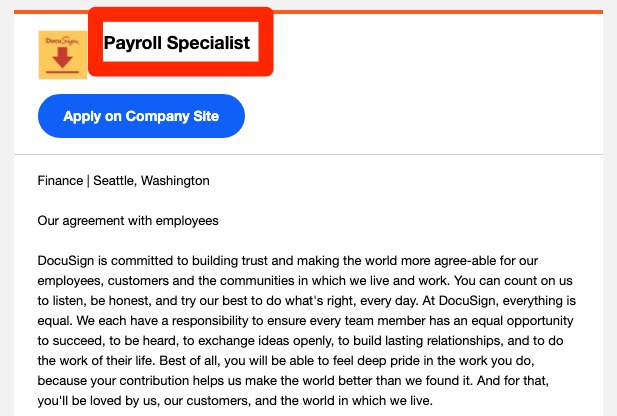
Check out Docusign’s job title below: “Payroll Specialist” is short and sweet and leaves no room for confusion
Job Posting Wording Tip #2: How to Introduce a Job Posting
So, what wording do you use to introduce a job posting? 2 tips:
- Be Conversational
- Tell the Candidate What’s In it for Them (Immediately)
Be Conversational
A good job posting is a job advertisement. And in ads and marketing it helps to be conversational.
One way to start a job ad is with questions…being conversational, when done right, is a proven winner in marketing.
Check out wording of the opening of ADP’s job posting below:
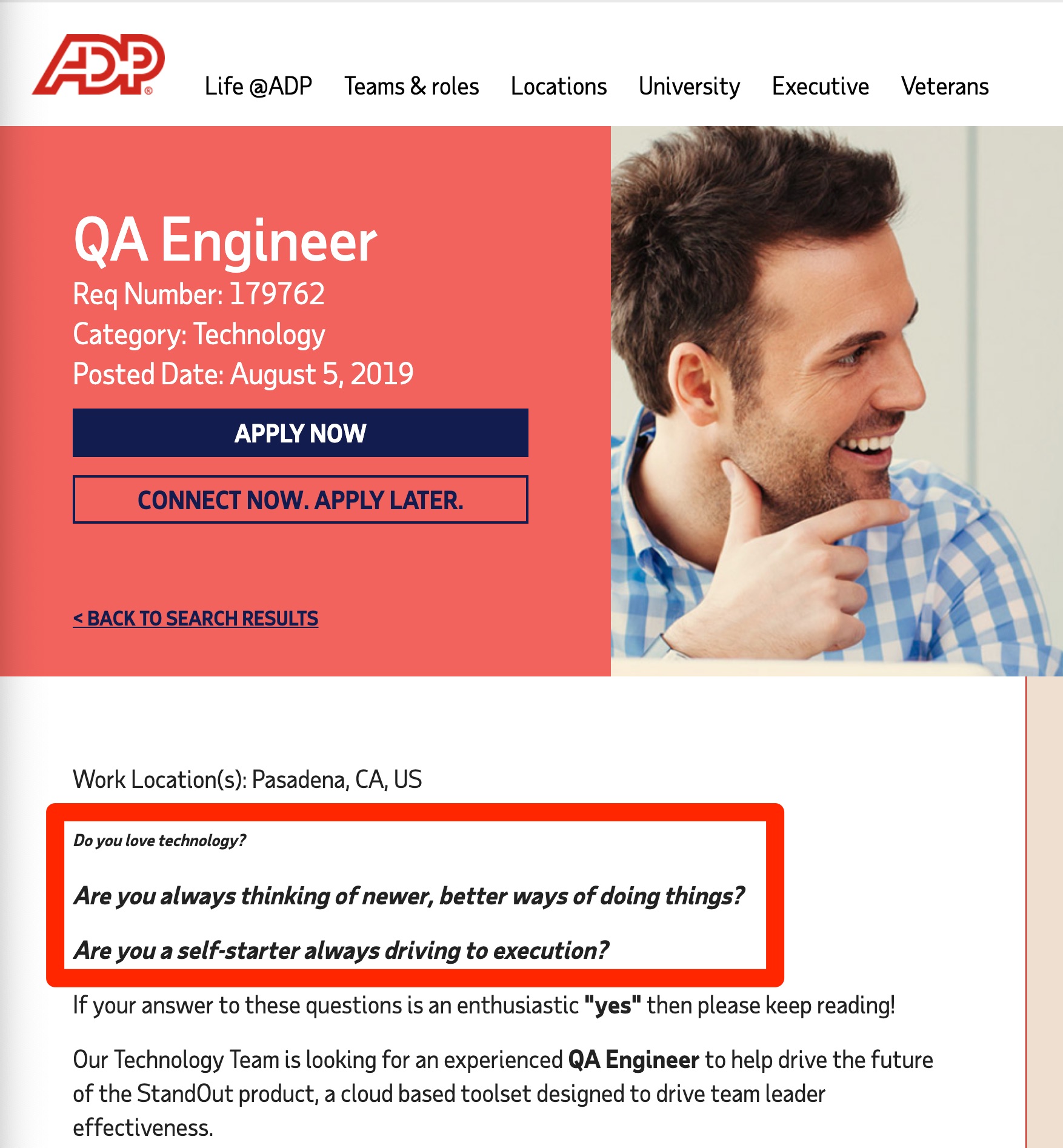
Asking questions at the start of your job posting is conversational. So, that’s a good thing because:
- Your candidates (customers) like to be engaged and questions get the candidate thinking about an answer (suddenly you’re both in a conversation).
- It shows the candidate you’re focused on them (notice that ADP mentions you 3 times in the first 3 sentences above.
It also helps to write in the 1st person/2nd person point of view (you, your, we, our, etc.) to be more conversational.
Tell the Candidate What’s In it for Them (Immediately)
When you introduce a job posting, it also helps to immediately tell candidates (customers) what’s in it for them.
Check out Dynamic Signal’s effective 2nd sentence in the job posting below:
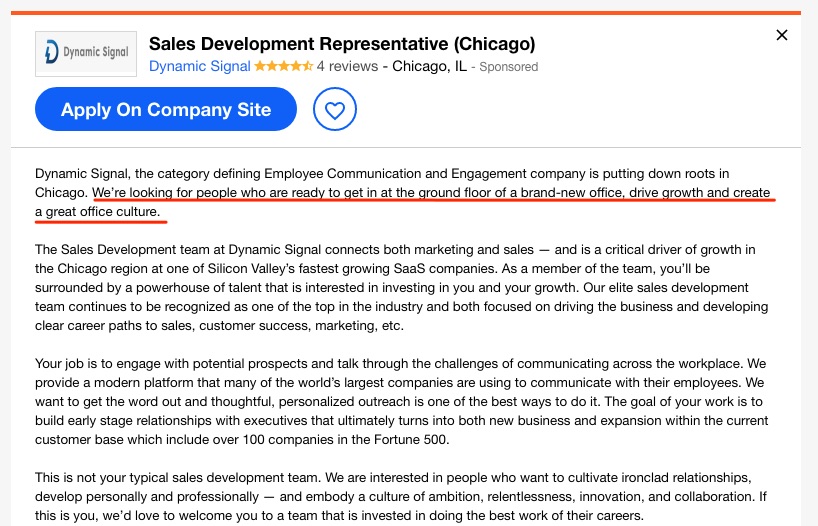
Dynamic Signal immediately emphasizes 2 things the candidate receives:
- they “get in on the ground floor of a brand new office” and
- can “create a great office culture”
How long does it take your job postings to answer the question:
“What’s in it for the candidate?”
I recommend you get to candidate value in the opening paragraph. Check out Maslow’s Hierarchy of Candidate Needs (for Job Ads) for more examples of what candidates care about.
If you’re wondering where your About Us section should go, it should be close to the end.
Job Posting Wording Tip #3: Compensation & Benefits
The first thing on a job ad that candidates look at is your compensation and benefits (if you include them), according to recent LinkedIn data. Although talent priorities have shifted (i.e., with the rise of workplace flexibility and career advancement), figures show that 63% of employees still consider compensation and benefits a leading priority at the workplace.
The more benefits you list (in your job posting the higher your apply rate. For example,, according to Appcast, here are the apply rates of job postings based on the # of benefits each had:
- 7.4% for 0 benefits
- 8% for 1+ benefits
- 11.5% for 2+ benefits
- 17.1% for 3+ benefits and
- 22.5% for 4+ benefits
So, what wording do you use for compensation in a job posting?
Check out the Terminix job ad below for one simple example:
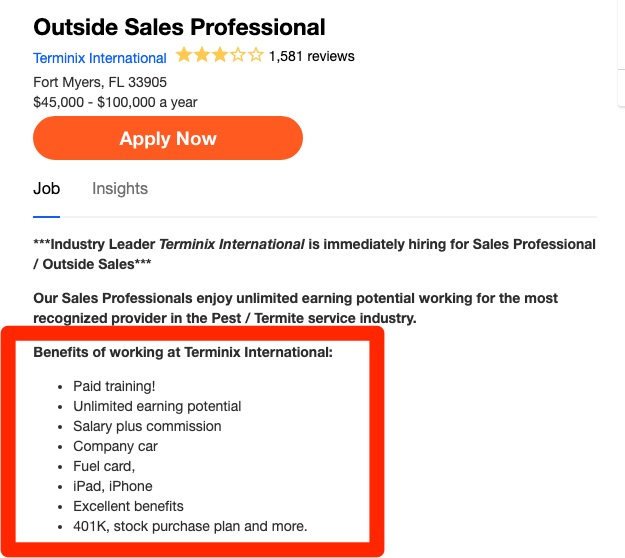
Salary is usually the main component of your compensation information. You can use general wording about salary (like Terminix above) or do one of the following:
- Give the actual salary
- Give a range
- Say “competitive salary”
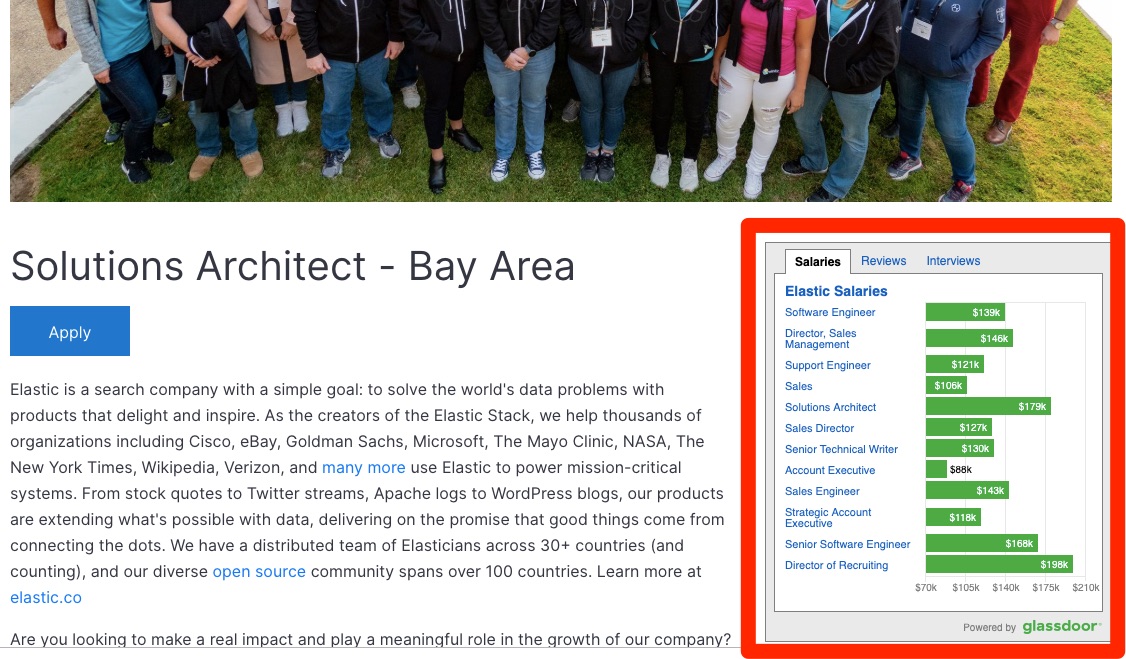
Another option for providing salary info is to let a 3rd party do the wording for you. Check out Elastic’s job posting below. It includes an embeddable Glassdoor widget that gives the candidate some estimates of how much salary they might make. Ongig also provides employers with the Glassdoor widget for job postings.
AIHR’s salary and compensation guide does well to remind us that two jobs offering the same salary could have vastly different total compensation. It’s a Gestalt process, where the whole is more than just the sum of its parts. So, how you word every entry on your list of compensations in a JD determines the overall impact on candidates and your hiring metrics.
So, it’s not just talking about career progression, healthcare insurance, and work-from-anywhere days. Instead, it’s the strategic alignment of these pillars to provide a cohesive narrative of holistic wellness.
Job Posting Wording Tip #4: Years of Experience
The main rule on the “years of experience” wording in your job posting is to make sure you need it.

Facebook CEO Mark Zuckerberg is clear on this via Mark Zuckerberg’s 7 Recruiting Tips:
“You can hire someone who’s a software engineer who’s been doing it for 10 years…that’s cool…but if you find someone whose raw intelligence exceeds theirs but has 10 years less experience…they could probably adapt and learn way quicker and in a short amount of time do a lot of things the (the more experienced person could never do).”
I agree. You don’t want to demand “10 years of experience” in your job posting if someone with fewer years of experience can do the job or quickly learn the skills needed to do the job.
The main takeaway here is that companies should consider prioritizing career trajectory rather than expecting X years of experience from the get-go.
A work culture that promotes a growth mindset and celebrates individuality is likelier to attract and retain talent. In fact, research indicates that women are less interested in promotions than men when faced with a lack of organizational sponsorship and support.
Investing in skills-based hiring and personal development could be pivotal in solving the ambition gap issue and fostering a more resilient workforce.
Job Posting Wording Tip #5: Diversity
When you word your diversity statement, you might want to review 10 Examples of Awesome Diversity Statements for tips.
Godaddy has a good one here:
“A Culture of Creativity is life at GoDaddy. We hire the best, give them first-class training and set them loose. If you’re driven to perform, you’ll fit right in. We approach our work fearlessly, learn quickly, improve constantly, and celebrate our wins at every turn. Everyone is welcome—as an inclusive workplace, our employees are comfortable bringing their authentic whole selves to work.”
Others, like Off the Grid, combine their diversity statement and EEO statement. Here it is:
“Off the Grid is committed to creating an inclusive environment that welcomes and values differences among our associates, customers, vendors, and the communities in which we live and conduct business. Our continued success and growth is enhanced through initiatives that promote diversity throughout the company and our communities. Off the Grid is an equal opportunity employer and considers qualified applicants for employment without regard to race, color, religion, sex, national origin, sexual orientation, gender identity, disability or protected veteran status.”
The key is to be truthful and say you’re inclusive (if you are).
Job Posting Wording Tip #6: EEO Statement
Your EEO statement wording depends on your situation.
If you’re working with the government or going public, you need to have an EEO statement to comply with the EEOC.
If you want to use the fewest EEO words and still likely be in compliance to work as a contractor or sub-contractor with the U.S. government (see Section 60-1.41 of the EEOC law on job advertisements), you can do what the Gallo wine company does in their job postings — they simply insert these 3 words at the bottom of every job:
“Equal Opportunity Employer”
If you’d like to use a bit more EEO wording for job postings that still mentions the magic 3 words (Equal Opportunity Employer), then check out what financial giant UBS does in their job posting EEO statement:
“UBS is an Equal Opportunity Employer. We respect and seek to empower each individual and support the diverse cultures, perspectives, skills and experiences within our workforce.”
There are great additional examples in 10 Samples of an Effective EEO Statement.
Job Posting Wording Tip #7: Wording to Attract Women Applicants in Tech Roles
A number of psychology journals and artificial intelligence tests prove wording in job postings impacts a woman’s likelihood of clicking apply.
Check out the below job posting for Senior Software Engineer at PEAK6 (analyzed by Ongig’s Text Analyzer software). It has a healthy percentage of its words proven to attract women applicants, such as collaborate, responsible and support.
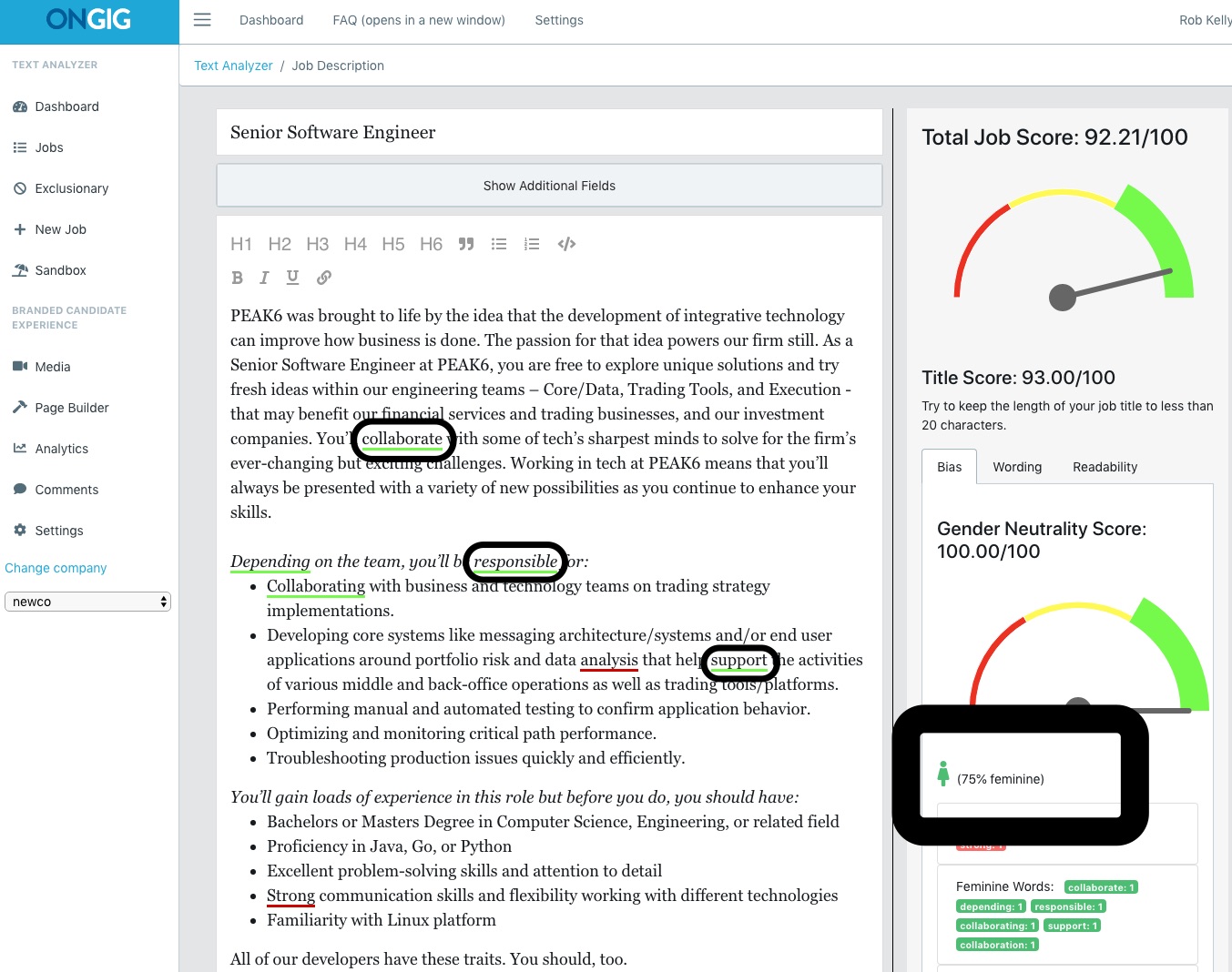
Here are the top 10 feminine words used in tech job postings:
- support
- share
- responsible
- understand (or understanding)
- together
- committed
- interpersonal
- feel
- collaborate (or collaboration)
- connect
Source: Top 10 Feminine-Biased Words Used in Job Descriptions
If you want effective wording to attract women applicants for tech roles, you should steer clear of overly masculine-coded words such as ninja and rock star.
So, here are the top 10 masculine words used in tech job postings:
- strong
- drive
- lead
- analysis
- analytical
- driving
- individuals
- proven
- workforce
- decisions
Source: The Top 10 Masculine Biased Words Used in Job Descriptions
Job Posting Wording Tip #8: Sell Your Company’s Mission and Culture
Your organization’s culture is its personality. So, it’s important to introduce it to your applicants in your job postings. According to the World Economics Forum, cultivating culture at work remains one of the top three factors for shaping people agenda in 2026 (along with AI readiness and redesigning the modern workplace).
As such, it’s important to define your organization’s values, ethics, mission, and working environment. This way you’ll get the best candidates who have a strong culture add that enhances your organizational productivity.
Note: culture add differs from culture fit, which was the traditional method of hiring like-minded people who match the demands and practices of the existing workplace. While culture fit lays the ground for smooth collaborations, it may lead to a lack of innovation and an exclusionary workforce that stifles company growth.
Here are some ways to sell your company’s culture in job postings:
- Add a “Why We Love to Work Here” section to your job ads. Ensure you’re featuring real stories of your employees sharing their experiences and thoughts.
- Share your organization’s story. Explain how your organization’s story, mission, and values guide the work your company does.
- Highlight the perks and benefits that align with your organization’s culture. For instance, if your organization values work-life balance, define the flexible, and remote working options you offer.
And also work on your organization’s website and social media pages. If potential candidates find that your website looks like it was made in the 1990s, they’ll probably avoid applying because it will give the impression that you can’t work on your website. Then, you won’t invest in their growth.
Job Posting Wording Tip #9: Avoid Jargon and Complex Language
The most important step with job posting wording is ensuring the language is easy to understand. A potential candidate shouldn’t have to spend any extra time trying to understand your job advertisement.
For instance, buzzwords such as “execution’, “leverage”, “viral”, and “self-starter” do little to describe your job post opening. And with these buzzwords, it’s hard to describe what it’s like for a candidate working for your organization.
Plus slang and cliches may also have different meanings to different candidates and carry unintended connotations. For instance, “be your own boss” may sound to some candidates that their supervisors and managers won’t have time for them.
So to ensure you’re using plain language, let the skills you’re looking for guide you in writing the job post. For instance, instead of writing, “We’re looking for a fast-paced javascript developer,” write, “We’re looking for a Javascript developer with experience in building websites with beautiful UI”.
Pro tip: Consider using measurable terms when highlighting a candidate’s contributions. Doing so establishes a sense of purpose. So, instead of a JD that seeks candidates with sales expertise, you could specify, “Our company is looking for a sales navigator who can raise our market share by 15% within the next 12 months.”
Job Posting Wording Tip #10: Explain the Next Steps
You’ve provided your applicants with all the details of the job opening. Plus you’ve provided them with your company’s background. And reasons why it’s an exciting place to work at.
But don’t leave the candidates in the dark about how the application process works. It’s also important to use the job ad to inform them on how the hiring and interview process will work if they decide to apply.
Most organizations overlook this important step but applicants need to know how the process is and how long it will take it. So they can decide if it’s worth the effort to apply.
Examples of details to provide are:
- The deadline for the application
- The number of stages they’ll undertake during the interview
- The timeframe on when they’ll know if their application was successful or not
- Any tools you’ll provide during the whole process
- AI transparency is becoming increasingly important as more employers implement the data-backed technology throughout their TA pipeline. As such, an AI disclaimer in the hiring process can forge trust between your company and prospective hires. Doing so also shows that your company values ethical AI and human oversight.
Examples of Wording for ADA Compliance for a Job Posting
Are you looking for the best wording for ADA job postings and to be more inclusive to people with physical disabilities? Then, check out:
- 10 Tips for Recruiting People with Disabilities in Job Descriptions.
- Employer Required to Pay $250K for Poorly Written ADA Job Description
- Newsday Gets Hammered on Disability Language for This Job Posting
Job Posting Wording Tip #11: Go Easy on The “Degree Demands”
A quality job description should keep only the necessary requirements. It’s not simply reducing the minimum amount of experience to an acceptable level but also considering criteria like university degrees and their pedigree (i.e., Ivy League universities). So before publishing a job posting, consider this: are my listed requirements nice-to-haves or necessary for hires to perform in a particular role?
If a role is highly technical or emerging (such as AI prompting), there’s probably no real need to enforce a degree requirement. After all, there’s no direct correlation that hires with a degree would clearly outperform peers without.
Plus, as more employers prioritize soft skills like communication and decision-making in the competitive landscape, it’s important that your job postings measure up to these trends. Studies also show that foundational skills like adaptability and problem-solving are vital for responding to workplace uncertainty.
Quite simply put, candidate competency is possibly the most reliable currency in TA success.
Job Posting Wording Tip #12: Talk About Internal Mobility
Modern employees seek purpose and transparent career pathways. Lateral movements are an impactful but often overlooked channel of workplace progression. These opportunities empower candidates in embracing new roles and responsibilities without the stress usually associated with a promotion.
By including a section on internal mobility opportunities within your job posting, you are essentially conveying these messages to your candidate:
1. We trust you to explore and familiarize yourself with different facets of our organizational practices.
2. We wish to keep you engaged by actively diversifying your skills and experience.
3. We are committed to evolving your career while preparing you for promotion and leadership roles in the long term.
These are powerful affirmations that attract talent with the positive mindset, improving the quality of hire.
Job Posting Wording Tip #12: Format for neurodiversity
Roughly 80% of recruiters still consider application quality an issue. That’s quite possibly due to the sheer diversity involved in the candidate selection process. Consider reworking your job postings so they’re easy on the eyes while using inclusive language (that Ongig’s Text Analyzer can help with) throughout your content.
Here are some points to consider as you create neurodiverse job postings:
- Reducing the cognitive load—breaking down information into bite-sized bits so they do not overwhelm the reader. This makes the posting understandable to neurodivergent candidates.
- Enhancing the readability of your website—using a sans serif font like Verdana, keeping your spacing at 1.5, and choosing neutral/muted colors—optimizes focus for talent with ADHD or dyslexia.
- Maintain an organized layout – Using paragraphs of 3-4 words and bulleted or numbered lists makes postings skimmable.
By making these adjustments, you can tailor your ads for neurodivergence, and every applicant has the same winning experience as they onboard with your company.
Bonus Job Posting Wording Tip: Use Action-Oriented Language
Using Action Verbs in Your Job Posting Wording to Describe Responsibilities and Expectations
When writing a job posting, it’s important to use action verbs. So, action verbs are powerful tools that help create a clear understanding of what the role involves. They describe job responsibilities in a way that grabs the attention of prospective candidates.
For example, instead of saying, “The software developer will be responsible for the development of software,” you could say, “The software developer will design, build, and implement innovative software solutions.” This approach not only makes the job description more engaging but also helps attract the right candidates by clearly outlining the key responsibilities.
Creating a Sense of Urgency and Excitement With Your Job Posting Wording
Creating a sense of urgency and excitement in your job postings is a great way to attract top talent. Therefore, you want to convey that this is a great opportunity that should not be missed. So, phrases like “Join our team today!” or “Apply now to be part of our innovative projects!” can make the job posting feel more immediate and appealing.
It’s also a good idea to highlight any perks or benefits that make your company stand out. So, mention benefits like “free meals” or “flexible work hours” to make the job listing more enticing. This also shows that your company values its team members.
Examples of Action-Oriented Phrases to Use in Your Job Posting Wording
Here are some examples of action-oriented phrases that can make your job posting more effective:
- “Lead a team of dedicated professionals”
- “Develop cutting-edge software solutions”
- “Drive our marketing strategy to new heights”
- “Collaborate with cross-functional teams to achieve company goals”
- “Innovate and improve our current processes”
- “Manage and mentor junior team members”
- “Execute comprehensive market research”
- “Implement new and effective sales techniques”
Using phrases like these in your job postings can help attract the best talent and ensure that you find the ideal candidate for your open role. It’s also a great way to make a good first impression on potential employees.
Focusing on an achievement-based outcome also strengthens the call for talent by giving them a sense of ownership. For example, instead of promoting a sales role that’s responsible for handling client portfolios, state: a role that manages and services over 1 million cloud-based user profiles. The posting enhances role clarity by converting duty into actionable metrics.
Remember, the goal of a job posting is to attract the right people who will be a good fit for your company. So, by using action-oriented language, you can create impactful job postings that stand out in the job market and on job sites.
Why is Writing Good Job Postings Important for Your Business?
An excellent job posting informs potential applicants why your company is the right place to grow and succeed.
Hence, leading them to apply for your job opening or wish to buy your products and do business with you. When done well, it’s the perfect tool to promote your business.
The job posting also:
- Saves your hiring team time: Writing a comprehensive job ad means you answer any more potential questions from candidates. So, this improves the interview and hiring process, quickly moving to the next steps.
- Bring out the best in candidates: If candidates see that you took time to write a high-quality job posting, they’ll also put effort into submitting a high-quality application that won’t be hard to go through.
- Reduces turnover and boosts retention: When your job ad makes the job’s responsibilities clear, applicants won’t be surprised by the tasks once they start working. They’ll stay for long because the job duties align with the details that were in the job advertisement.
Why I wrote this?
Job posting wording is at the heart of Ongig’s mission (“to transform job postings”). Our Text Analyzer job description software optimizes wording to attract top-tier talent and eliminate bias. Please click the demo request button if you’d like to get a demo.
Shout-Outs!
- AIHR – Compensation and Benefits The Complete Guide
- LinkedIn – New Data: See What Your Candidates Want in 2025
- McKinsey & Company – Women in the Workplace 2025
- Harvard Business Review – Soft Skills Matter Now More Than Ever, According to New Research
- The Mentra Publication – JD Blueprint: How to structure Neuroinclusive Job Descriptions
