Your career site is the candidate’s first touchpoint with your employer brand.
According to Employ’s Job Seeker Nation Report, 71% of job seekers expect an application process to take less than 30 minutes. In comparison, 35% will abandon an application if it feels too long or complicated.
Career sites that are clunky and hard to navigate can potentially drive away highly qualified talent.
What Makes a Great Career Site in 2026 (Criteria Section)
Branding, headline, storytelling, job search UX, EVP, and perks still matter when designing your career site.
In 2026, personalization, a mobile-first experience, and hybrid/remote work options are also important factors that many candidates consider before deciding whether to apply.
AI/Personalization
Candidates now expect the same personalized experience on a career site that they get from Netflix or Amazon. AI on career sites is no longer just chatbots. It’s job matching, content recommendations, and dynamic candidate journeys.
However, Phenom’s State of Candidate Experience: 2025 Benchmarks Report found 87% of Fortune 500 employers failed to use AI and automation to hyper-personalize career sites. This means companies are still a long way from making their sites genuinely candidate-friendly. What separates 2026’s best career sites is whether the candidate feels like the site was built for them and not just a generic job board. In particular, candidates are looking for modern career site features such as:
- AI-powered job matching that surfaces relevant roles based on skills or browsing behavior
- Smart search that autocompletes, suggests, and filters without extra clicks
- Candidate-type segmentation (students vs. experienced, in-store vs. corporate) as a baseline form of personalization
- Resume upload or profile creation that stores candidate data for future matching
- Chatbot or conversational AI that answers questions 24/7 without a recruiter
Mobile-First Framing
Mobile is no longer just about a responsive layout. Candidates expect to search, apply, and follow up entirely from their phone.
The bar in 2026: under 3 minutes to apply, auto-filling forms, and no jarring handoffs to a third-party ATS in a different UI. On-site retail and hourly workers, especially, are applying from mobile. A clunky mobile experience directly costs you, applicants.
Hybrid/Remote Work Signals
In 2026, remote work is a baseline expectation that candidates screen for before applying.
Career sites that don’t disclose flexible work options lose candidates easily to competitors.
Gen Z candidates check company social media and career sites specifically to review employee feedback and company culture before applying.
The 10 Best Career Site Examples
Shopify
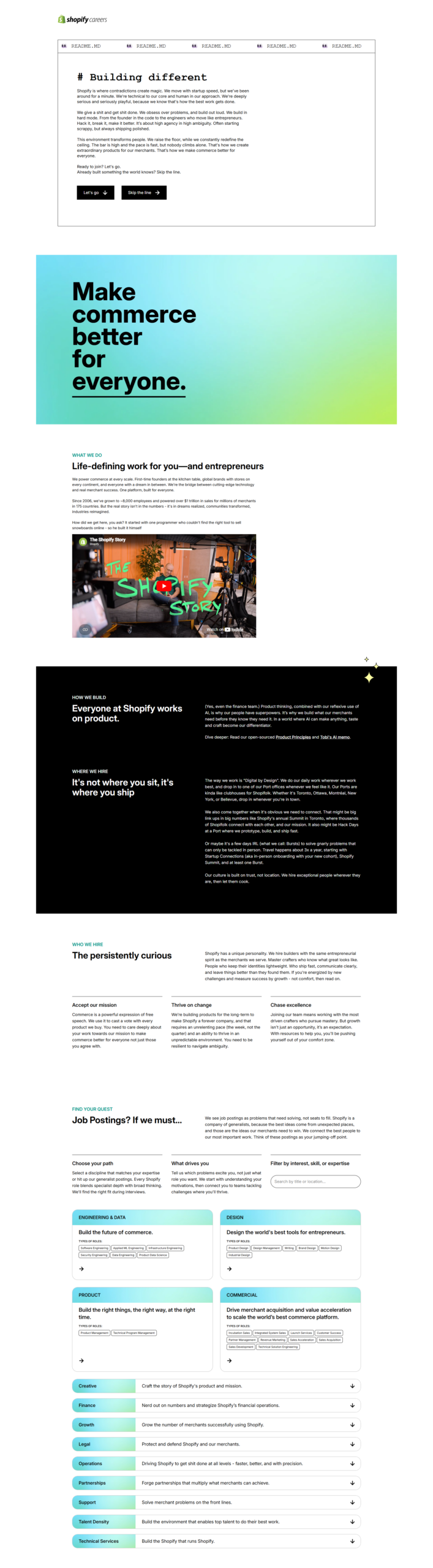
- EVP is highlighted across the whole candidate journey: “We give a shit and get shit done’ and “Digital by Design”.
- “Skip the line” CTA for already-accomplished candidates. This is a rare move that prequalifies applicants and signals that they want only people who are genuinely skilled.
- “We see job postings as problems that need solving, not seats to fill,” reframes job listings in a way no other career site on this list does
- “Shopifolk” as the employee term builds internal community identity and brand distinctiveness
- Social proof grounded in merchant impact, not company size”: $1 trillion in sales for millions of merchants in 175 countries”:
- Job search and navigation remain fast and uncluttered on mobile, without overwhelming candidates with dense navigation or excessive redirects
Babbel
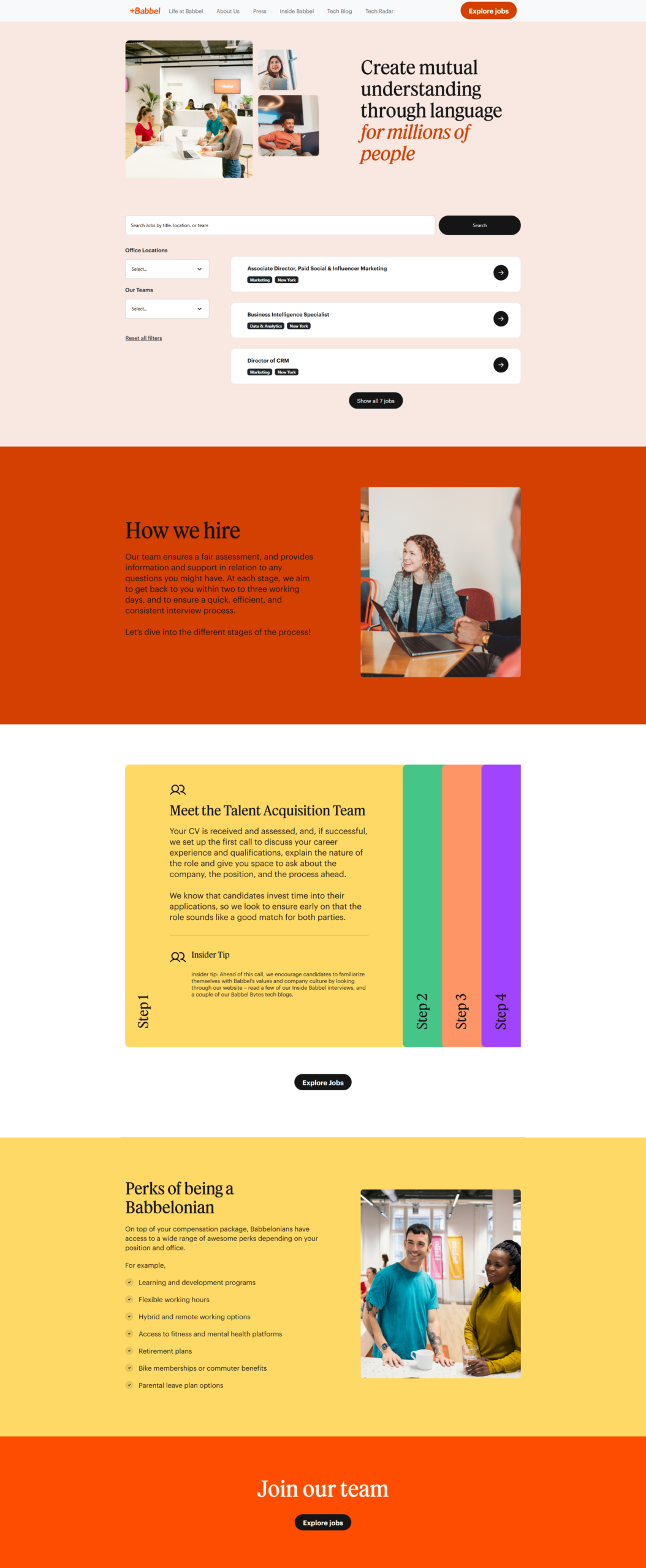
- Powered by Ongig’s Career Site Builder, which enables personalized candidate experiences at the platform level
- Candidates can browse roles, filter openings, and complete applications smoothly from mobile without losing functionality
- Strong employer proof points upfront: 16M+ subscriptions, 80+ nationalities, Fast Company’s Most Innovative Companies
- Employer brand content conveys culture throughout: the language learning mission (“mutual understanding through language”) is carried consistently from the hero section into job listings
- Individual job listings specify location flexibility
Frontier Airlines
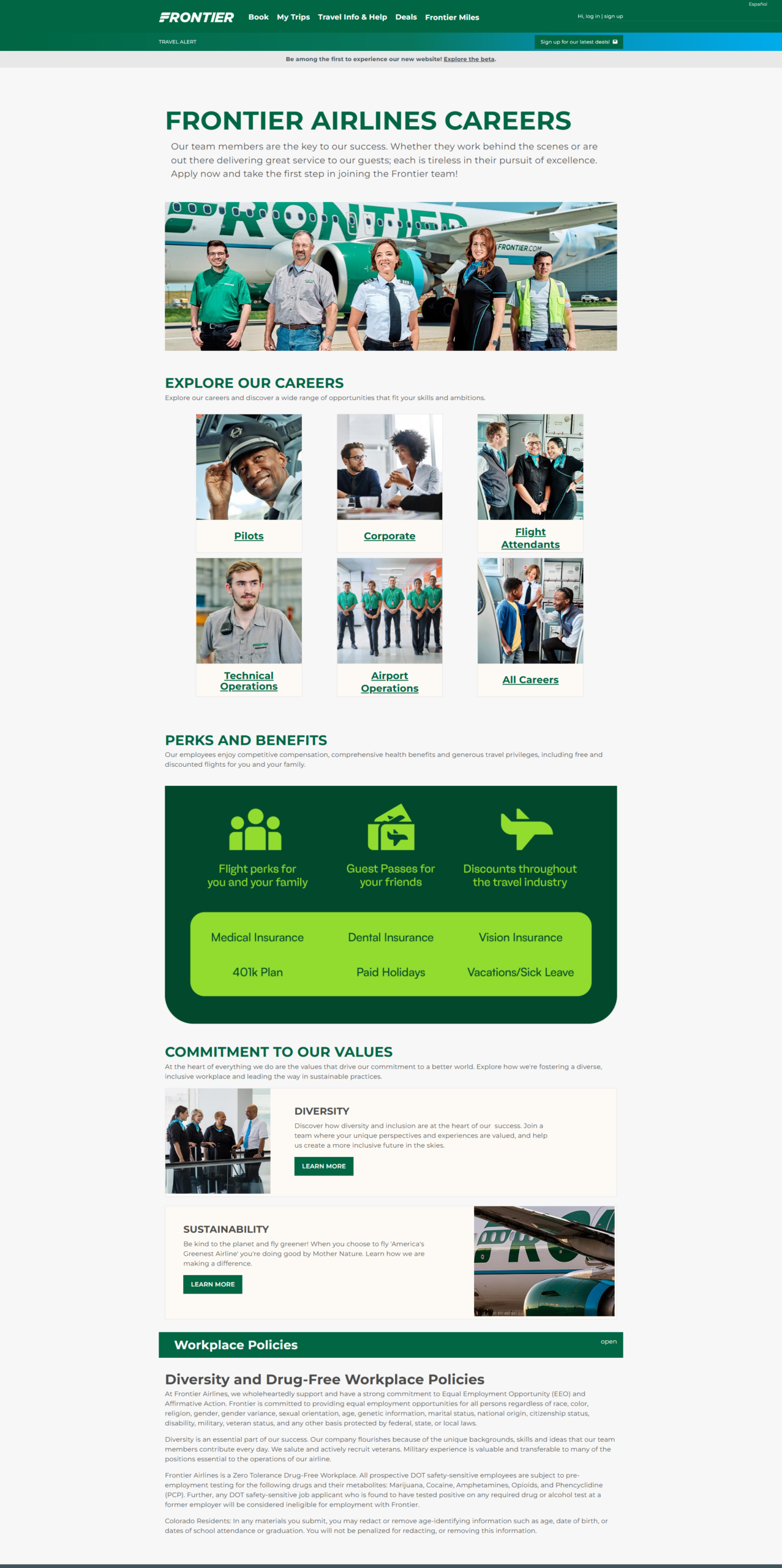
- Role segmentation by department (Pilots, Flight Attendants, Technical Ops, Corporate, Airport Ops) means candidates land immediately in the relevant territory. Candidates don’t waste time browsing through job listings
- Diversity and sustainability positioning are above the fold, signalling the employer’s genuine commitments rather than compliance checkboxes
- “America’s Greenest Airline” sustainability identity carries through the careers page. It’s rare to see an environmental brand pillar explicitly integrated into employer branding
L’Oréal
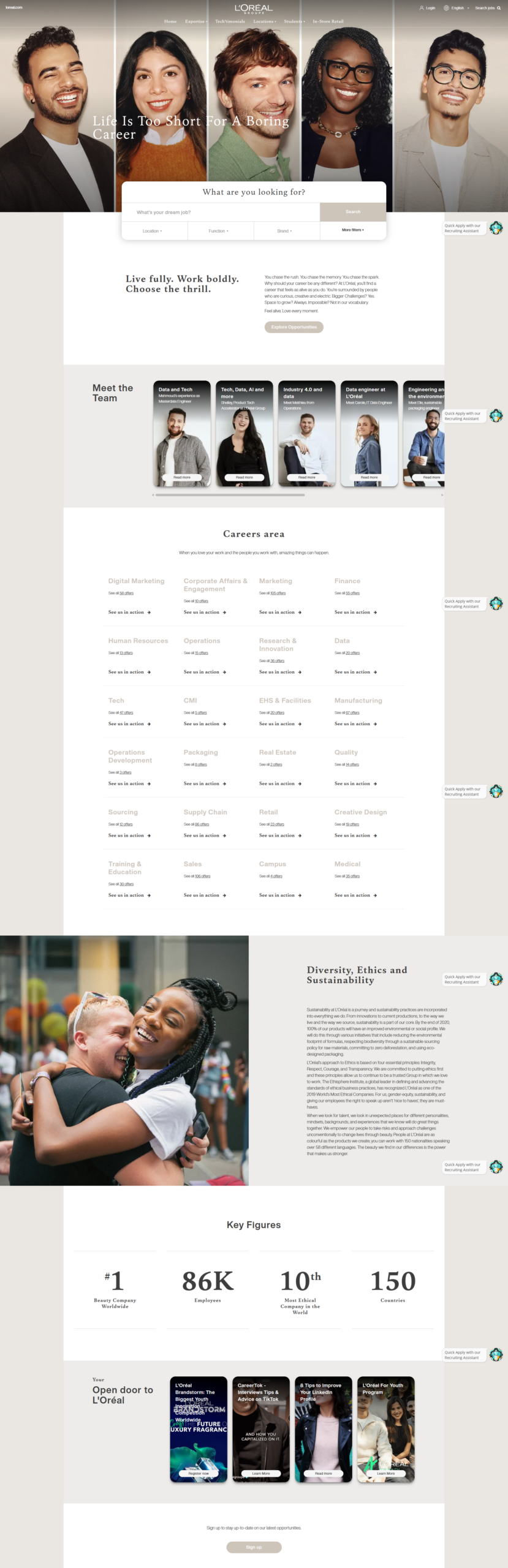
- Segmented candidate journeys across roles and levels, including employment type and contract type. There are also separate pathways for students and in-store retail applicants
- Multi-brand architecture: candidates can explore L’Oréal Paris, Lancôme, Kiehl’s, and other sub-brands as distinct employer identities under one platform, which is rare and useful for a conglomerate
- Candidates can explore roles across regions and brands. They can easily upload resumes directly from their mobiles.
- Global roles listed by region. Flexibility positioning is role-dependent.
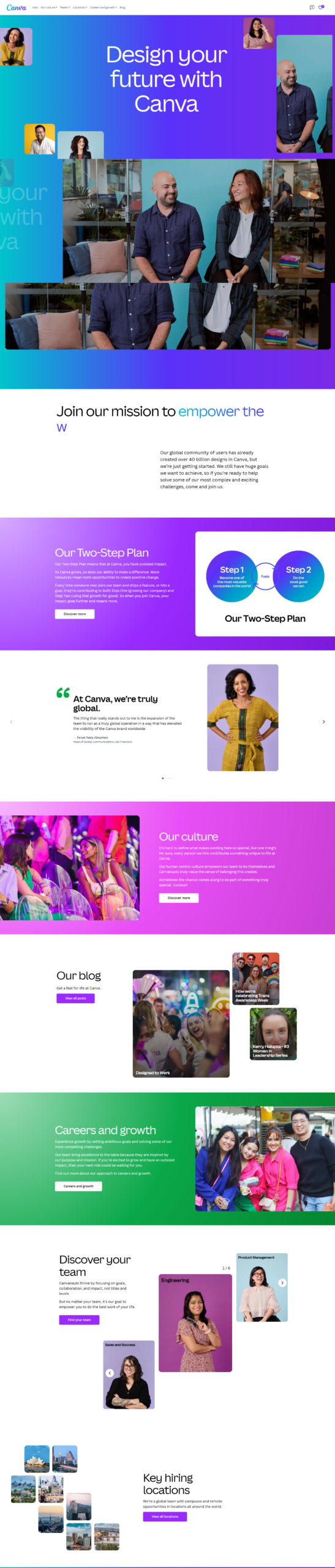
Canva
- EVP is carried consistently throughout the entire candidate journey: “Design your future with Canva,” “Crazy Big Goals,” and “Canvanauts” appear across every section of the site.
- Team-specific pages (Engineering, Product, Design, Sales, Marketing, Operations, and Finance) each have their own dedicated pages with real employee photos, named quotes, and role-specific context. Candidates can explore their exact function before applying.
- Despite its visually rich design, the career site remains easy to navigate on mobile. Content sections and job discovery flows adapt cleanly to smaller screens.
- Job search and apply flow meets the three-step or less standard, with no third-party ATS redirect breaking the experience
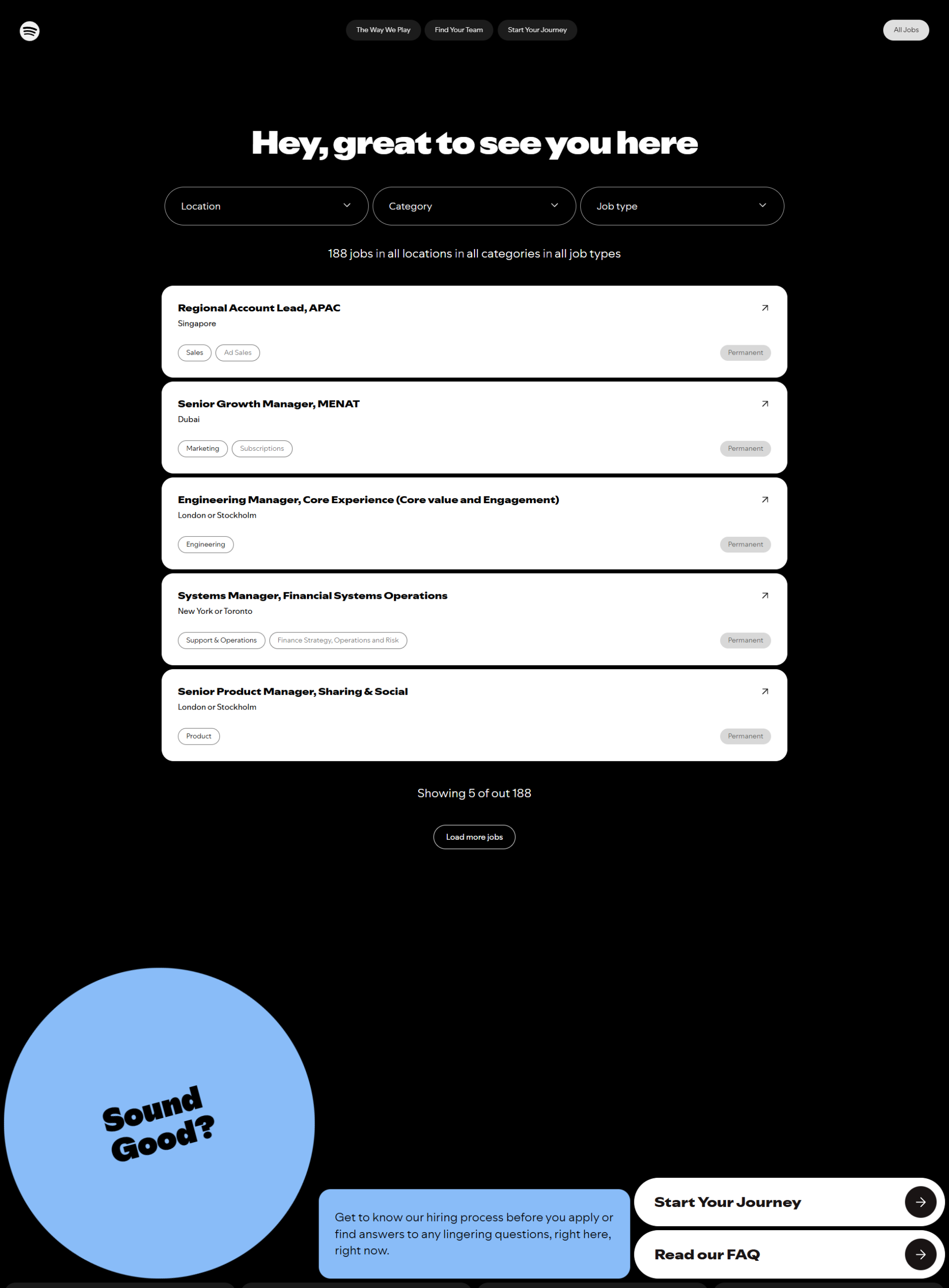
Spotify
- Spotify’s brand-native language (“Hey wanna join us”, ‘Werk, werk, werk,’ and ‘Hey, you got this’) makes the experience feel cohesive rather than corporate, helping candidates immediately understand the company’s personality before applying
- Start Your Journey page from the career site provides a step-by-step hiring process: from applying to decision making, plus FAQs for other candidates’ questions
- Jobs are categorized according to location or department
- The Way We Play page highlights Spotify’s values, which also flows to the Culture and employee benefits pages
- Job filters work properly on mobile
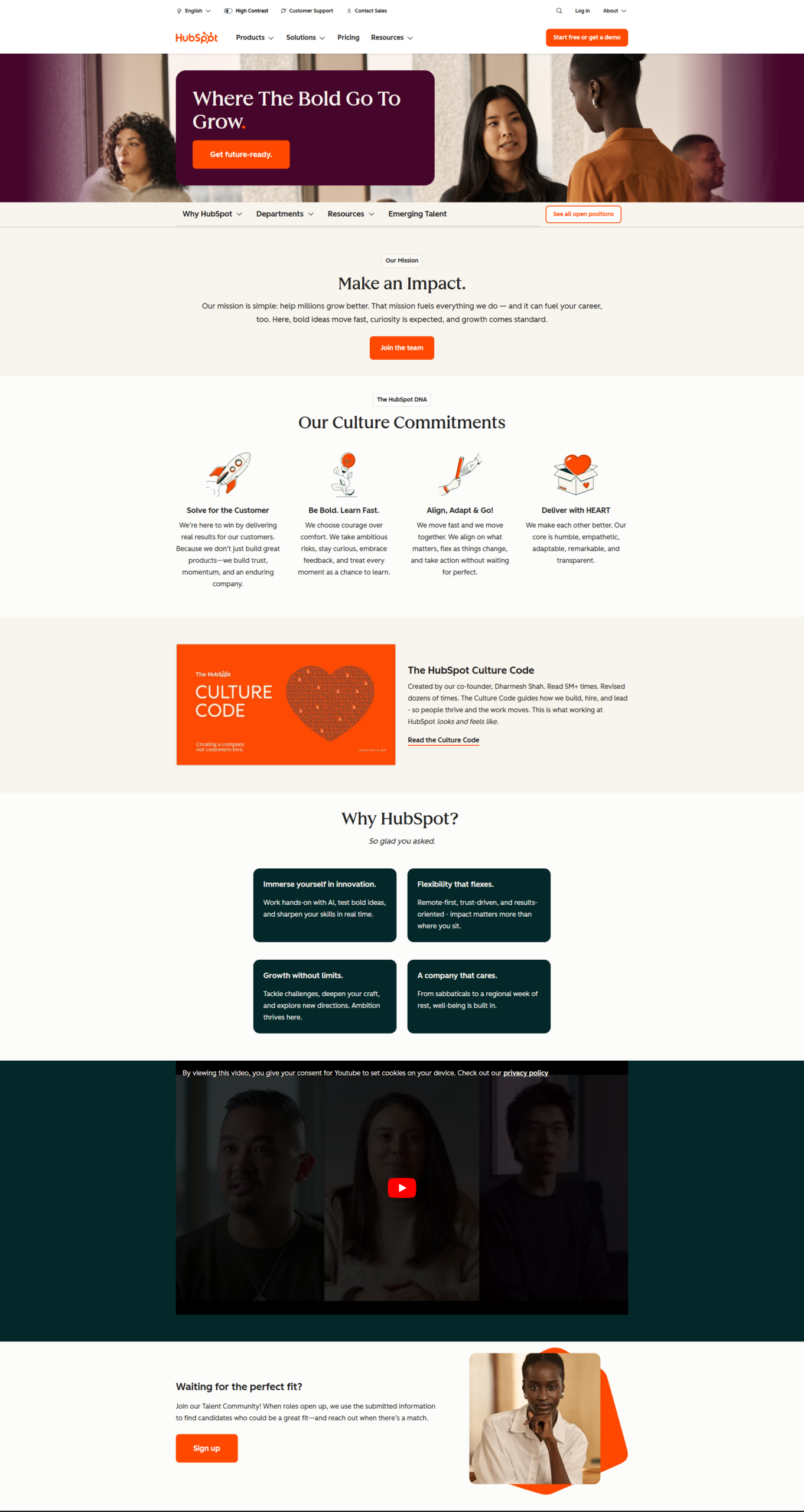
Hubspot
- HubSpot prioritizes culture-fit employees as the company’s mission and culture commitments are displayed prominently at the top of the career site.
- Remote-first policy with their Flex ethos, explaining, ‘It reflects a flexible, intentional approach that balances autonomy with clear expectations and prioritizes results over hours or location.
- There’s also a dedicated career page for each department: each team has its own work philosophy, and showcasing projects to know more about the department before applying.
- “Work hands-on with AI, test bold ideas, and sharpen your skills in real time” appears on the careers homepage as a core EVP pillar. AI fluency is positioned as a growth opportunity for all roles, not just engineering
- A talent community sign-up is also available for candidates not yet ready to apply
- The career site maintains a lightweight, easy-to-scan experience even on mobile devices, so candidates can easily explore roles without friction.
- The career site is simple and mobile-friendly. Minimal clicks to apply
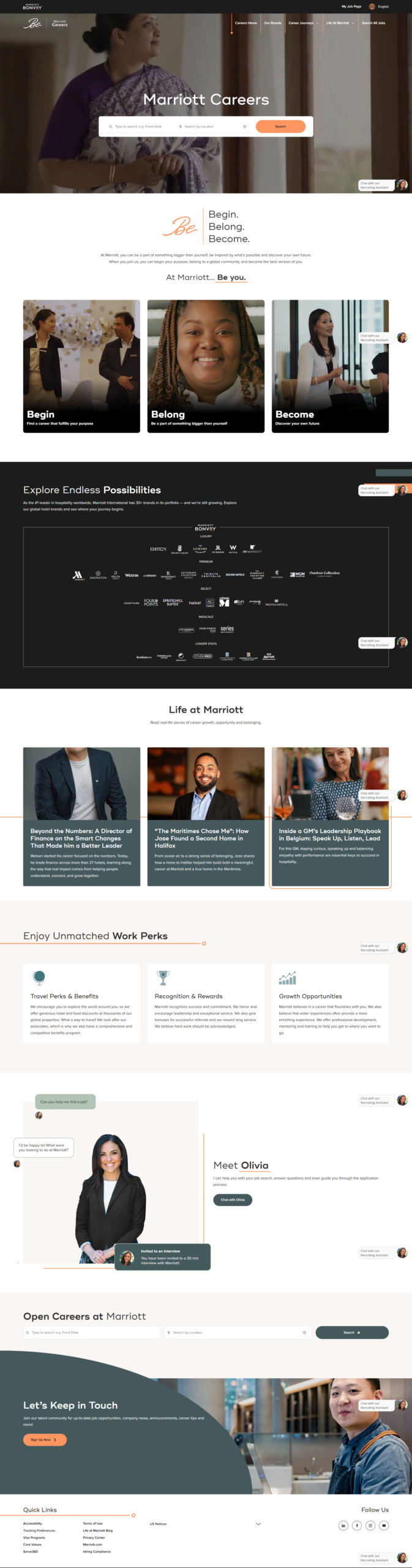
Marriott
- “Begin. Belong. Become.” : each word maps to a distinct stage of the employee journey (start strong, feel connected, reach potential) and carries through every section of the site consistently
- Multi-brand career architecture: 30+ hotel brands each have their own careers’ landing page under one platform, so a candidate interested in W Hotels gets a completely different experience than one exploring Ritz-Carlton or Courtyard. This is the hospitality equivalent of L’Oréal’s multi-brand segmentation
- Career journey segmentation goes beyond job type: Hotel Jobs, Corporate Jobs, Flex Talent Solutions, and Early Careers are distinct pathways with their own content, not just filtered search results; the Flex Talent Solutions track for temporary and gig-style roles is unique.
- The tile-based navigation compresses cleanly on mobile
- Marriott’s AI chatbot Olivia is embedded directly on the career homepage. She guides candidates through the application process, answers questions, and books interviews.
Ikea
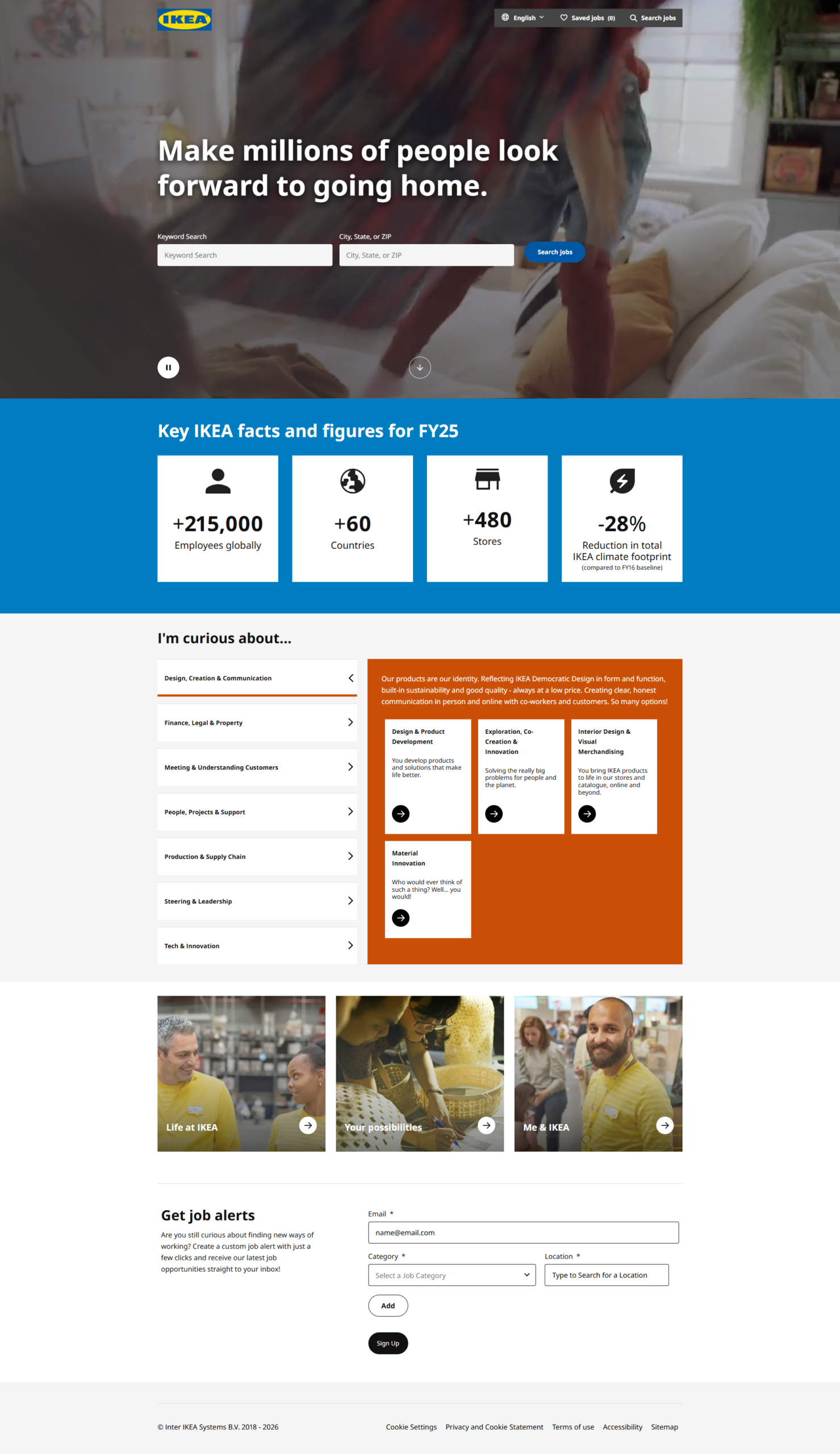
- “Make millions of people look forward to going home” is a very strong headline, connecting the product mission directly to the employer brand
- Function-first job navigation: 30+ distinct job families organized under six categories (Design & Creation, Finance & Legal, Meeting Customers, People & Projects, Production & Supply Chain, Technology) with brief descriptions for each category
- Clean, fast-loading tile navigation collapses well on small screens; job search is prominent above the fold and works without friction on mobile. No third-party ATS redirect breaks the experience
CVS Health
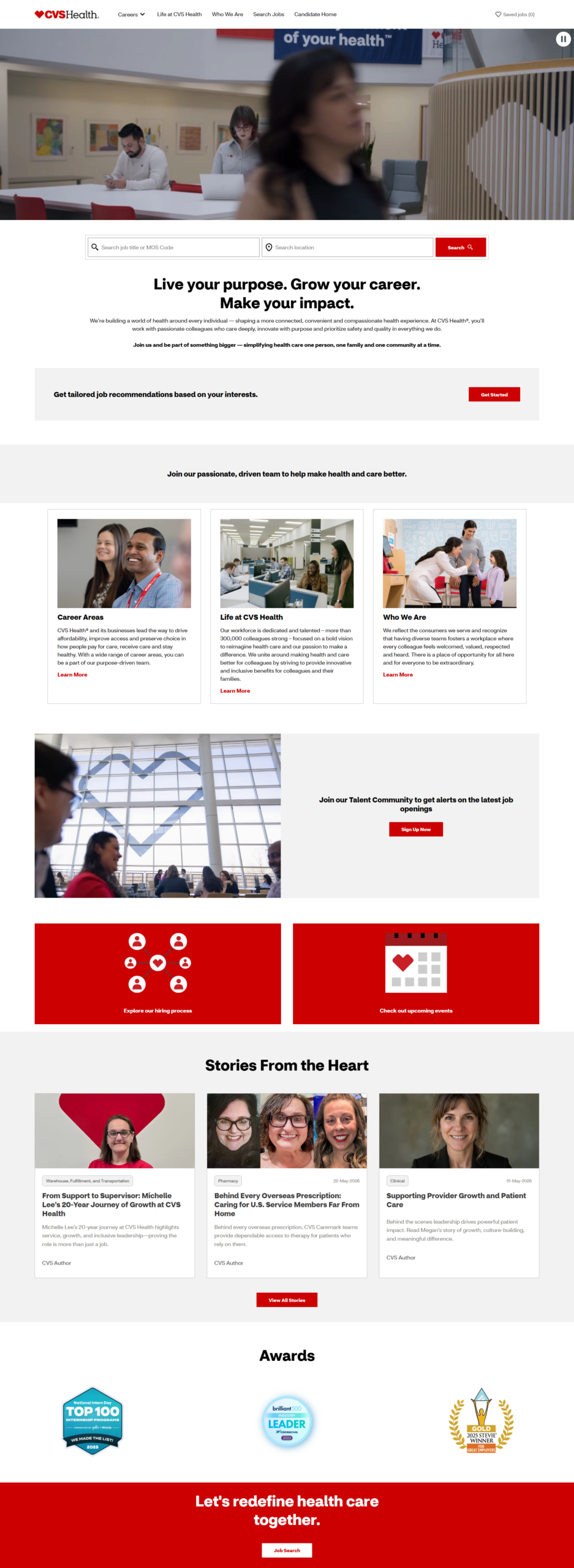
- “300K+ colleagues reimagining health care” and “We’re building a world of health around every consumer” establish scale and purpose immediately. Candidates can quickly understand the company’s size and mission before they see a single job listing.
- The award wall is one of the most comprehensive on this list: 2026 Where You Work Matters Platinum Employer, LinkedIn Top Companies 2025 and 2026, 2025 CandE Award Winner for Candidate Experience, and Stevie Award for Great Employers are all displayed on the homepage.
- Community impact content is specific and verifiable: CVS Health Foundation, Health Zones for social determinants of health, and Project Health Events are detailed with real program names and outcomes, not generic “we give back” copy.
- AI-powered job matching, personalized recommendations, and talent community sign-up are all available on the site; the talent community CTA is prominently placed for candidates not yet ready to apply — keeping them in the pipeline without forcing an application
- Clean tile-based navigation reflows well on mobile
What You Can Steal for Your Own Career Site
- Lead with mission-aligned proof points before the job search bar — Babbel’s 16M+ subscriptions, 80+ nationalities, and Fast Company ranking give candidates a reason to apply before they ever see an open role
- Spotify is one of the only companies on this list to proactively disclose how AI is used in hiring; candidates increasingly distrust black-box screening, and a single transparency statement sets you apart
- Segment your candidates visually from the homepage. If your workforce has distinct tracks, don’t make a store associate and a finance director wade through the same search results. Shopify’s department tile navigation (Engineering & Data, Design, Product, Commercial) are simple but effective models.
- L’oreal’s segmentation by department, location and brand makes for hyperpersonalized career journey.
- Tell your origin story. Shopify’s snowboard programmer and Canva’s Lego-block metaphor, framing all give candidates a human entry point into the company before they see a single job listing.
- Feature employee stories or testimonials to give candidates a glimpse of what it’s like to work for your organization. Marriott’s ‘Life at Marriott’ tells stories about career growth, opportunities and belonging.
- Investing in chatbots reduces time answering candidate initial questions. If chatbot is not an option, career FAQs is a good alternative
- Have a Talent Community/Network sign-ups to capture qualified candidates to keep the candidate pipeline growing
Why I wrote this
Company career pages are an important part of your digital recruiting strategy. The goal is to attract and engage candidates and to move them onto your job openings. Ongig’s Career Site Builder helps employers create awesome careers sites with drag-and-drop builder, artificial intelligence-based search, instant microsite pages and dynamic job descriptions.
Shout Outs:
2025 Job Seeker Nation Report (by Employ)
State of Candidate Experience: 2025 Benchmarks Report (by Phenom)
