Quick Summary
Start with a job title candidates actually search for. Then cover six core sections:
- Role summary (1–4 sentences)
- Key responsibilities (3–7 items)
- Must-have vs. nice-to-have qualifications
- Salary and benefits
- Company or mission overview
- EEO statement
Keep sentences short — 8 to 13 words. Keep lists tight — 3 to 7 items. That’s what makes a job description easy to scan, for candidates and AI search tools alike.
What Is a Job Description?
A job description explains a role’s responsibilities, required qualifications, and where it fits in your company. It’s the first thing most candidates read, so it needs to sell the role, not just list duties.
“How to write a job description” is the most-searched HR term on Google, according to Ahrefs data — which tells you how many talent leaders are looking for guidance on getting this right.
The Ongig team put together this guide after analyzing millions of job descriptions, and we hand-write JDs for many Fortune 500 companies.
We use “job description” as an umbrella term here — covering both external job postings and internal job descriptions.
Here’s what you’ll find in this guide:
- 5 Tips on what to do BEFORE you write a job description
- The 2 most important tips on writing job titles
- How to show job location in a JD
- The 6 sections to consider for the structure of a job description
- 2 best practices for what to do AFTER you write a JD
- Job Description Template
- 5 examples of the structure of a job description (the examples we show are from Disney, Instagram, Bark, Anthropic, and Novartis)
- How to write a LinkedIn job description
5 tips to use BEFORE you write your job description
Here are a few tips to think about BEFORE you start writing a job description:
- Put the important stuff first — think about what might catch your reader’s attention and start with that.
- Consider using 1st or 2nd person vs. 3rd person — it’s more conversational to say “we” or “you” than “the [Company]” or “the [Job Title].”
- Use active voice instead of passive voice — for example, “Tesla changes the way we drive cars” v. “People will drive cars differently because of Tesla.”
- Write about the candidate early and often — write about the candidate early on, so you hook them in. Phrases that should be sprinkled throughout might include:
- You’ll be working on…(or you’ll be running…)
- You are…
- Can you…
- Your expertise…
- How you’ll make your mark…
- Note: Avoid the pitfall many companies make when they start their job descriptions with “About Us” (which is about the company, NOT the candidate)
- Cut down on “fluff” — candidates are overloaded with content daily. Keep your job descriptions simple. Your sentences should be punchy (8 to 13 words is ideal). Your bulleted lists should be in the 3 to 7 range. And most of your paragraphs should be 3 or fewer sentences.
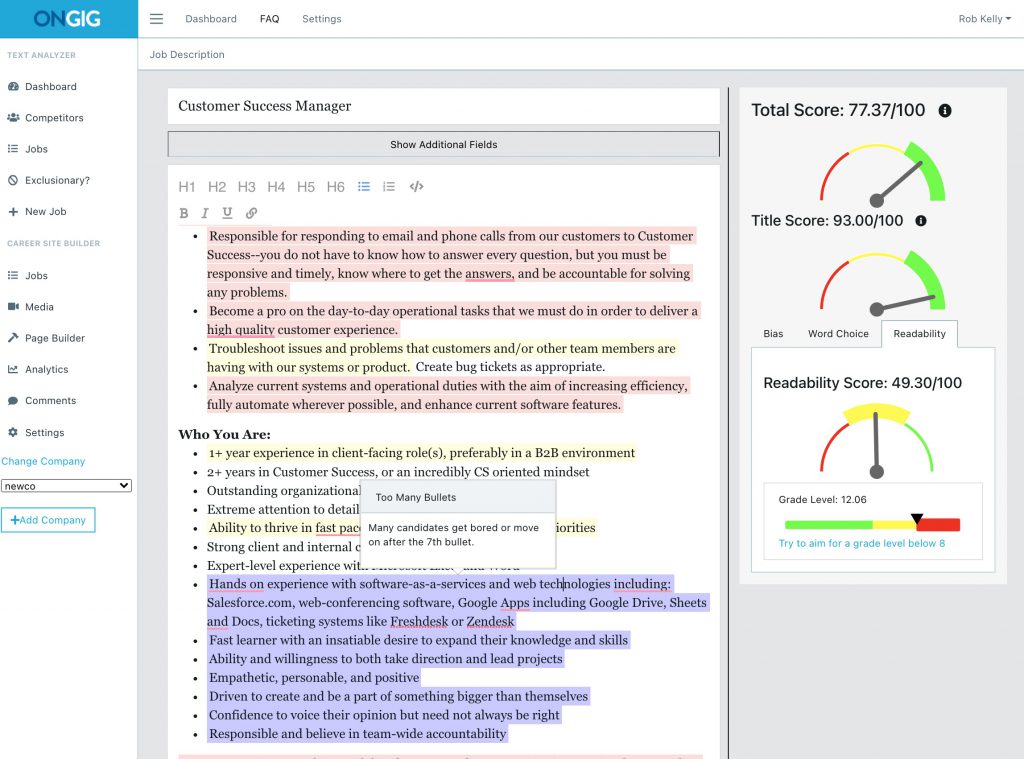
Check out the below screenshot of Ongig’s Text Analyzer analyzing a Customer Success Manager job description. The red highlights extra-long sentences, yellow highlights long sentences, and purple highlights long lists.
How to write the job title for your job description (2 tips)
To write a great job description requires writing a great job title. That’s because job titles are the first thing candidates see on a job description. It’s also a key part of what they search for on Google.
1. Make your job titles searchable
Use a job title that candidates search for on Google. An Indeed survey found that 36% of job seekers search using the exact title of the role they want. That means your title needs to match what candidates are already typing.
Ongig’s Text Analyzer software scores job titles on the number of words or syllables and helps answer what candidates are searching for. Here’s an example of SEO-optimized job title suggestions for a Marketing Specialist job description:
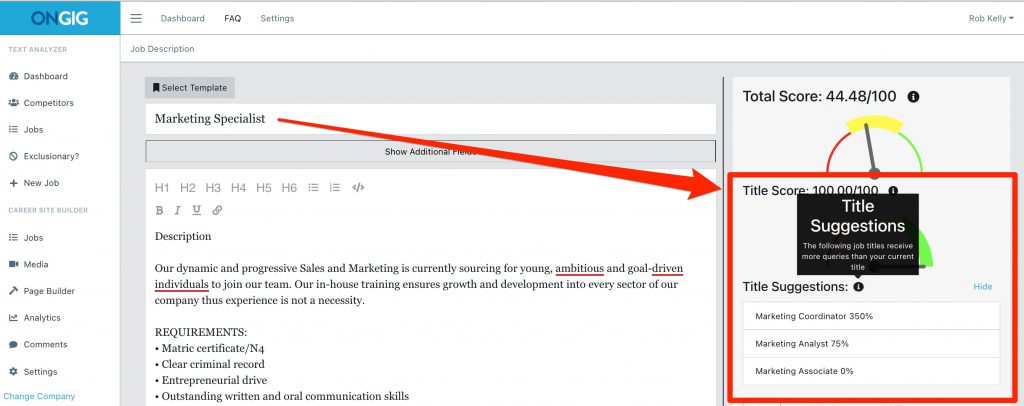
“Marketing Coordinator” and “Marketing Analyst” jobs are searched more per month on Google than Marketing Specialist, according to Ongig’s research (with the help of search engine optimization tools like Google Keyword Planner and ahrefs.com).
So, choosing one of these 2 job titles to write your marketing job descriptions might be a better choice.
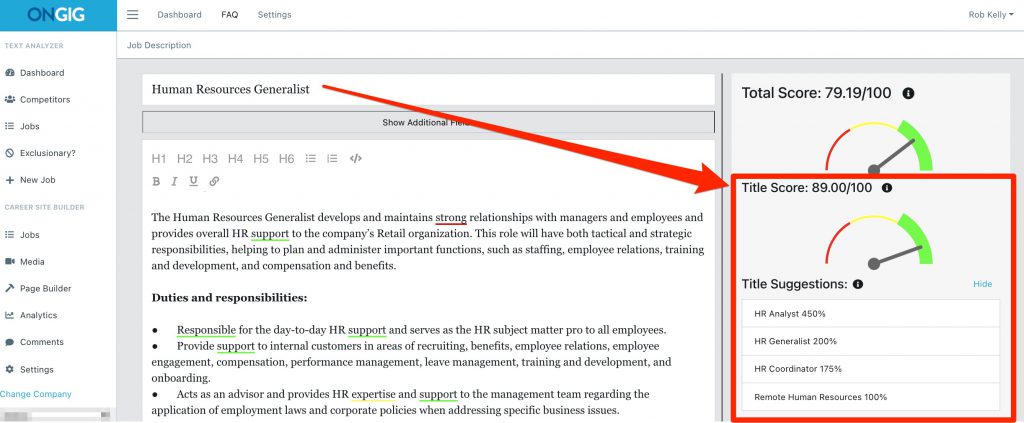
Here’s another example. The below job description is for a “Human Resources Generalist.” There are 4 job titles searched more than “Human Resources Generalist.”
Here’s another example of a job title suggestion for a Senior Network Engineer. Our research says Network Engineer is searched on Google 7,000+ percent more than Senior Network Engineer.
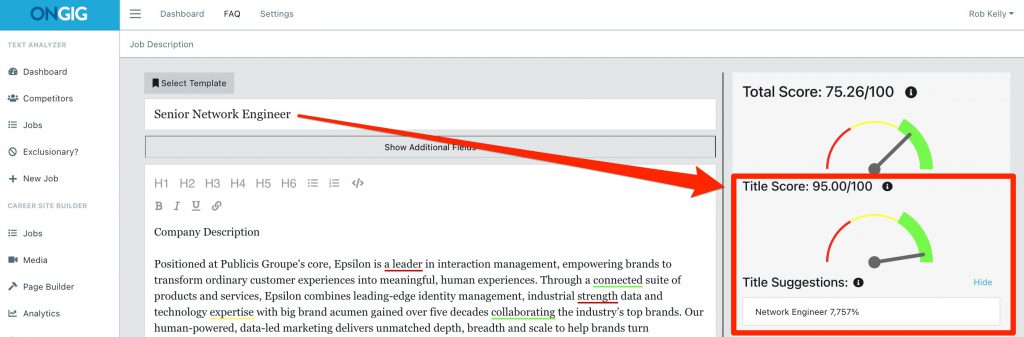
Using job title suggestions to write job descriptions impacts the number of candidates you reach.
2. Keep job titles simple
Use 1 to 3 words and less than 20 syllables in your job titles. Short and punchy job titles perform better than long, cryptic ones.
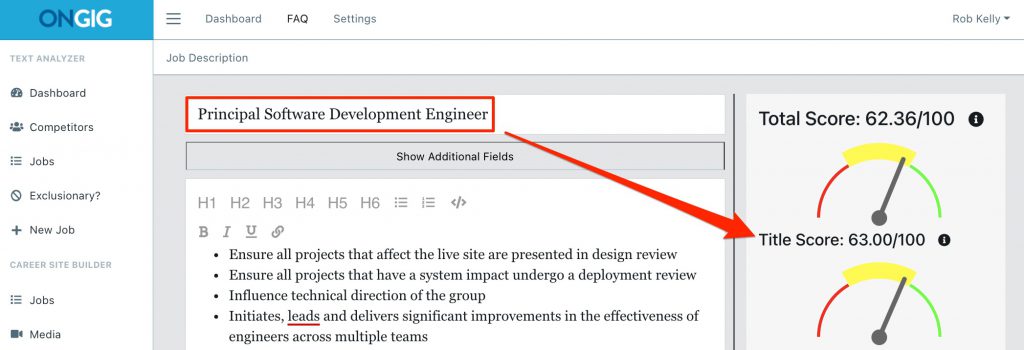
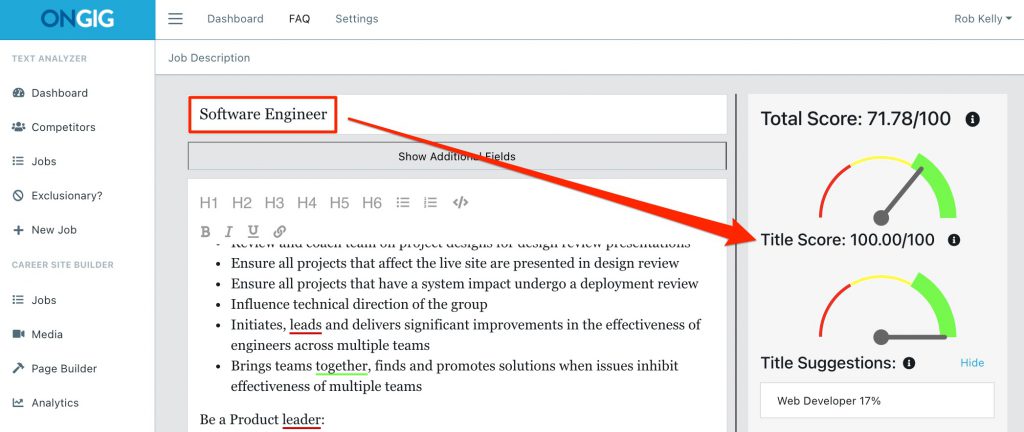
Look at these two examples. The first title, ‘Principal Software Development Engineer,’ scores 63 out of 100. But if you use a simpler title like ‘Software Engineer,’ it gets a perfect score of 100 out of 100. You can also use the title ‘Web Developer’ to make it even better for search engines.
Appcast.io did an analysis from 400k+ job seekers and found that the hot spot for job titles is between 50-60 characters. The analysis showed that titles between 50-60 characters do better than other titles by 30-40%.
Caution: Don’t Try to Be Clever
You might want to use a creative or funny job title in a job description because it’s fun. But studies show that people usually don’t search for these fancy titles when looking for jobs.
How to Write Job Descriptions Using AI
Once you’ve nailed your job title, AI tools can help you build the rest of the description more efficiently.
More than just asking AI to spit out ‘generic’ job descriptions, you can prompt LLMs like ChatGPT, Claude, Gemini, etc. to build candidate personas. According to PeopleScout, AI can draw on existing employees’ profiles and historical hiring data for a given role to surface patterns and common characteristics. These patterns, combined with data from job interviews, can help you to define a persona profile of the ideal candidate for the role, which you can use to ‘prompt’ a job description. For example, you can prompt ChatGPT, “You are a Senior UX Lead. Write a job ad for a Mid-level Designer that focuses on our specific need for ‘accessibility-first’ design systems, using a tone that is professional but avoids corporate ‘fluff’.”
What to use for the “Location” Field in Job Descriptions [Physical Remote or Hybrid]
The “work from anywhere” era is being replaced by the hybrid model (a combination of onsite and remote work). According to Resume Builder, companies increasing the required in-office days are doing so primarily to strengthen company culture (64%), improve productivity (62%), and maximize office space utilization (45%).
Be specific in your location field when writing your job description:
- Use Onsite or In-office only – for roles requiring 100% on-site presence. This means employees will work on-site 5-6 days a week. State the specific reason, such as hardware lab access.
- Remote for those with zero travel or office requirements – define the “radius” (e.g., “Must reside within 100 miles of Austin”). Clarify if pay is localized or “flat-rate” regardless of city. Specify required time zones if applicable (e.g., ‘Must be available during EST business hours’)
- Hybrid (combined on-site and remote) – list the exact days (e.g., Tue/Wed) or define the monthly minimum (e.g., “4 days per month”) the employee works onsite/remotely.
The 6 Main Sections to Consider for the Structure of Your Job Description
To write a job description, it helps to have an outline/structure.
Here are 6 sections to consider in order of where we recommend you place them:
1. Job description summary
A job description summary starts off by giving candidates a clear idea of the role without going into too many details yet.
Curology’s job description summary for a Communications Director (below) does this well:
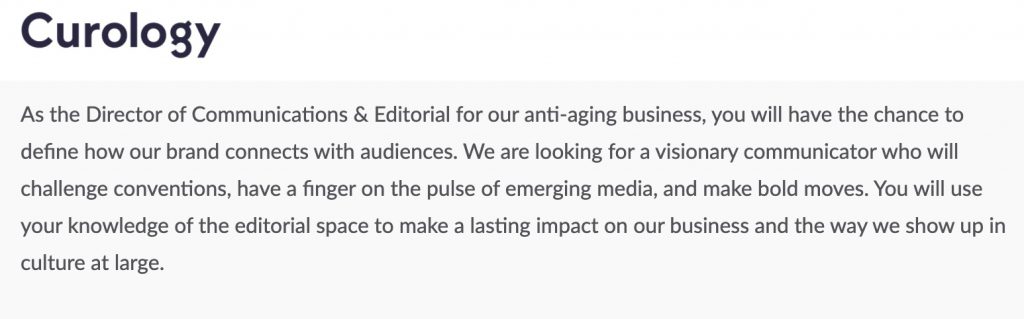
Notice how Curology uses language like:
- You will have the chance to define how our brand connects…
- You will use your knowledge of the editorial space…
Here are some tips for how to create a job description summary:
- Catch candidates attention with 1 or 2 high-impact benefits (e.g., creating software that will save lives)
- Engage candidates with a question (e.g., “How would you like to work in a place where your contributions and ideas are valued?”)
- Keep it short but meaningful — CIO Magazine says you should keep your JD summary/overview to between 1 to 4 sentences, and it should:
“…include a description of the job’s major function, how it contributes to larger company objectives, and why it’s important not just to the company, but to society as a whole.
2. Job responsibilities
If you can create a good job description, you know you have to be clear about what you want from the new employee. The list of job responsibilities can be long, but it doesn’t have to be.
Here are a few writing job descriptions best practices for this section:
- Highlight 2-4 primary responsibilities. List the most important duties first, as they will be the role’s primary focus.
- Break tasks into categories like “administrative”, “technical”, and “customer interactions”
- Replace jargon or overly technical terms with simple and straightforward words or phrases.
- Specify any tools, software, or systems they’ll be using when hired.
Lululemon also does this well in their job description for an Expeditor:
Key Responsibilities and Accountabilities
Under the direction of the Expeditor Leader, you will:
Receive/Process stock received from warehouse, involving: unpack, count, fold, size and place on the floor, overflow stock placed in back room and stored areas
Assist in preparing the store for the day including: replenishing garment styles and other merchandise by color, size, and quantity requirements; folding, sizing, and organizing product
Ensure stock replenishment in work areas
Complete other additional projects as required or by request, under the direction of the Expeditor Leader
3. Requirements and qualifications
Requirements and qualifications also tends to be an extra-long section in job descriptions. Here are a couple of tips on how to write a job description without too many requirements:
- If you don’t really need years of experience, don’t make it a must-have for the job. Some companies are also hiring people based on their skills for the job, without focusing on the number of years they’ve worked.
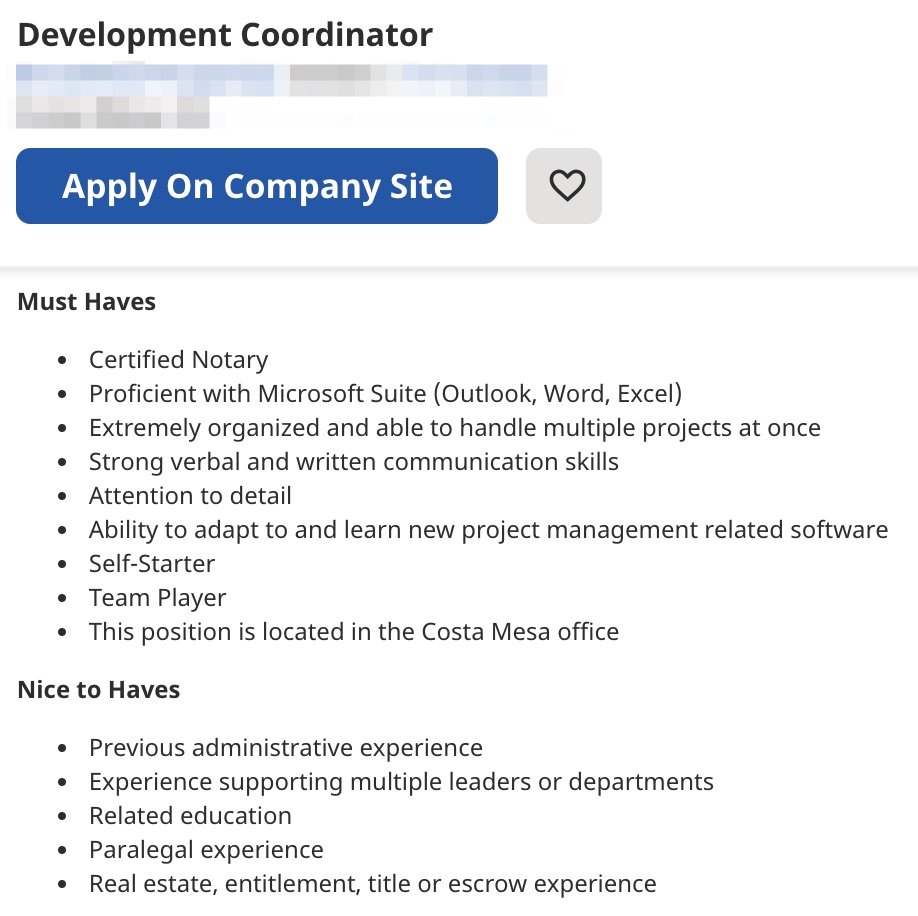
- Did you know that many female candidates will not apply unless they meet 100% of the requirements? Be clear on the “must-haves” qualifications versus the “nice to haves”. “Must-haves” might be proficiency in a software solution, or a specific certification required to perform a job. “Nice to haves” might be previous experience in a similar role or industry.
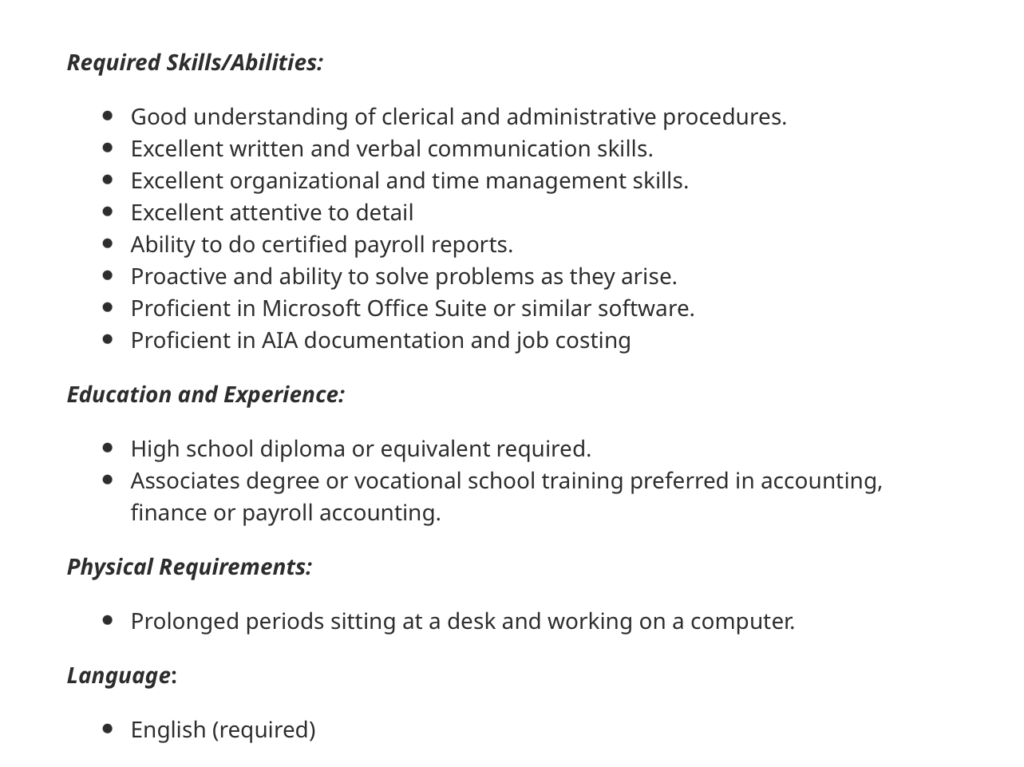
Job Requirements Examples:
The Shift to Skills-Based Hiring
According to Test Gorilla, 85% of organizations are implementing skills-based hiring. Employers are dropping degree and traditional educational requirements in favor of hard and soft skills.
In your job descriptions, list the skills needed for the role. For example, instead of requiring a bachelor’s degree in marketing when hiring a digital marketing executive, you can write, “Highly proficient in SEO tools such as Ahrefs, SEMrush, Google Search Console”.
In skills-based hiring, you can also remove the ‘years of experience’ and replace it with “strong understanding of SEO, SEM, and content marketing strategies.”
4. Benefits, salary, and perks
Job seekers always want to know what’s in it for them. Indeed reported that nearly one in four job seekers say compensation is the most important factor in a job description. For many candidates, it’s the deciding factor on whether to apply at all.
Depending on where you’re hiring, you may be legally required to include salary information. It doesn’t have to be the exact figure, but the salary range would do. Most US job postings on Indeed now advertise pay details. Currently, 16 US states have enacted pay transparency laws.
Here’s what we recommend you include, no matter how you organize it:
- salary range, even if it is not 100% set (include commission % for sales roles)
- vacation policies (unlimited days or number of weeks per year)
- retirement plan offerings (401k matching)
- medical packages (health, vision, or dental plans)
- fee reimbursements (phone, gym memberships, or healthcare expenses)
- parental leave (exact time off available for new parents)
- wellness opportunities (yoga classes, on-site gym, or group sports teams)
- free training you provide
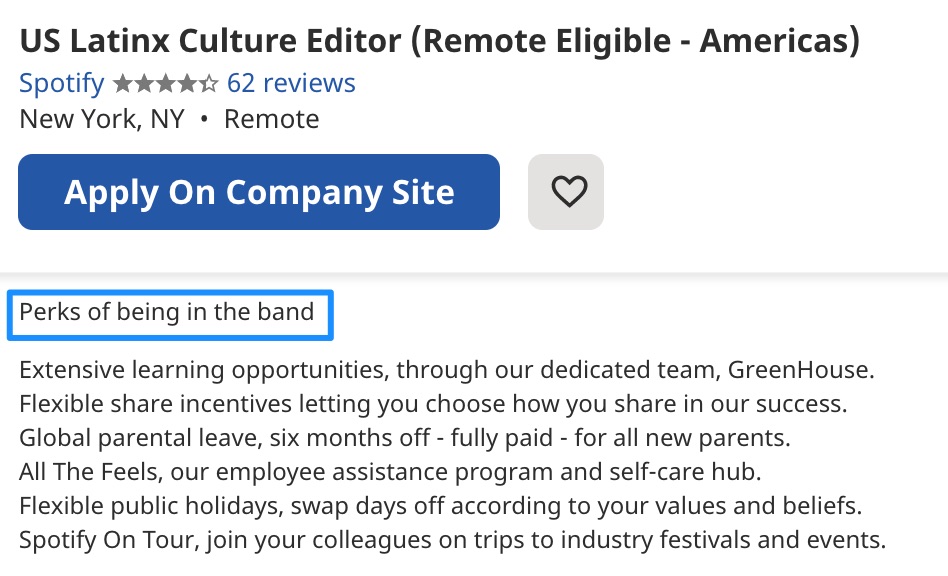
Spotify knows how to write up a job description with perks while making it fun. The job description below for a Latinx Culture Editor lists the perks of the job in a catchy way:
How punctuation affects your job description
The way we use punctuation in job ads really matters. Before, too many exclamation points made a job ad seem unprofessional. But lots of questions engaged candidates more. Now, things have changed. Using more exclamation points is better. People like it because it shows excitement. Questions are viewed with doubt. This change might be because we communicate a lot through emails now. And emails are often informal and enthusiastic, so people respond better to exclamation points.
According to the latest data, bulleted content should account for around 25% of your JD. This balance has been found to be effective in increasing the number of applicants. It is noteworthy that this represents a decline from a few years ago, when job descriptions with nearly 40% bullet points were considered most effective.
Also, it’s important to keep sentences short in job ads. Short sentences keep people interested and help them understand better. Long sentences with too many words can be confusing and make readers lose interest. Good job ads usually have sentences with 13 to 18 words. So, avoid using too many words or very long sentences to make the job ad work well.
5. About Us (or “Mission Statement”)
This part of job descriptions is where you talk about your company and what it’s like to work there. It’s called the ‘About Us’ section. Here, you talk about your company culture and also share interesting details about what it is like to work in your team.
Here are a few tips on how to write a job description “About Us” section:
- introduce your employer brand and industry
- include the company location and/or the location of the role
- write a description about the team
- talk about the company’s mission or vision
Here is an About Us from Nike at the beginning of their job descriptions:
NIKE, Inc. does more than outfit the world’s best athletes. It is a place to explore potential, obliterate boundaries and push out the edges of what can be. The company looks for people who can grow, think, dream and create. Its culture thrives by embracing diversity and rewarding imagination. The brand seeks achievers, leaders and visionaries.
Consider Using “Purpose/Mission” over “About Us”
Research from SHRM shows that Gen Z candidates in particular are drawn to companies with a clear purpose.
A good alternative to About Us is having a ‘Purpose/Mission’ statement in your job description.
Coca-Cola has a purpose statement at the end of its job posts. Notice how it goes beyond describing the company — it tells candidates exactly what behaviors and values are rewarded there.
We are taking deliberate action to nurture an inclusive culture that is grounded in our company purpose, to refresh the world and make a difference. We act with a growth mindset, take an expansive approach to what’s possible and believe in continuous learning to improve our business and ourselves. We focus on four key behaviors – curious, empowered, inclusive and agile – and value how we work as much as what we achieve. We believe that our culture is one of the reasons our company continues to thrive after 130+ years.
6. EEO and Diversity Statement
Many JD templates include a standard EEO statement, but some companies go further at the end of their job descriptions with Diversity statements.
Diversity statements are often on a company website or careers page, but they’re important in job descriptions too.
Check out SAP’s simple diversity commitment:
“To harness the power of innovation, SAP invests in the development of its diverse employees. We aspire to leverage the qualities and appreciate the unique competencies that each person brings to the company.”
Hewlett Packard Enterprise (HPE) uses a longer hybrid EEO statement and diversity message:
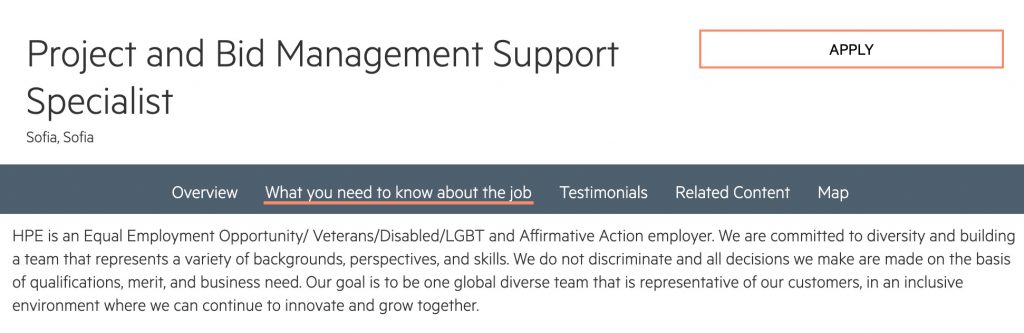
The six sections we talked about in a job description are just ideas. You can also mix them up or change the order. But bear in mind that it’s best to talk about the job first and the company later.
Writing Job Descriptions — AFTER You Write
Ok. You’ve written your JD. What next?
The first step is to use inclusive language in JDs. This means using words that don’t exclude or offend people based on their race, age, sexual orientation, disability, or other biases.
Remove potential bias from job descriptions
Text Analyzer has found that most JDs have exclusionary words. So, common examples include”he/she,” “blacklisting,” “digital native,” “culture fit,” and “recent graduates.”
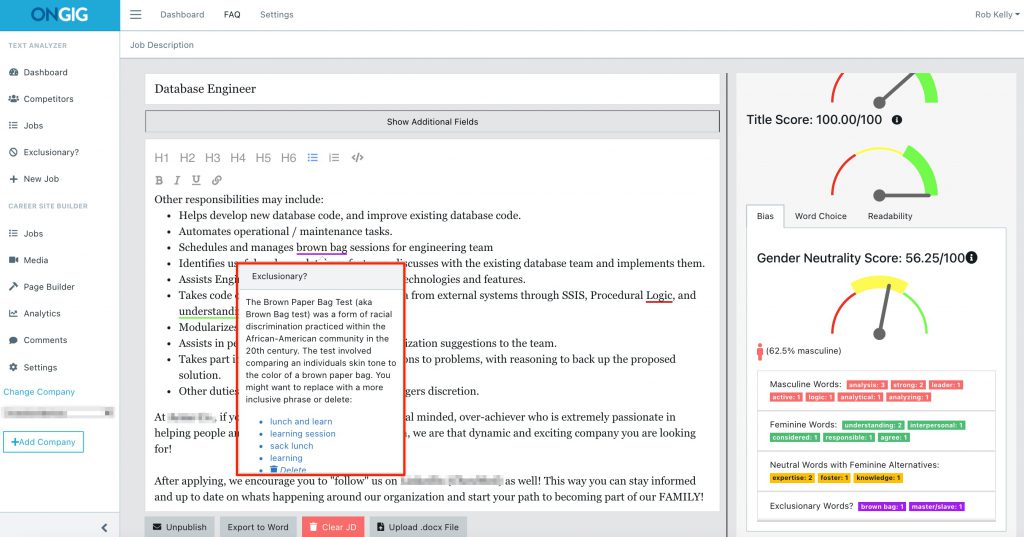
After you’ve written all the sections in your JDs, you should (if you can afford it) run your job descriptions through a Text Analyzer to flag “exclusionary words”. Make sure that you use a Text Analyzer that explains why the term might be exclusionary and also offers inclusive synonyms.
Here’s an example of Ongig’s Text Analyzer at work. The database engineer job description below flags the phrase “brown bag sessions” and explains why it might be exclusionary. It then also presents “lunch and learns” as a more inclusive synonym.
Want to compare more options? See our roundup of diversity tools for job descriptions.
Improve readability in job descriptions
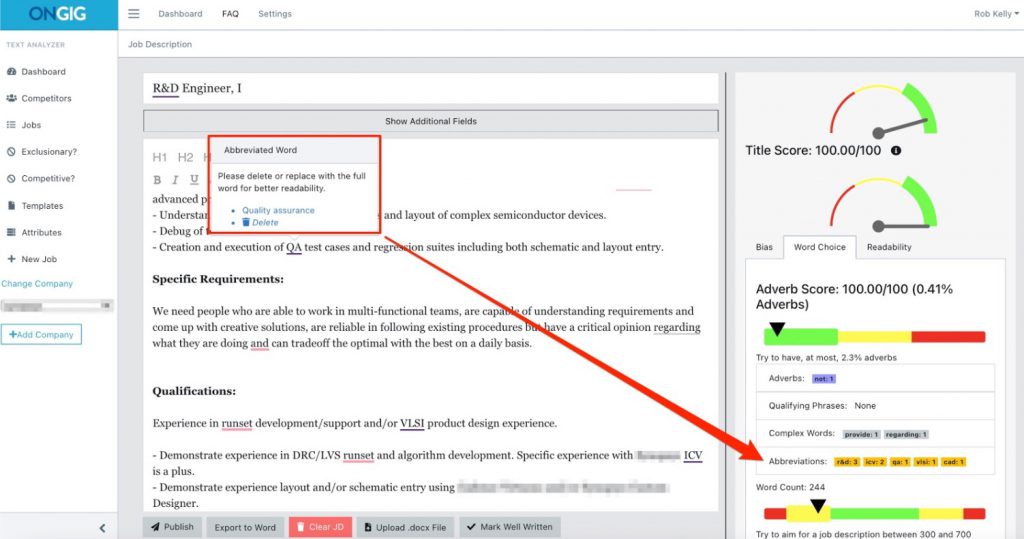
Using simple language is crucial. It means not using short forms or complicated words that confuse people. Also, long sentences can be hard to understand. So, by keeping things clear and straightforward, more people can easily understand what the job is about. This way, job descriptions become clear and also accessible for everyone.
Here’s another example of Text Analyzer at work with this R&D Engineer job description below:
Job Description Template
Copy this template and fill in the brackets to build a job description using the structure covered above.
[Job Title]
About the Role
[1–4 sentences: what this role does, how it fits into the team or company, and 1–2 things that make it worth applying for. Write as if speaking directly to the candidate — use “you,” not “the [Job Title].”]You’ll be responsible for:
- [Most important responsibility first]
- [Responsibility]
- [Responsibility]
- [Responsibility — keep this list to 3–7 items]
You’ll need:
- [Must-have qualification or skill]
- [Must-have qualification or skill]
- [Nice-to-have qualification or skill]
Compensation & Benefits
[Salary range, e.g. “X–Y”] plus [key benefits: health/dental/vision coverage, PTO policy, retirement match, remote/hybrid flexibility, etc.]About [Company Name]
[2–3 sentences: what your company does, who you serve, and/or your mission. This is also a good place for a Purpose/Mission statement instead of a generic “About Us” if that fits your brand.]Location
[Onsite / Remote / Hybrid — be specific: state why if onsite, define radius/time zone if remote, list exact days if hybrid][Company Name] is an equal opportunity employer. [Your EEO/diversity statement.]
Here’s what it looks like filled in:
Job Description Example: Marketing Coordinator
Marketing Coordinator
About the Role
We’re looking for a Marketing Coordinator to help plan and execute campaigns that connect our brand with customers. You’ll work closely with our content, design, and sales teams to bring marketing initiatives to life.
You’ll be responsible for:
- Coordinating campaign timelines across email, social, and paid channels
- Tracking campaign performance and reporting on key metrics
- Assisting with content creation for blog posts, social media, and email
- Managing vendor relationships for print and digital materials
You’ll need:
- 1–3 years of marketing or communications experience
- Strong writing and organizational skills
- Familiarity with tools like HubSpot, Canva, or Google Analytics (nice to have)
Compensation & Benefits
$55,000–$68,000 base salary, health/dental/vision coverage, 401(k) match, and unlimited PTO.
About Us
[Company] helps [what you do] for [who you serve]. We’re a remote-first team that values clear communication and getting things done.
Job Description Examples
Job descriptions can come in different styles. It’s like using different templates or examples. For example, what you write for a sales job might look different from what you write for a tech job. Companies often use specific formats for different types of jobs. So, this helps to clearly explain what each job involves and also what they’re looking for in a candidate.
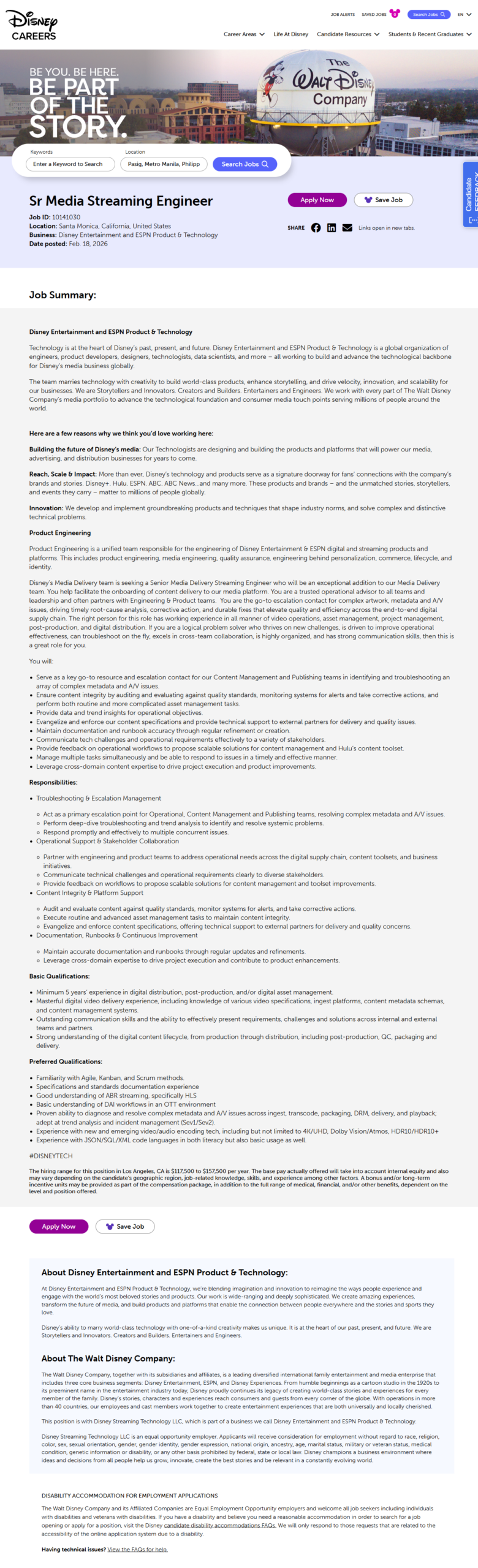
Disney (Sr Media Streaming Engineer) Job Description Example
Disney’s detailed/layered job description format works well for large enterprises, complex roles requiring extensive context:
Ongig’s Analysis
- Job Summary: includes company/division overview (Disney Entertainment and ESPN Product & Technology), team description (Product Engineering), and role overview
- You will: bullet list of high-level responsibilities. Starting with what the candidate will actually do (before diving into detailed responsibilities) is better UX. It gives candidates a quick overview of the role without overwhelming them with fine details upfront.
- Responsibilities: detailed breakdown organized into subsections (Troubleshooting & Escalation Management, Operational Support & Stakeholder Collaboration, Content Integrity & Platform Support, Documentation, Runbooks & Continuous Improvement). Breaking them into labeled subsections makes scanning easier.
- Basic Qualifications: required experience and skills
- Preferred Qualifications: nice-to-have skills and experience
- About Disney Entertainment and ESPN Product & Technology + About The Walt Disney Company: two separate “About” sections at the end. Splitting these helps candidates understand both the specific team culture and the broader company mission, which aids in self-selection.
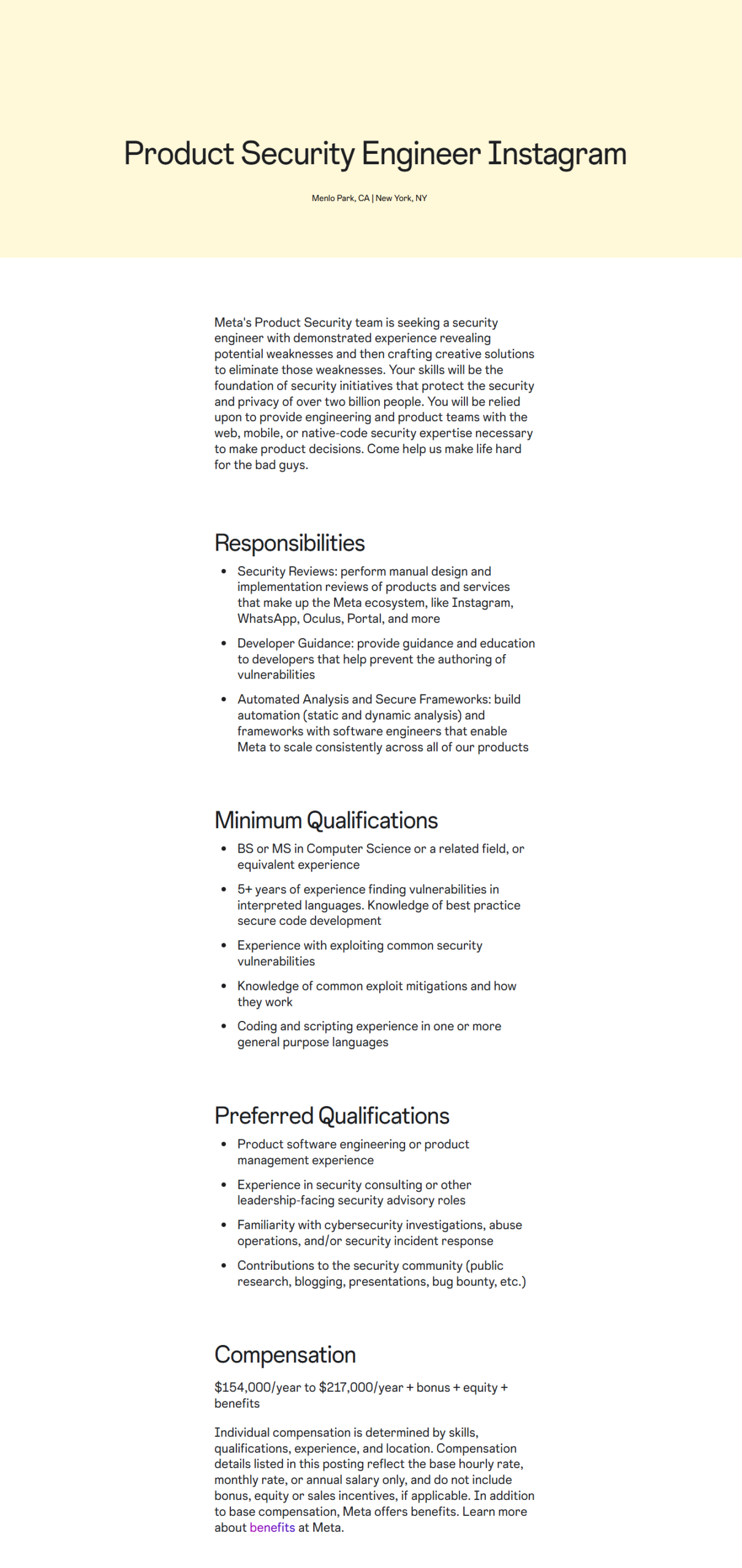
Instagram (Product Security Engineer) Job Description Example
Instagram’s classic/streamlined JD format works well for tech roles, startups, and companies with simpler org structures:
Ongig’s Analysis
- Role overview: single introductory paragraph explaining the team and what you’ll do
- Responsibilities: bullet list
- Minimum Qualifications: bullet list
- Preferred Qualifications: bullet list
- Compensation: show salary range upfront + benefits link
- About Meta: company description at the end
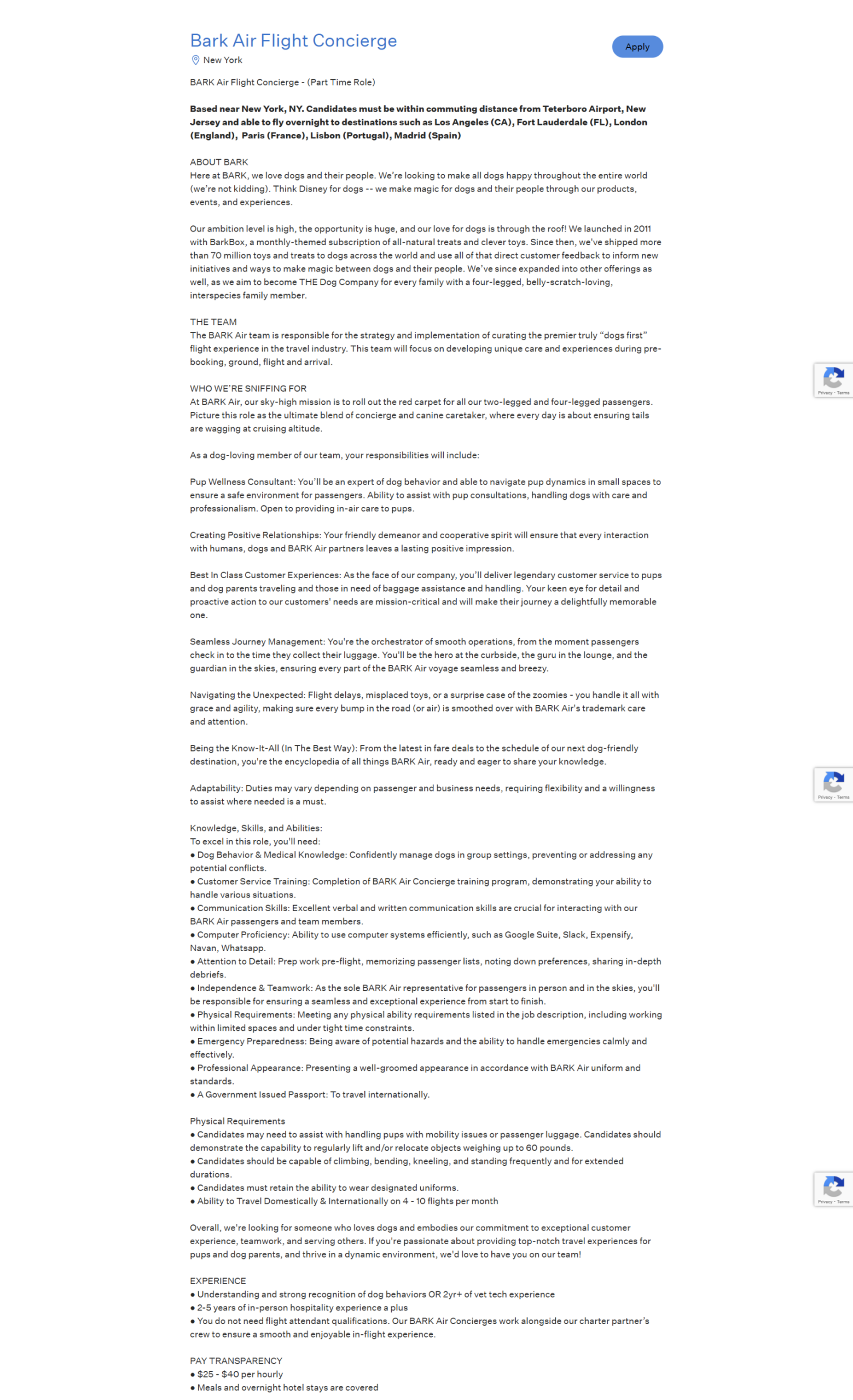
Bark (Air Flight Concierge) Job Description Example
Bark job posting follows a narrative/storytelling format. The “WHO WE’RE SNIFFING FOR” section reads like a letter rather than a list: conversational, creative, and brand-forward. This reflects how consumer-facing brands have more personality-driven JDs.
Ongig’s Analysis
- About Bark: Company description (not “Who We Are”)
- The Team: Team description (not part of “Who We Are” anymore)
- Who We’re Sniffing For: Combined role overview, responsibilities, and qualifications all in one long narrative section (not split into separate sections)
- Experience: Separate experience requirements
- Pay Transparency: Hourly rate and benefits
Anthropic (Customer Trust Lead) Job Description Example
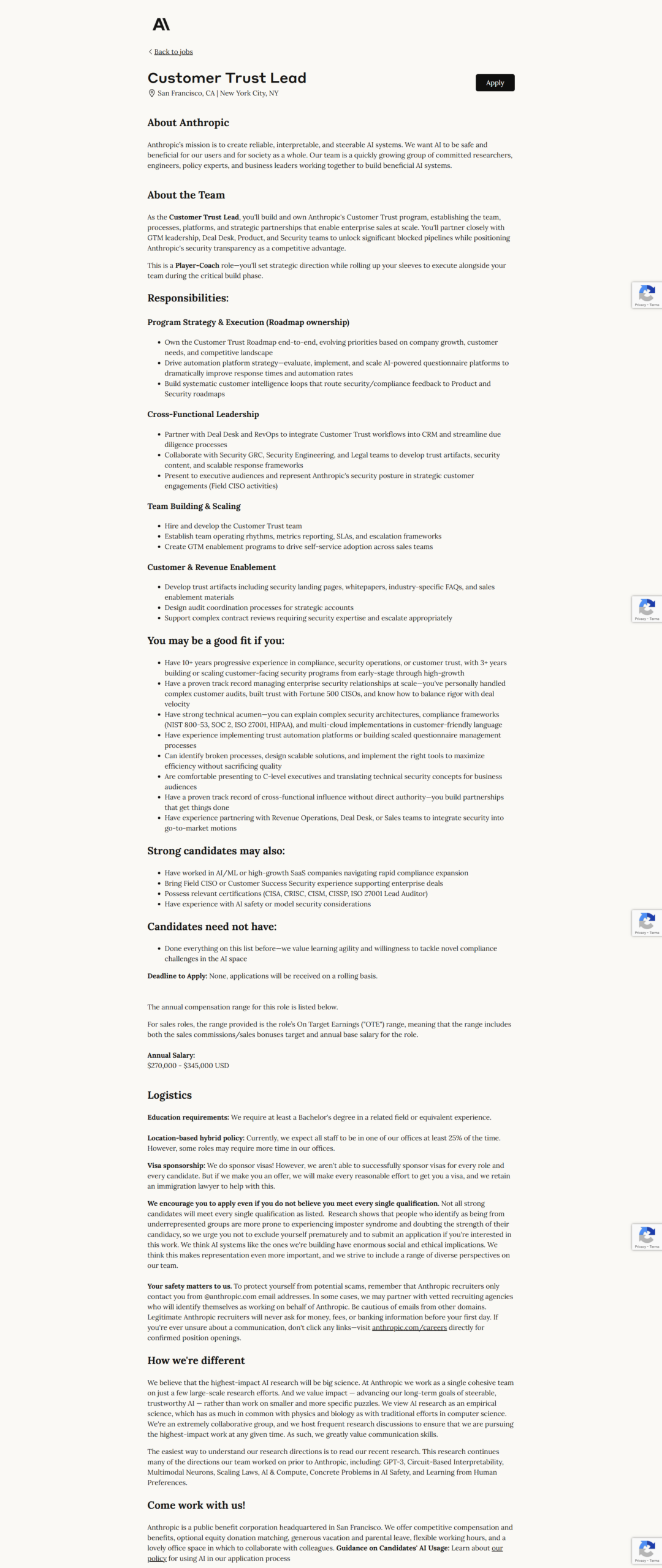
Antrophic’s job description follows a modern and candidate-friendly format. Instead of the usual ‘preferred/nice to have’ qualifications, the company opted for a “Candidates need not have” section, making it more inclusive and straightforward. The section “You may be a good fit if you” is warmer than “Required Qualifications” while still maintaining clarity:
Ongig’s Analysis
- About Anthropic: Company mission and overview
- About the Team: Role context and what the position entails
- Responsibilities: Organized into 4 labeled subsections: Program Strategy & Execution Cross-Functional Leadership, Team Building & Scaling and Customer & Revenue Enablement
- You may be a good fit if you: Required qualifications (conversational framing)
- Strong candidates may also: Preferred/nice-to-have qualifications
- Candidates need not have: Explicitly states what’s NOT required (innovative approach)
- Compensation: Salary range upfront
- Logistics: Education, location policy, visa sponsorship
- How we’re different: Culture/values section at the end
Novartis (Head, Translational Research and Biomarkers) Job Description Example
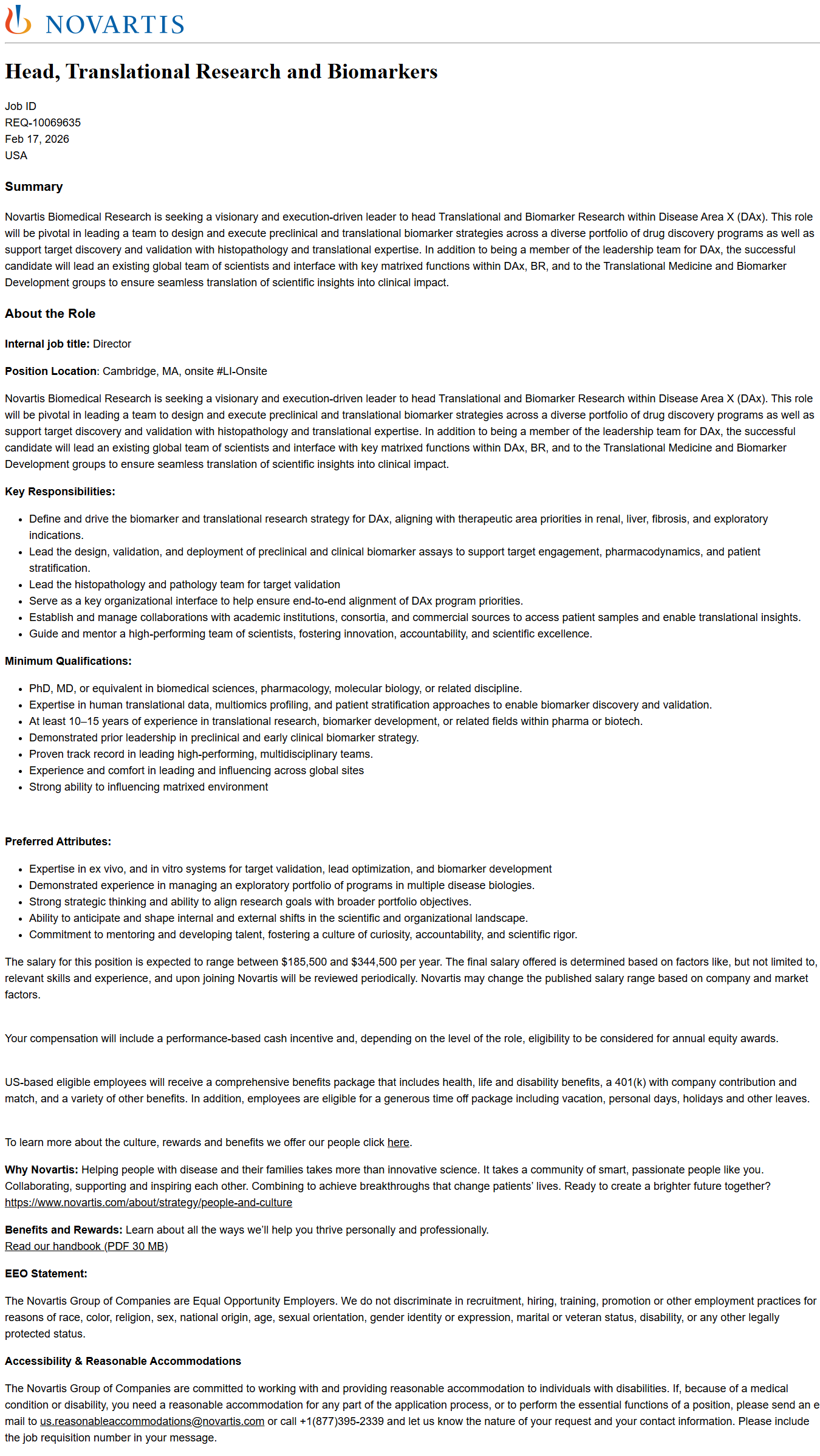
Novartis’ traditional JD format is usually employed in the pharmaceutical, healthcare, and life sciences industries. It features comprehensive sections on compensation transparency and strong regulatory compliance. Language used is formal, technical, and detail-oriented:
Ongig’s Analysis
- Summary: High-level role overview (2 paragraphs)
- About the Role: Includes internal job title, location, detailed description, and key responsibilities
- Minimum Qualifications: Required education and experience
- Preferred Attributes: Nice-to-have skills and experience
- Compensation & Benefits: Shows salary range ($185K-$344K), explains how it’s determined, mentions equity eligibility, AND links to full benefits handbook
- Why Novartis / EEO Statement / Accessibility: Lengthy EEO and accessibility sections reflect healthcare industry requirements
5 Job Description Format Examples: Find Your Style
| Format Type | Best For | Example |
| Detailed, Layered | Large enterprises, complex roles | Disney |
| Streamlined, Classic | Tech, startups, clear hierarchies | |
| Narrative, Brand-forward | Consumer brands, creative roles | Bark |
| Candidate-centric, Modern | Transparency-focused companies | Anthropic |
| Traditional, Professional | Pharma, healthcare, regulated industries | Novartis |
Write job descriptions at scale
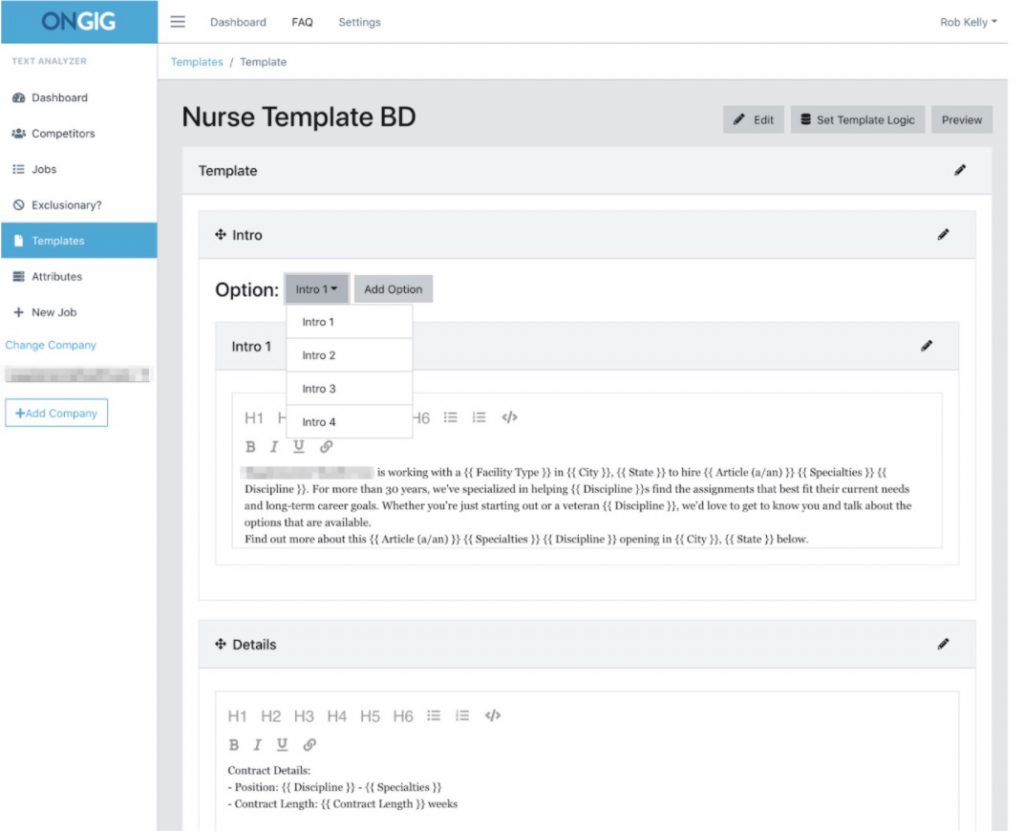
If you’re writing a large volume of job descriptions (many dozens to thousands per year), you’re likely going to want a different template for different departments or jobs. So, this way, you don’t have to reinvent the wheel each time.
The Text Analyzer template builder feature allows you to create and store your best job description content in the tool too!
How to write a LinkedIn job description
LinkedIn’s “Post a Free Job” feature has specific requirements and limitations that differ from posting on your career site or other job boards.
LinkedIn currently automatically prefills the following fields: (1) Company About Us, (2) Employee count and company size, and (3) Industry information.
As a recruiter, here’s what you actually need to provide:
- Job title — Use the searchable title format from earlier in this guide (LinkedIn’s algorithm prioritizes exact-match titles like “Marketing Manager” over creative titles like “Brand Wizard”)
- Workplace type — Onsite, Remote, or Hybrid
- Job location — Be specific (affects “jobs near me” searches)
- Job type — Full-time, Part-time, Contract, etc.
- Description — Clear role overview and 4-6 bullet points for responsibilities (optimize for mobile)
Optional but recommended:
- Skills — Add specific required skills (if you don’t, LinkedIn auto-generates them based on your job title)
- Screening questions — LinkedIn recommends at least 3 to filter applicants
- Salary range — If required by law in your state (see salary transparency section) or to attract 2-3x more qualified candidates
LinkedIn free job limitations:
- Active for 21 days only
- Can only post 1 free job at a time
- Gets de-prioritized in search over time as newer jobs post
- Caps on number of applicants
LinkedIn now offers an AI assistant that drafts job descriptions based on your job title. You can customize its suggestions or write from scratch. For best results, keep your LinkedIn JD concise with full details should live on your career site. Alternatively, you can share your job postings as regular LinkedIn posts that can be seen by your LinkedIn network. Just make sure to include the details above.
SEO and Social Media Strategies for Job Descriptions
Targeting Gen Z candidates with TikTok and Instagram
Gen Z and young professionals are increasingly discovering jobs through short-form video rather than traditional job boards. In 2026, Zety reported that 46% of Gen Z were securing roles or internships via TikTok.
Write ultra-concise job descriptions (50–100 words max) and pair with compelling visuals/Reels.
Start with a hook like “Ready to create viral content that drives real growth?” or “Turn your creativity into a career that matters.” Highlight culture, values, flexibility, growth opportunities, and perks that resonate, such as purpose, transparency, work-life balance, and career growth.
Use energetic, conversational language: emojis, questions (“Love storytelling?”), and calls to action like “DM ‘APPLY’ to chat” or “Swipe up/Link in bio to apply.” Avoid corporate jargon. Use conversational language, like talking to a friend. For Reels/TikTok: Overlay text on employee “day-in-the-life” videos, trend sounds, or quick testimonials. Caption with the shortened JD, relevant hashtags (#Hiring #GenZJobs #EntryLevel #RemoteWork #JoinOurTeam), and a clear link (e.g., via bio or Stories).
Optimize for AI-Driven Search
According to Ipsos,69% of American AI users say they’ve used it to search for information. Looking for jobs via LLMs isn’t mainstream yet, but it’s only a matter of time before it becomes a reality.
With tools like Google AI Overviews and Gemini summarizing answers directly, candidates often see job details pulled into quick overviews. Structure descriptions for easy parsing: use clear headings, bullet points, short paragraphs, and front-load key information (role, location, skills). Match user intent with natural phrases from real queries—no extra keywords needed, just scannable, helpful content that AI loves to cite.
The Power of Employee Testimonials and Interactive Elements
Candidates appreciate when employers keep it real. Research shows that job postings accompanied by videos (such as employee stories and testimonials) are viewed 12% more than those without videos and have a 34% higher application rate.
Use tools like Elfsight to embed real-time star ratings and featured reviews directly into your JD.
To create authentic employee testimonials that look professional without the corporate polish, forget the script. Provide employees with prompts (e.g., “What was your biggest win this month?”) to make it more personal. Focus on the specific. Instead of “The work balance culture is great,” encourage “I love that I can pick up my kids at 3 PM without feeling guilty.” You can use the smartphone to record the testimonials.
Evaluating and Updating Your Job Descriptions Regularly
Job description best practices evolve as candidate expectations and hiring trends change. Review your JDs at least annually, or when you notice:
- Low application rates
- High candidate drop-off during the application process
- Compliance issues: changes in salary transparency laws, DEI requirements, etc
- Shifts in remote/hybrid work policies
Track metrics such as time-to-fill, application completion rate, and quality-of-hire to identify which JD elements are effective. Many companies also A/B test different versions of their most-posted roles to optimize results over time.
Quick Reference: Job Description Writing Checklist
Here’s your actionable checklist for writing effective job descriptions in 2026:
Before You Write:
- Put the important stuff first — hook candidates early
- Use 1st or 2nd person (“you/we”) instead of 3rd person (“the company”)
- Write in active voice and keep it concise (8-13 word sentences, 3-7 item lists)
- Consider using AI tools (ChatGPT, Claude, Gemini) to build candidate personas and draft descriptions
- Use a JD optimization tool like Text Analyzer to check readability and bias
Job Title Best Practices:
- Make titles searchable — 36% of job seekers search by exact job title (Indeed)
- Keep titles simple (1-3 words, under 20 syllables)
- Avoid creative titles like “Marketing Ninja” — candidates don’t search for them
Location Specificity:
- Onsite: State why (e.g., “hardware lab access required”)
- Remote: Define radius and time zone requirements
- Hybrid: Specify exact days or monthly minimum (e.g., “Tuesdays + Thursdays onsite”)
Core Structure (6 Sections):
- Job Summary
- Job Responsibilities
- Requirements & Qualifications (focus on skills, not just degrees or years of experience)
- Benefits, Salary & Perks (include salary range — it’s legally required in 16 US states)
- About Us or Purpose/Mission Statement
- EEO & Diversity Statement
After You Write:
- Remove biased/exclusionary language (e.g., “digital native,” “culture fit”)
- Check readability (short sentences, clear structure)
- Optimize for AI search (clear headings, bullet points, front-loaded key info)
Modern Considerations:
- If targeting Gen Z, create ultra-concise versions (50-100 words) for TikTok/Instagram
- Tailor LinkedIn JDs to platform constraints (skills field, 21-day free post limit)
- Review and update JDs annually or when application rates drop
Why I wrote this?
Hiring practices are constantly changing, reflecting current developments in AI, skills-based hiring, remote/hybrid work arrangements, and salary transparency compliance. It makes sense to update job description formats and best practices to stay current and relevant for today’s job seekers.
At Ongig, we can help you transform your non-compliant or broken job descriptions into effective, inclusive job postings. Check out our Text Analyzer job description writing software if you’d like to learn more.
FAQs on Job Description
1. What is a job description?
A job description explains a role’s responsibilities, required qualifications, and where it fits in your company. It’s the first thing candidates read, so it needs to sell the role, not just list duties.
2. How long should a job description be?
There’s no fixed word count. Keep it as long as it needs to be to cover the role clearly, and no longer. Use short sentences (8 to 13 words), bulleted lists of 3 to 7 items, and cut anything that doesn’t help a candidate decide whether to apply.
3. What should you include in a job description?
Six things: a job title candidates actually search for, a short role summary, 3 to 7 key responsibilities, your must-have vs. nice-to-have qualifications, salary and benefits, and a quick company or mission overview. Skip the fluff.
4. What are the key responsibilities to list in a job description?
List 2 to 4 primary duties first, the ones that define the role. Group the rest into categories like “administrative” or “technical” so it’s easy to scan. Skip jargon.
Shout-Outs
- Survey: How to Improve Your Job Postings to Attract Better Candidates (by Indeed)
- AI in Recruiting: A Handbook for Talent Acquisition Leaders (by PeopleScout)
- 3 in 10 Companies Will Eliminate Remote Work by 2026 (by ResumeBuilder)
- The State of Skills-Based Hiring (by TestGorilla)
- 2026 Pay Transparency Laws by State (by Paycor)
- 46% of Gen Z Has Secured Jobs Through TikTok (by Zety)
- Best practices for writing a better Job Posting (by CareerBuilder)
