Quick Summary
Ongig analyzed job posting data from January 1 to July 13, 2026. “Strong,” “lead,” and “independently” are the most common masculine biased words in job descriptions. Other frequent offenders include “strengthen,” “competitive,” “leaders,” “analyze,” “champion,” “analysis,” and “independent.” Replacing these with gender-neutral alternatives can help increase female application rates.
How We Identified These Masculine Biased Words
What are the most common masculine biased words in job descriptions?
Knowing if you have masculine vs. feminine job descriptions is a hot topic these days. Most companies want to hire more women.
This week, I used Ongig’s Text Analyzer software (the tool for gender bias in job descriptions) to find out.
I had Text Analyzer review 48,246 random job descriptions from U.S.-based companies of all sizes.
Note: Text Analyzer has a proprietary masculine vocabulary library. It’s culled from social science and artificial intelligence research, and it flags masculine and feminine words like those shown below.
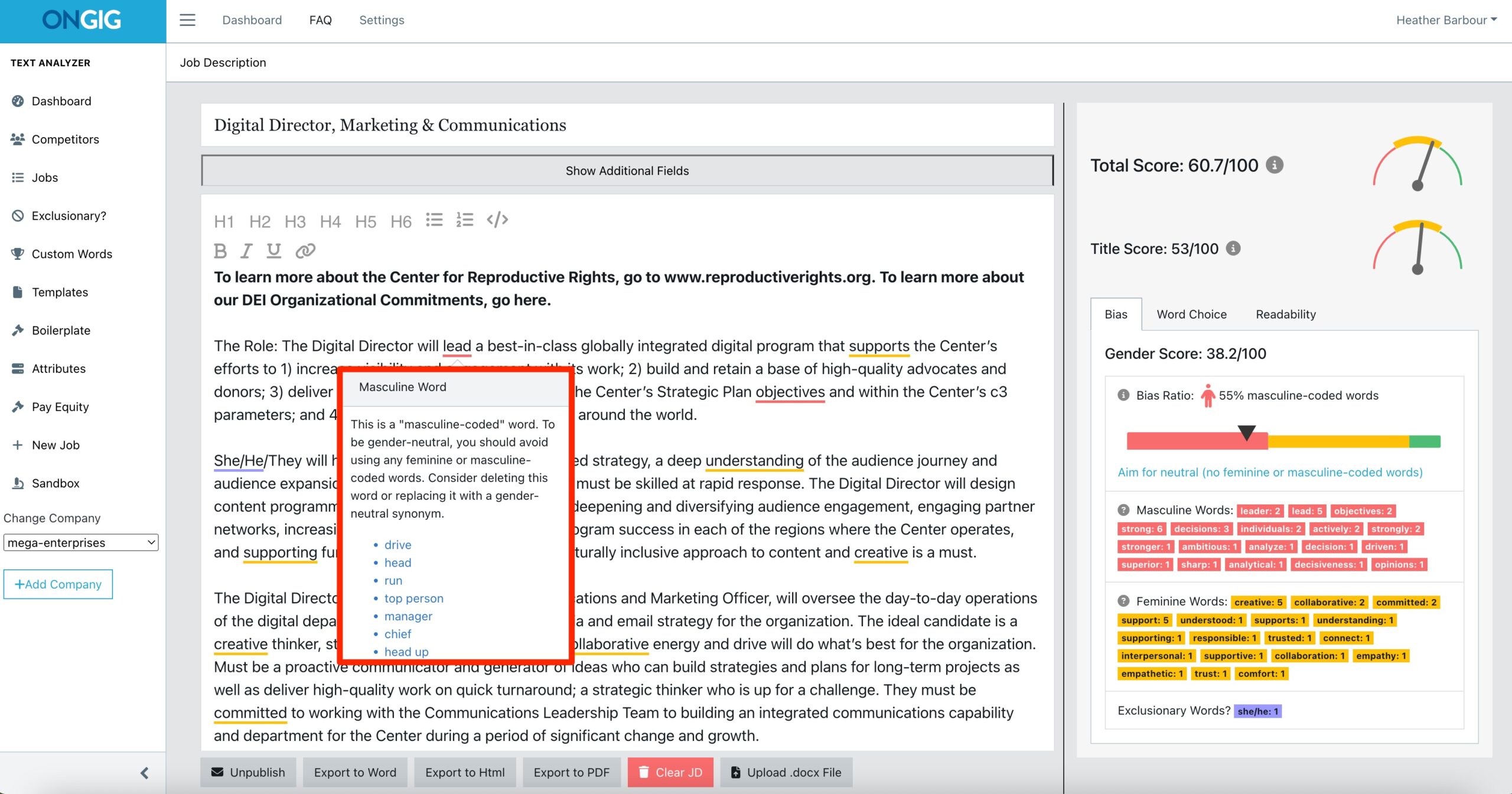
Top Masculine Biased Words in Job Descriptions (2026 Update)
Words keep shifting, however, so we track this data regularly. I pulled the numbers again. This time, I looked at swap data from Ongig’s Text Analyzer between January 1 and July 13, 2026, and here’s what showed up most.
Below is a count of how many times each word got flagged and swapped out during that stretch. Alternatives that still work well are listed alongside each one:
| Rank | Words | Times Swapped | Gender-Neutral Alternatives |
| 1 | strong | 42 | able, proven, exceptional, sound, steady, excellent, solid |
| 2 | lead | 26 | drive, head, run, chief, manage, steer, guide |
| 3 | independently | 13 | alone, exclusively, unaided, unsupervised |
| 4 | strengthen | 12 | build, reinforce, improve, develop, grow |
| 5 | competitive | 10 | attractive, fair, results-oriented, enthusiastic, comparative |
| 6 | leaders | 10 | managers, people, stars, pioneers, principals, mentors, top people |
| 7 | analyze | 9 | parse, examine, review, study, dissect, break down, research, evaluate |
| 8 | champion | 8 | support, advocate for, promote, back |
| 9 | analysis | 7 | investigation, study, test, testing, research, data |
| 10 | independent | 7 | self-directed, autonomous, self-sufficient |
You’ll notice some of the same “masculine wording” made the list again. Plus there are a few new masculine biased word choices in the lineup.
What Changed in the 2026 Data
As a result, a few things stand out this time around. Strong” and “lead” are repeat offenders. They show up nearly every year we run this. “Strengthen” and “champion,” though, are new to the list.
They’re common in leadership and strategy-heavy job ads. They’re both words that lean masculine biased in the research, even though they sound harmless on the surface.
“Objectives” and “decisions,” which made earlier lists, dropped off the top 10 this round. However, that doesn’t mean they’ve disappeared, just that other words are getting flagged more often right now.
Why This Matters for Your Job Ads
The Business Case for Gender-Neutral Language
For example, in late 2022, Ongig partnered with a global employment website. Together, we researched gendered language, other biased words, and how they affect application rates. The study revealed Ongig’s scoring is predictive of higher application rates across industries. Total apply starts increased by 13% and apply starts from female applicants boosted by 21%. This study proved the use of gender-sensitive language can help increase applies.
In a pilot of Ongig’s Text Analyzer, one firm wanted to tackle gender imbalance. Their industries, engineering and finance, are traditionally male-dominated. After updating the use of gender-biased words in their job ads, they saw a 22% increase in female applicants.
A Word on Nuance
Let me be very clear here. There are numerous women who are “strong” and great “leaders” and don’t need any softening of job description language. But, as a marketing cohort, there is data proving that women as a group will apply to jobs at a lower rate when certain masculine words are in the job posting.
This isn’t just an opinion. Data shows women, as a group, apply to jobs at a lower rate when certain masculine words appear in the posting. A study in the Journal of Personality and Social Psychology backs this up. The research is called Evidence That Gendered Wording in Job Advertisements Exists and Sustains Gender Inequality. It’s led by researchers Danielle Gaucher, Justin Friesen, and Aaron C. Kay of Duke University and the University of Waterloo.
In fact, Kat Matfield used this study to create a free tool, Gender Decoder, that flags words associated with a specific gender.
How to Put This Into Practice
In addition, try using the gender-neutral synonyms above for your job descriptions. That’ll go a long way towards eliminating masculine job descriptions/bias.
Want to automate this? Ongig flags masculine words in real-time. You’ll get a pop-up with gender-neutral synonyms, so you can click and replace easily.
For more tips on writing job descriptions, check out our How to Write a Job Description — Best Practices & Examples.
Note: We also did a breakdown of the 10 most used female-biased words if you want to see common words you can remove to create more gender neutral job ads.
And, here’s a list of 25 of the most-used exclusionary words. Check these out if you want more inclusive swaps when creating job adverts during your hiring process. They include acceptable replacements for non-binary people, people with disabilities, people of color, and many other underrepresented groups.
FAQs on Masculine Biased Words
1. What are the most common masculine biased words in job postings in 2026?
The top 10 are strong, lead, independently, strengthen, competitive, leaders, analyze, champion, analysis, and independent. This is based on Ongig’s Text Analyzer data from January to July 2026.
2. How does masculine language in job descriptions affect who applies?
Research shows women apply to jobs at a lower rate when postings are heavy with masculine biased language, even when they’re qualified. Ongig’s own data found that removing gender-biased words boosted total applies by 13% and female applies specifically by 21%.
3. Has the list of masculine biased words changed over time?
Yes. Words like “strong” and “lead” show up nearly every year Ongig runs this analysis, but new words emerge as hiring language shifts. “Strengthen” and “champion,” for example, are new entrants in the 2026 data.
4. What should I use instead of masculine biased words in job ads?
Swap them for neutral alternatives that mean the same thing. For instance, use “build” or “improve” instead of “strengthen,” or “support” or “advocate for” instead of “champion.” Ongig’s Text Analyzer flags these in real time and suggests gender-neutral synonyms.
Why I wrote this?
Ongig is on a mission to transform job descriptions. If you want to remove masculine biased words from your job descriptions, contact us for a demo. Thanks!
