I’ve read some job postings that gave me the “ick”. Like, actual secondhand embarrassment. That’s the feeling we’re talking about today.
I’ve seen some cringeworthy job postings that sound like a middle schooler trying to impress their cool cousin. Others just haven’t evolved since 1998. And the worst part? Candidates notice. They roll their eyes, they screenshot it, and they share it in group chats as a warning.
The Usual Suspects in Cringeworthy Job Postings
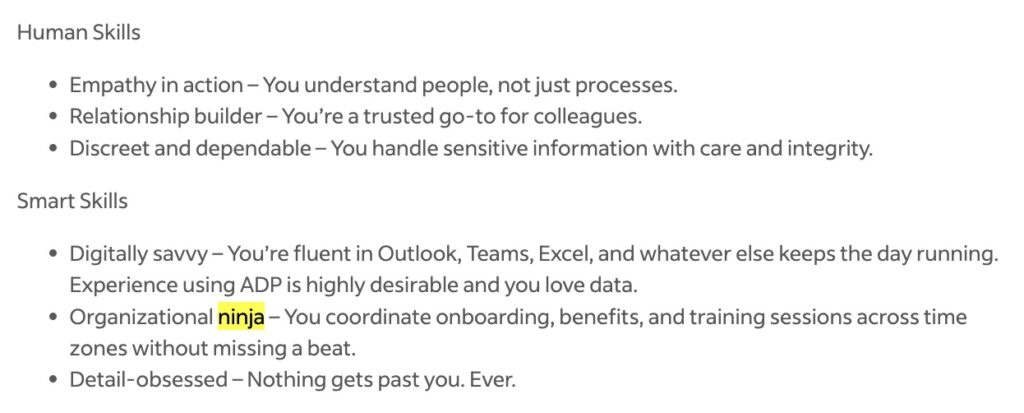
1. The “Rockstar/Ninja/Unicorn” Language
Still showing up. Still bad. When you say you’re looking for a “coding ninja” or “marketing rockstar,” you’re not making the job sound fun; you’re making it sound unserious. Worse, it’s alienating. It tells people you’re not really sure what you want, just that you want someone magical to fix it all. We wrote about how these and other buzzwords can hurt your JDs.
2. The “Must Thrive in a Fast-Paced Environment” Cliché
This one’s a red flag wrapped in beige. What does “fast-paced” mean? Tight deadlines? Unrealistic workloads? Constant fire drills? Be specific. Candidates aren’t allergic to challenge—they’re allergic to vagueness and burnout.
3. “Work Hard, Play Hard”…Just No
We get it, you have a ping pong table. This phrase is a relic. It usually signals a lack of boundaries or a culture that rewards overwork. Instead, talk about how your team supports balance, not burnout.
4. Gendered or Biased Language
Words like “aggressive,” “dominant,” or even “competitive” can skew male. On the flip side, words like “supportive” and “nurturing” can be coded as female. Neither is inherently bad, but together they shape who sees themselves in the role. This post shows you how can you be more gender-neutral in your job postings . Tools like Ongig help flag and fix this automatically.
5. “Must Have 10+ Years of Experience in a Tool That’s Only Been Around for 5”
This one’s more hilarious than cringey, but it still happens. When you reuse templates or don’t validate requirements, this kind of thing slips through. And it chips away at your credibility. Here’s how to fix your job requirements.
6. “Flexible Workplace”
What exactly is “workplace flexibility?” It seems like a term that has been abused in recent times as employers return to fully on-premise arrangements. It is important to explain what exactly a flexible workplace entails.
Instead of simply using the vague term “hybrid,” it is best to offer details, such as the expected number of days at the office and the number of remote work days. If applicable, mention synchronous and asynchronous hours to mentally prepare hires for their roles.
By explicitly stating these expectations, companies eliminate the potentially frustrating guesswork. This breeds trust and accountability, fostering a more harmonious workplace.
7. Keyword Stuffing
Keywords are strategic for improving the visibility of your JDs. But you know what they say about “having too much of a good thing.” An obviously keyword-stuffed JD would appear AI-generated or contrived to astute job seekers. They’re likely to skip the position altogether, thinking that it is a quick-fix attempt at filling a vacancy.
Instead, your JD should take a candidate-first approach. Focus on what is in it for the applicant, considering priorities such as career advancements (traditional promotions and lateral movements) and learning opportunities. It is great to include trending keywords, but a JD should ultimately speak to people and not a search engine algorithm.
A JD that sounds human has a higher chance of impressing (and converting) your target talent than one that ticks off the checkboxes of the top 40 industry keywords.
8. Culture Fit
It is quite ironic that seeking candidates who are a “culture fit” in your organization could actually turn them away instead. That’s because JDs with such messaging indirectly tell the candidate that your organization isn’t receptive of differences and uniqueness at the workplace.
A culture fit expectation could be particularly triggering for neurodivergent talent, who may interpret it as an instant deal breaker.
As such, explicitly stating the search for a culture fit or “someone who fits our vibe” should be avoided at all cost. Instead, consider hiring someone with a “culture add.” Hiring teams can frame it in a way that they’re constantly looking for people who can inject something fresh and innovative into the workplace.
Culture add welcomes individuals to freely express themselves and improve upon a system, while culture fit limits talent growth and expectations to proven methods—it seems pretty exclusionary in comparison!
9.Tricky Salary Ranges
Pay transparency is absolutely necessary when it comes to quality JDs and has become somewhat of a gold standard.
With a stated salary range, you’re telling hires that you value their invaluable time and effort. As such, most employers usually include a salary range within their JD layout.
But here’s the rub.
Extremely broad salary ranges (i.e., $60,000 – $100,000) in a job ad are as bad, if not worse, than a JD that omits pay details altogether. Expansive salary ranges are essentially filled with potential loopholes that threaten to underpay talent for their services.
Top hires could interpret these JDs as unprofessional and deceptive and avoid them like the plague.
So, if you’re attracting the best candidates, it’s best to keep salary spreads within 15-20% unless your JD explicitly explains the reason for the disparity. For instance, your company might allocate the highest salary tier of a managerial role to individuals with a proven track record of team leadership within the industry.
10. The “Bottomless Interview” Process
The buck doesn’t stop with salary ranges when it comes to transparency. Your candidate’s experience (CX) is everything when it comes to successfully hiring the best people for the job.
According to Forbes, half of companies lose star talent due to overly complex hiring processes such as broken interview stages.
Poor candidate experiences may include biased questions, lengthy rounds of interview, and punishing candidate assessments (i.e., conducting a full-fledged product presentation to an entire panel of senior managers by the second meeting).
But perhaps the biggest issue involves catching candidates by surprise. A quality JD should include a section that outlines the hiring road map.
These may include the number of interview stages and a company’s average response time. Such transparency within the JD lays out the expectations between companies and hires while empowering applicants to put their best foot forward.
What Cringeworthy Job Postings Cost You
Every one of these phrases and missteps makes your posting look less professional or just outdated. Candidates judge your culture based on your job ads. And good candidates? They scroll right past.
It also hurts inclusion. For example, Harvard Business School research found that vague job ads caused qualified women to apply 25% less often than men—but when the job requirements were made specific, women applied even more often than men.
Canva’s analysis of job postings also found that jargon-heavy language turns off younger and underrepresented talent. And research from the University of Florida shows that too much jargon in workplace messaging hurts clarity and trust—especially among early-career professionals.
Here are some great examples of inclusive job descriptions that make a difference: https://blog.ongig.com/diversity-and-inclusion/inclusive-job-descriptions/
How to De-Cringe Your Job Postings
Start with Real Language
Write like a human. Be specific. If the job has tight deadlines, say that. If collaboration is key, describe what that looks like. Use structured JD templates to help.
Review for Bias
Use tech (like Ongig) or a peer review process to spot gender-coded words or overused corporate jargon. It makes a difference.
Keep It Updated
If you’re copying and pasting JDs from 2017, stop. Review them quarterly, especially for high-volume roles. Job markets evolve, and your content should too.
Test with Real People
Send your JD to someone outside your department and ask: “Would you apply to this? Does anything sound off?” Fresh eyes catch cringe.
Opt for an Outcome-Based JD
Instead of unloading a laundry list of expectations on new hires, consider reframing the hiring process. You could do this by defining what success looks like during the first 90 days at the company. This creates a sense of purpose and gives hires a reason to commit.
What Good Looks Like
A great JD is clear, inclusive, and specific. It sets expectations without puffery. It respects the candidate’s time. And it reflects your brand—not your ATS’s default template.
The next time you post a job, read it out loud. If you cringe, your candidates will too.
Why I Wrote This
I wrote this because job postings are often a candidate’s first impression of your company. A cringeworthy one drives great people away. Ongig’s software helps clean up the language, structure, and formatting of job descriptions so they actually do their job: attract top talent. Request a demo if you’re ready to stop the scroll and start converting candidates.
FAQs
What makes a job posting cringeworthy?
Overused buzzwords, unrealistic requirements, or outdated slang make postings feel inauthentic or unprofessional.
How do I know if my job postings are outdated?
If you’re using phrases like “rockstar” or templates older than your phone, it’s time for a refresh.
Does job posting language affect inclusion?
Yes. Biased or vague language can discourage diverse talent from applying. Inclusive wording expands your reach.
What about my JD sections? Do they matter?
Yes, as mentioned regarding salary range, your candidates’ responses are shaped by what’s available in the JD. Key sections like salary range, benefits, and about the company are essential, as well as the order that you list them. Focus on what’s in for your hire before moving on to describe your company’s values, vision, and mission. Doing so keeps applicants invested in the role. Consider it a hook.
Can software really fix this?
Absolutely. Ongig flags problematic language, suggests improvements, and helps keep your postings on-brand and bias-free.
Should I depend on AI for JD creation?
Absolutely not. AI is a powerful tool that helps reduce common errors (such as subconscious biases or poor readability) that may pass unnoticed. However, for the best JD outcomes, always run generated JDs through your TA team for a final vibe check before publication.
Is it okay to be funny or casual in job postings?
Yes—if it aligns with your culture and doesn’t come off as forced. Avoid trying too hard. Clarity over cleverness.
What else should I note for JDs?
Skill-based hiring could be a game-changer, especially during challenging job markets with worrying talent gaps. So you might want to reword your JDs accordingly.
TA teams could work closely with HR to separate the “nice-to-haves” from the requirements. Degrees and rigid academic qualifications could be hurting your talent pipeline. Plus, they’re not surefire indicators of workplace performance.
