Employees are one of the biggest assets in your company. That’s why the best career sites feature an employee testimonials section that showcases the genuine sentiment of their team.
Did you know:
“Candidates trust the company’s employees 3x more than the company to provide credible information on what it’s like to work there.” – Career Arc
Employee reviews are social proof that helps persuade others who trust your employees more than you.
What type of employee testimonials work best?
According to Indeed, there are three main categories of testimonials that effectively reflect your company’s culture:
- Article Testimonials – These showcase your employee’s journey in the organization. For instance, an employee might share the challenges of juggling parenting duties while at work and the type of organizational support received during these scenarios.
- Journey Testimonials – Such testimonials focus on the career growth of employees, documenting their initial positions and the rise through the ranks. These would prove effective for jobseekers who prioritize long-term advancement and professional development within a company.
- Interview Testimonials – A compilation of employee interviews on a series of standardized questions on their top company moments, learning experiences, and preferred staff benefits.
The most effective testimonials often allude to the following points to drive an enticing company narrative.
Company values
Potential hires want to know what your company stands for, beyond the words in your mission and vision. As such, employee testimonials that highlight your core company values can motivate and attract talent.
Employees showing how these values are part of their daily work life can show job seekers that your company isn’t just talking the talk but walking the walk.
Diversity and inclusion
Diversity and inclusion are important to many job seekers. According to a survey from Glassdoor, 76% of respondents say that a diverse workforce is an important factor when evaluating companies and job offers.
Testimonials that showcase your commitment to a diverse and inclusive workplace can attract a broader range of talent. Employees talking about how they feel respected and valued, regardless of their background, can reassure potential hires that your company is a place where everyone can thrive.
Answers to “why” people want to work there
Why do people choose to work at your company? This question is on the minds of many job seekers.
Testimonials that answer this can be incredibly persuasive. When employees share their reasons—whether it’s the exciting projects, growth opportunities, or the positive impact they can make—it helps paint a clear picture of why your company is a great place to work.
Company culture
35% of job seekers say that they will pass on a job offer if the company culture is a bad fit. That’s how big of a deal your company culture is to job seekers.
Testimonials that highlight what it’s like to be part of your team, how employees interact, and what the day-to-day atmosphere is like can be very appealing.
Employees sharing their personal experiences with team collaboration, work-life balance, and office traditions can give a real sense of what it’s like to work at your company.
Employee testimonials
Straightforward employee testimonials are still highly effective.
These testimonials allow employees to speak about their experiences in their own words. Whether it’s about career development, the support they receive from management, or simply why they enjoy their job, these personal stories can be compelling.
Answers to “why” people stay here
Understanding why employees choose to stay at a company can be just as important as why they joined.
Testimonials that focus on employee retention can highlight the benefits of long-term employment with your company. Whether it’s job satisfaction, career growth, or a sense of belonging, hearing why current employees stay can help convince others to join.
7 Examples of Employee Testimonials
Here are 7 examples of powerful employee testimonial pages curated from various career sites:
Delaware North
Source: https://careers.delawarenorth.com/
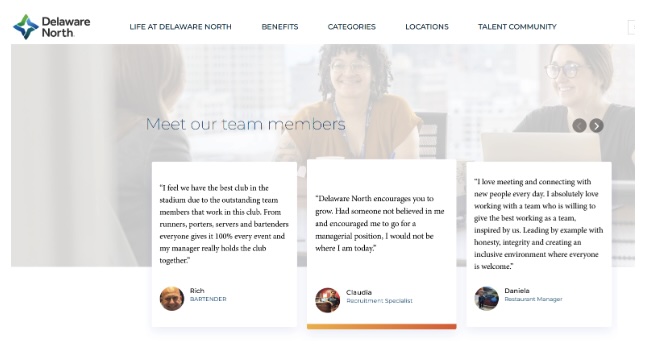
Delaware North’s career site clinched first place in the 2025 Rally ® Awards for their unified global career site. The company’s website layout featured targeted messaging, including an employee testimonial carousel with a broad range of positive perspectives. These employee narratives present the company as a reliable and encouraging space for growth and development.
EbizCharge
Source: https://ebizcharge.com/careers/
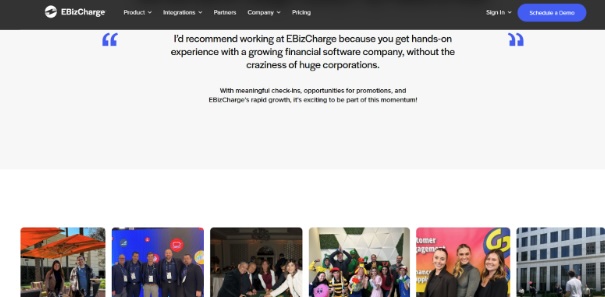
Payment processing solution EbizCharge’s dynamic careers page features detailed feedback on company experiences, and perhaps more importantly, visual proof of employee involvement and their satisfactory expressions. These images are testament that in most cases of social proof, it is more impactful to show than tell.
Xylos
Source: https://xylos.com/jobs/#Employee-stories
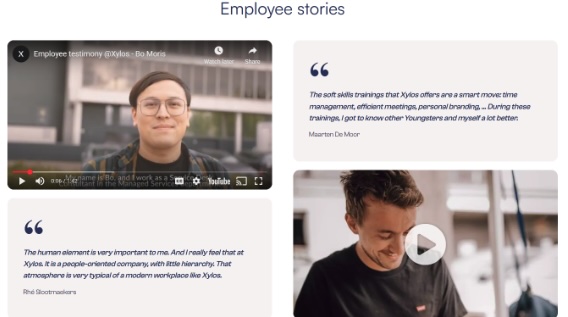
Tailored IT solutions company Xylos cleverly combines written and video-based employee testimonials to present an inspirational and consistent organizational story. Video testimonials on the site conveyed with real human emotions and expression speak of an inclusive culture where employees can comfortanbly share a cohesive workspace with the CEO.
Wise
Source: https://wise.jobs/
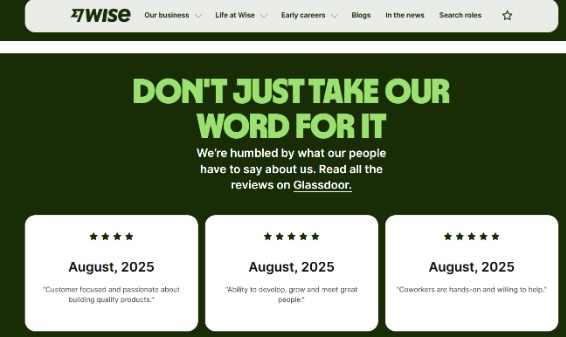
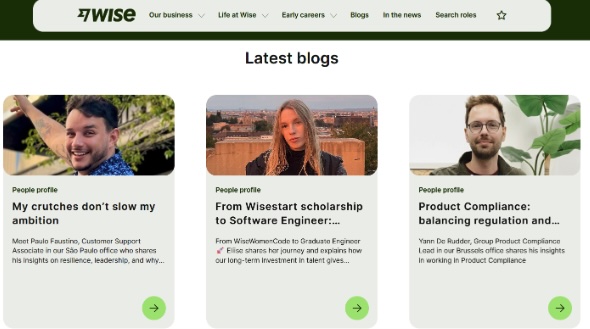
Fintech giant Wise’s career page strategically features Glassdoor ratings and inspiring people profiles in their blog section that place the trials and triumphs of employees in the spotlight.
Canva
Source: https://www.lifeatcanva.com/en/
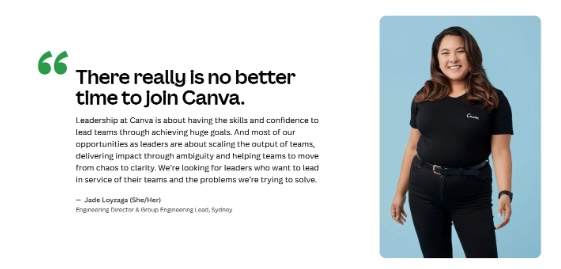
Canva’s testimonials add a winning touch to the overall delivery: friendly smiles to the faces behind each testimonial. Research for the Harvard Business Review reveals that a simple smile can promote trust and increase demand in marketing, a strategy that you can tactfully incorporate into your employee testimonials for improved responses.
Hubspot
Source: https://www.hubspot.com/careers
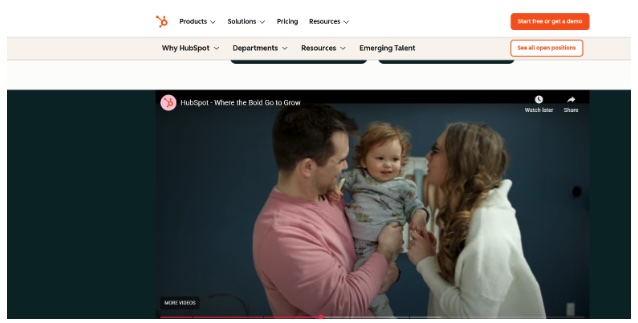
Hubspot collates wove diverse employee testimonials in a single visual montage. The dynamic footage includes employees sharing the plentiful growth opportunities within the company. These include warm and encouraging videos of a parent-employee sharing the screen with her young family.
Spectrum
Source: https://app.altrulabs.com/spectrum/feed
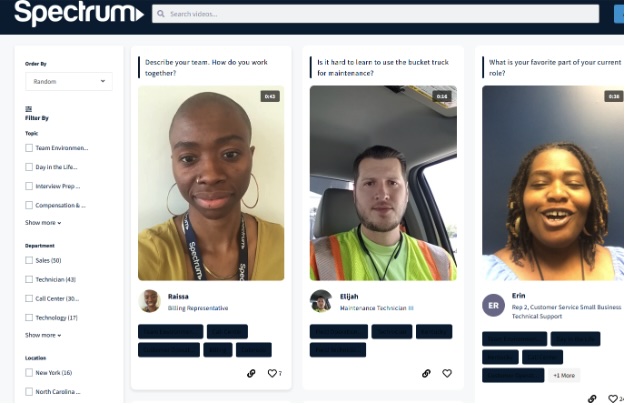
Connectivity solutions company Spectrum provides a fresh and engaging approach to employee testimonials via a social-media style format. The subject headlines, tags, shareability, and ‘like’ widgets make the viewing process seamless and almost instinctive for job seekers in the digital age.
-
How to Collect Employee Testimonials
Gathering employee testimonials doesn’t have to be complicated. Here’s how you can do it effectively:
Surveying Employees
One of the easiest ways to collect testimonials is through surveys. Here are some actionable tips to enhance your surveys:
- Create simple questions. Use straightforward questions that employees can answer quickly in your survey. For instance, ask questions like, “What do you enjoy most about working here?” or “How has the company supported your growth?”
- Keep it anonymous (if possible). The truth is, sometimes if you want honest feedback, consider allowing employees to respond to your survey anonymously. Sure, doing so might invokes brutal honesty unbecoming of testimonials. But these also provide the much-needed comfort to share undisguised thoughts in a way that puts your company in a good light.
- Distribute the survey widely. Send the survey to all employees, or target specific teams if you want testimonials from certain departments. Leveraging tools like Google Forms or SurveyMonkey makes the process fuss-free and scalable.
One-on-One Interviews
Surveys are great. But if you want more in-depth testimonials, conduct one-on-one interviews. Use the following tips to carry this out.
- Choose the right employees. Select employees who have been with the company for a while or who have unique experiences to share.
- Prepare open-ended questions. Ask questions that allow employees to share detailed stories, such as “Can you describe a project that made you feel proud?” or “What makes you excited to come to work each day?”
- Make the interview session comfortable. Choose a relaxed setting, like a quiet conference room or even a virtual meeting if you’re working remotely. The more comfortable the employee feels, the more genuine their responses will be.
- With their permission, record the conversation so you can capture their words accurately. You can use these recordings for written testimonials or even turn them into video content.
Utilizing exit interviews
If an employee is leaving on good terms, you shouldn’t forget to do an exit interviews to get testimonials.
- During the exit interview, ask the employee to share what they enjoyed most about working at the company. Questions like “What will you miss the most?” or “What were the highlights of your time here?” can yield valuable insights.
- If the employee is leaving due to negative reasons, be respectful and avoid pressing for a testimonial. Focus on those who have had a positive experience.
- Always ask for permission to use their responses as a testimonial, even if they’re leaving. Some might be happy to leave on a positive note and share their good experiences.
Best practices for creating employee testimonials
If you want to get started with creating employee testimonials for your company’s career page, here are some best practices you should follow.
Encouraging participation
Getting employees to share their stories can be tricky, but it is an important step if you want to create genuine testimonials. Use the following tips:
- Make it voluntary. Let employees choose to participate. Don’t pressure anyone into telling their story.
- Highlights the benefits of participation. Explain to the employees how their testimonials can help attract coworkers and improve the company culture.
- Create a comfortable environment. Ensure employees feel at ease. Offer a relaxed setting for interviews or recording sessions.
Crafting effective questions
The right questions can lead to the best testimonials. Here’s how to ask questions that make your testimonials engaging.
- Keep it simple. Use straightforward questions. Avoid jargon or complicated words.
- Focus on experience. Ask about specific projects, challenges, and achievements.
- Seek personal insights. Encourage employees to share what they love about their job and the company.
Here are some employee testimonial questions you could ask your employees for engaging testimonials:
- What do you enjoy most about working here?
- Can you share a memorable project you’ve worked on?
- How has the company helped you grow professionally?
Editing and approval process
Testimonials should look authentic or there’s little point in creating them. Inauthentic testimonials risks sounding flat to talent interested in your company’s culture. This might cause them to abandon their job applications entirely.
Here are some ways you can prevent this:
- Respect the original message. Make sure every edit doesn’t alter the employee’s original message.
- Ensure clarity. But make sure to keep the natural tone of the speaker. You wouldn’t want your testimonial to seem scripted.
- Get approval. Always let employees review and approve the final version of their testimonial before it is published.
Why I wrote this:
The types of content on your career site impact how candidates perceive your company, workplace and values. Ongig gives employers the ability to add employee testimonials and many other types of recruiting content with our Career Site Builder.
