You need someone who understands a highly specific market and can get up to speed quickly.
The problem? The people you want to hire may never have heard of your company. And even if they find your job post, “great culture” and “exciting work” won’t tell them much about the role.
That’s why strategic employer branding is a must if you want to attract the specialists you need. A strong employer brand helps candidates see what your team works on, why it matters, and what they could gain by joining.
You don’t need a huge budget or a household name to do it well. In this guide, I’ll show you how to build an employer brand around the people and work you already have, and carry that message into your hiring content. Consider using this guide as a checklist. It walks you through the basics so you can start building your employer brand today!
What is employer branding?
Employer branding is how a company presents and earns its reputation as a place to work. It includes what employees say about their experience, what candidates see on your careers page, and what your job descriptions promise.
Why does employer branding matter when you hire for specialized roles?
When only a small group of people can fill a role, every good candidate counts. You can’t afford to lose them because they don’t get what you do.
Here’s what a strong employer brand does for you:
- Attract relevant candidates: Specialists notice roles that speak their language. A clear employer brand shows people with the right skills that the role is worth a closer look.
- Give candidates a reason to consider a lesser-known company: If nobody’s heard of you, “competitive salary and great culture” won’t cut it. An employer brand shows them what they’d work on, who they’d work with, and the difference they could make.
- Set clear expectations: A small team feels every bad hire. When you’re upfront about the role, the pace, and the team, candidates can decide whether it’s a fit before they apply. (And you can avoid an awkward conversation three months in.)
How to build an employer brand that attracts specialized candidates (as a small B2B company)
With the basics out of the way, here’s how to build an employer brand that attracts specialized candidates as a small B2B company, step by step:
1. Ask your team why they joined and why they stay
Start by talking with your employees to learn what drew them to your company, what they enjoy about the work, and what surprised them after joining. Send out an anonymous survey and meet as a group to chat more informally. You’ll learn valuable information from both methods.
Then, analyze your team’s answers. Look for themes that come up more than once and that you can support with real examples. For instance:
- If people mention a pleasant surprise, like less red tape than they expected, ask what that looks like day to day. (E.g., maybe it’s getting a new tool approved in an afternoon instead of a quarter.)
- If several people say they joined for the ownership, find a specific project someone led in their first few months and the decisions they made along the way.
- If “I learn a lot from the people here” keeps coming up, note who mentored whom and what skill or knowledge got passed on.
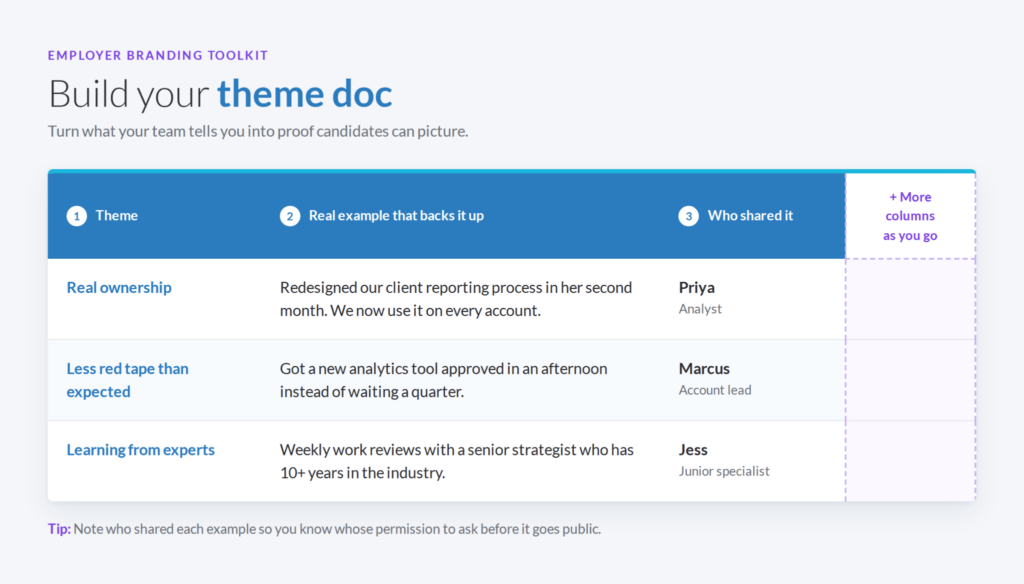
These examples will become the raw material for your careers page and job descriptions later, so keep them somewhere you can easily access them. I use a simple Google Doc table I call my “theme doc.” Copy mine. Start with three columns: the theme, the real example that backs it up, and who shared it, so you know whose permission to ask before it goes public.
Here’s a visual example of what that looks like:
(Image provided by Ioana)
Theme Doc
The theme doc example shows three columns to help employers build an employer branding toolkit.
P.S. You’ll add a couple more columns as you go through the rest of the steps.
2. Define what makes the work appealing to your target candidates
Connect what you learned to the roles you need to fill. Make sure to choose the strongest points you can honestly promise.
According to LinkedIn’s 2025 research, compensation, work-life balance, and flexible arrangements remain candidates’ leading priorities. Interest in shared company values and inclusive workplaces is also growing, while leadership preferences vary across job functions.
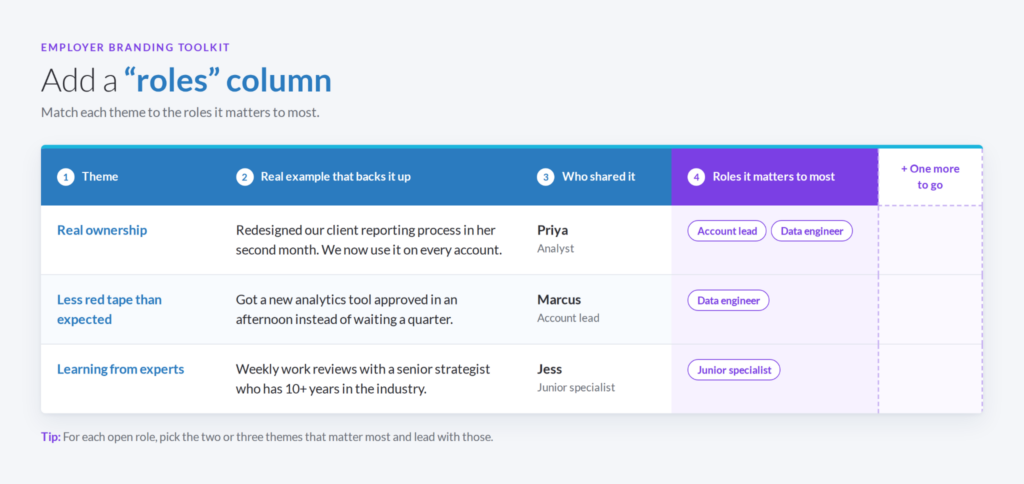
So cover the basics, then lead with what’s specific to the role. Add a fourth column to your theme doc for the roles each theme matters to most, then pick the top two or three for every open position.
Here’s what that looks like:
(Image provided by Ioana)
Theme Doc
The theme doc example shows four columns to help employers build an employer branding toolkit.
For instance:
- Hiring a junior specialist? Lead with the people they’d learn from, like weekly work reviews with a senior teammate who’s been in the industry for a decade.
- Hiring an account lead? Lead with the calls they’d get to make, like owning client relationships from day one instead of shadowing someone for a year.
- Hiring a data engineer? Lead with the problems they’d solve, like rebuilding a messy data pipeline that’s slowing down the whole team.
Before you commit to a point, run a quick gut check. If someone already in that role read it, would they nod along? If they’d roll their eyes, cut it.
3. Prove your claims with real examples
Replace broad statements with details candidates can picture. This is where the examples in your theme doc pay off. For instance:
Instead of “You’ll have real ownership,” try “In her second month, our newest analyst redesigned our client reporting process, and we now use it on every account.”
Instead of “We’re a collaborative team,” try “Every Friday, our strategists and engineers review one live project together and agree on what to change before it ships.”
If professional growth is part of your pitch, make the investment visible. “Room to grow” could mean budget and time to attend executive education programs, plus a chance to lead a new initiative. Tell candidates what support they’d receive and what they’d be able to do with it.
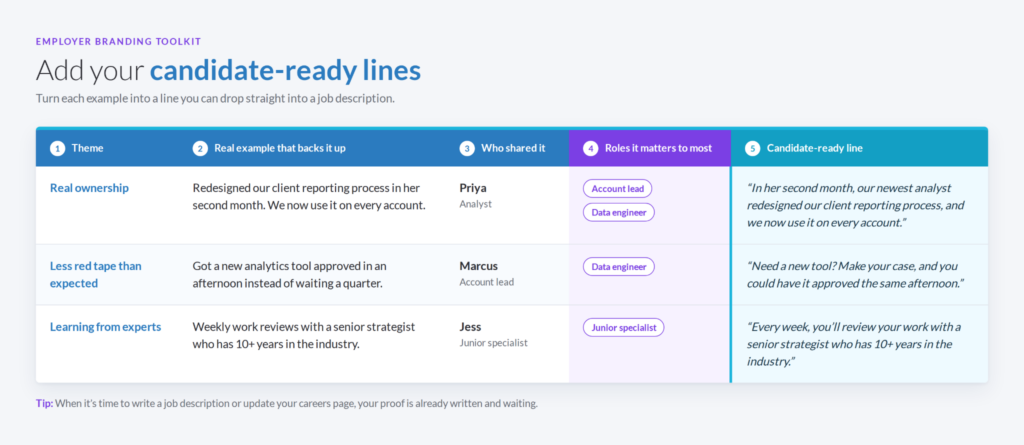
Add a fifth column to your theme doc for all of these candidate-ready lines. That way, when it’s time to write a job description or update your careers page (see below), your proof is already written and waiting.
(Image provided by Ioana)
Theme Doc
Theme doc example shows five columns to help employers build an employer branding toolkit.
4. Put your message into your careers page, job descriptions, and hiring materials
Now it’s time to take those candidate-ready lines from your theme doc and put them where candidates will see them.
Make it easy for candidates to see what the company does, what the role involves, and why the work matters. Use the same core message across all of your hiring materials, but tailor each job description to the actual team and role.
If your company markets itself as a specialist, your hiring materials should show that same expertise. Say you offer HVAC marketing services and your website speaks directly to the challenges HVAC businesses face. If your job ad only says “join our fast-paced, innovative team,” candidates won’t learn what they’d actually do.
Instead, try something like: “You’ll build campaigns around HVAC businesses’ busy seasons, helping clients keep technicians booked when demand spikes and dips.” Now a candidate can picture the work and see why their industry knowledge matters.
The same goes for healthcare tech. A candidate eyeing roles at the best remote patient monitoring companies wants more than “you’ll help improve patient care.”
What does the product help clinicians do? Which part of that work would the new hire own? A line like “You’ll own the alert workflow that tells care teams which patients need a check-in today” answers both questions at once.
5. Share employee stories where candidates will see them
Remember that “who shared it” column in your theme doc? This is where it comes in. Ask those employees whether you can feature their stories, then give them room to describe their work in their own words.
Here are some easy formats:
- A quote pulled straight into the job description for the role they know best
- A 60-second video of them explaining what a typical work week looks like
- A short Q&A on your careers page about a project they’re proud of
Share these on your careers page and company LinkedIn page, and send them to candidates before interviews so they already have a feel for the team.
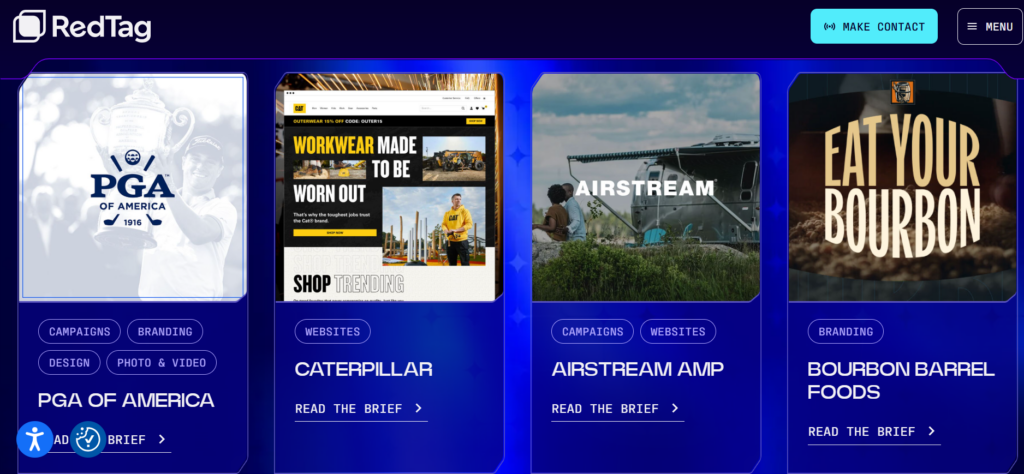
Your client work can also be part of your employer brand. Take a marketing agency in Louisville like RedTag Digital. When prospective hires can browse the projects the team produces and the clients it works with, they get a real sense of the work, the standards, and who they’d be making it for.
Projects
Examples of showing off team projects on a home page.
That can tell candidates more about what it’s like to work there than any careers page copy, without requiring additional content.
6. Check whether you’re attracting the right applicants
Your employer brand is working when the right people apply for the right reasons.
The easiest way to find out? Ask.
In your first interview with each candidate, ask two quick questions:
- “What made you apply?”
- “Where did you first hear about us?”
Then look for patterns:
If candidates keep mentioning a specific employee story or project, that theme is landing. Use it in more of your job descriptions.
If candidates rarely mention your role-specific examples, those details may be easy to miss. Move your strongest proof points higher up in the job ad.
If you’re getting generalists when you need specialists, your message is probably too broad. Add details only a specialist would care about, like the tools they’d use, the clients they’d support, or the problems they’d solve.
Jot down what candidates say next to the matching themes in your doc, and review it every few hires. The themes that keep coming up are working. The ones nobody mentions may need a rewrite or a full cut.
Wrap up on employer branding for niche B2B companies
A small team doesn’t need a huge employer branding campaign to attract specialized talent.
Start by asking employees why they joined and why they stay, then jot down the themes and real examples in your theme doc.
Turn those examples into specific, candidate-ready proof for your careers page, job descriptions, and LinkedIn page, featuring employees’ stories with their permission. Then ask new applicants what caught their attention, and keep refining whatever isn’t landing.
P.S. Want your job descriptions to reflect what makes your team worth joining? Ongig can help you write and manage them across your open roles. Request a demo to try Ongig now.
FAQs about employer branding for niche B2B companies
What is employer branding for small B2B companies?
Employer branding for small B2B companies is how a niche business shows candidates what it’s like to work there. Think careers page, job descriptions, and employee stories that make specialized roles easy to understand.
How can a small B2B company compete with bigger employers for specialized talent?
A small B2B company can compete with bigger employers for specialized talent by selling what big companies often can’t: real ownership, expert teammates, and direct access to leadership. Be upfront about pay, then prove the rest with real examples.
How do you know if your employer brand is working?
You know your employer brand is working when the right people apply for the right reasons. Ask candidates what caught their attention. If they mention your stories and themes, it’s landing. If not, rewrite.
Read this next: 72% Can’t Find the Right Talent: Why Hiring More People Won’t Fix Every Project Bottleneck.
Author Bio:

Ioana Wilkinson
Ioana Wilkinson is a business strategist and content writer for B2B tech and SaaS brands. She also helps aspiring entrepreneurs and writers build remote businesses. Born in Transylvania and raised in Texas, Ioana has been living the digital nomad life since 2016. When she’s not writing, you can catch her snorkeling, exploring, or enjoying a café con leche in Barcelona!
