Quick Summary
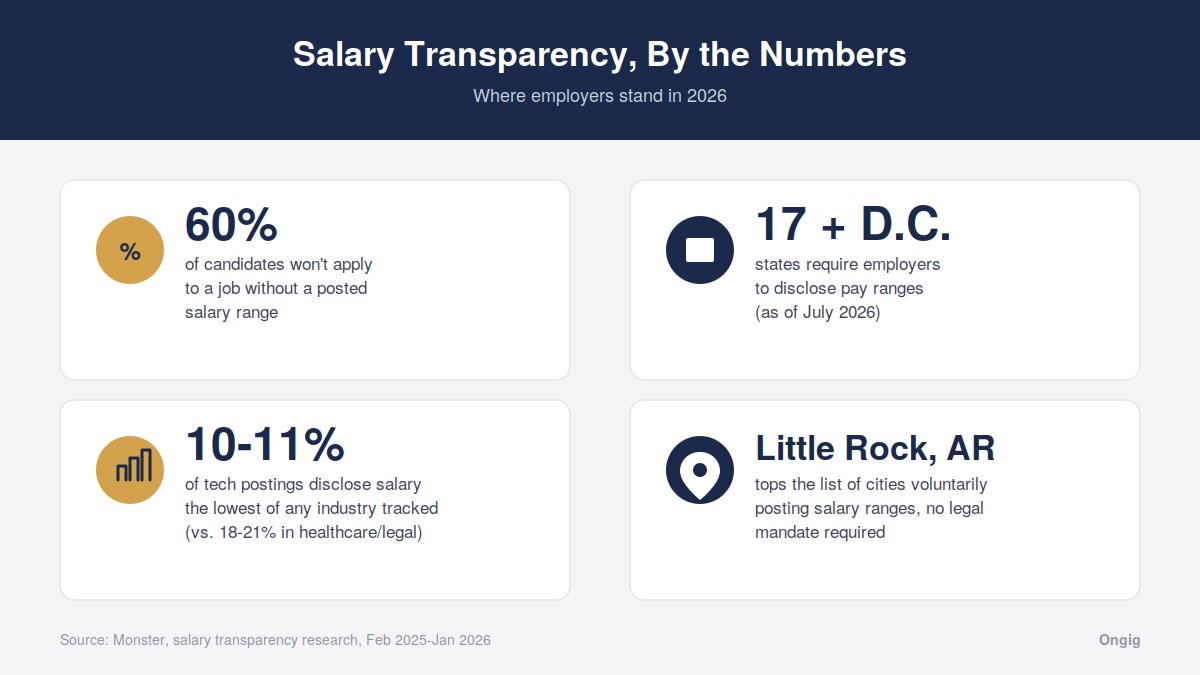
Salary transparency has moved from trend to expectation. 60% of candidates won’t apply without a posted range, and 17 states plus D.C. now require disclosure. Yet even the most transparent industries barely clear 20%, and tech lags at just 10-11%. This piece breaks down where transparency is actually happening, why employers still resist it, and how to keep pace at scale.
Salary transparency isn’t a nice-to-have anymore. It’s the baseline.
Monster’s latest report found that 60% of U.S. workers won’t apply to a job without a listed salary range. Candidates are filtering out blind postings before they even open them. The ones who do apply are already qualified and already know the range works for them.
This isn’t just a candidate expectation anymore, either. In fact, it’s compliance. As of July 2026, 17 states plus D.C. require employers to disclose pay ranges. Requirements vary by state, but the direction doesn’t. Hiding the number isn’t a strategy anymore. It’s a risk.
Why Employers are Resisting Salary Transparency (and Why It’s Losing Ground)
Employers holding out on salary transparency aren’t being unreasonable. They’re just behind.
Monster’s Career Expert Vicki Salemi gets right to it. Employers, she says, worry that publishing salary ranges “may limit their flexibility during salary negotiations.” They also worry it “could give competitors insight into their comp packages.” Fair concerns. Outdated ones.
However, the real hesitation shows up when internal pay isn’t consistent. She says, “Employees may feel shortchanged if they see ranges above what they’re getting paid for a job they’ve done for years.” That’s not a transparency problem. That’s a pay problem transparency just made visible.
And in states without a mandate? Meanwhile, salaries aren’t posted because they’re not a priority.
Salary Transparency Statistics: Where It’s Happening and Where It Isn’t
Top 10 Cities for Salary Transparency
(voluntary adoption only — excludes states with active pay transparency laws)
- Little Rock, AR
- Virginia Beach, VA
- Topeka, KS
- Harrisburg, PA
- Salt Lake City, UT
- Fort Lauderdale, FL
- Lincoln, NE
- Jacksonville, FL
- Tallahassee, FL
- Jackson, MS
Source: Monster analyzed postings across the 150 largest US metros, based on data collected February 2025–January 2026.
Tech postings disclose salary just 10-11% of the time. That trails behind healthcare and legal, where the rate is still only around 18-21%. Even in the most transparent industries, roughly 4 out of 5 job postings still leave pay out entirely.
The Internal Fear Recruiters Actually Need to Solve
Call it fear of fines or just fear of the work involved. Either way, the resistance holds up. Auditing comp and fixing gaps is real effort. So is defending an underpaid role once regulators or candidates start asking questions. Employers aren’t avoiding one hard problem. They’re choosing which hard problem to have.
Salemi doesn’t let leadership off the hook on this one: “Salary transparency doesn’t create inequities. Instead, it shines a spotlight on them.”
If leadership is worried about what it’ll reveal, her advice is straightforward: audit internal comp and make underpaid employees whole. She says, “Compensation should be fair, competitive, and based on objective criteria.”
The Range Nobody Sees: Why the Same Job Pays Differently Everywhere
There’s a quieter version of the transparency problem. It doesn’t show up in Monster’s data because it isn’t about withholding a range. It’s about who the range actually applies to.
It shows up most clearly with remote hiring. A qualified developer in Manila or Bangalore can do the same work as a developer in San Francisco. At a fraction of the cost. Both candidates might accept an offer that looks fair to them individually. Yet they’d be sitting nowhere near the same number. Neither one is being underpaid by their own market’s standard. But once hiring goes remote, “the market” isn’t one thing anymore. A single posted range can’t hold two very different realities at once.
How well-funded or mature the company is complicates it further, and it’s not subtle. Same-title roles at a company like Google routinely pay double what an identical title pays at a funded startup. The gap is almost entirely in equity. A startup can offer a hefty paycheck, or a stringent one, depending on funding. Well-established tech leaders, on the other hand, can afford to poach top-notch candidates outright.
Salary history bans exist partly to close a version of this gap. They stop employers from anchoring a new offer to what someone made last time. Instead of what the role is worth now.
But those laws only address history. They don’t touch geography. And they don’t touch how well-funded a company is when it’s paying for the exact same seat.
A posted range makes the floor visible. It doesn’t make the negotiation disappear.
3 Steps for Employers Adopting Voluntary Pay Transparency
Salemi’s first step for employers: establish consistent salary bands based on market data and internal equity. This keeps ranges accurate and current. Everything else depends on getting this right.
- Start with the range, not the guesswork. Salary bands should come from market data and internal equity, not instinct. A range built on stale or inconsistent data undermines the transparency it’s supposed to support.
- Remember the posted number is a range, not a figure. So during the interview, you can negotiate toward the lower, middle, or higher end. It depends on the experience of the candidate and the demands of the position. That’s expected. Still, it’s not a transparency failure. The real risk is a hiring manager working from expectations that no longer match the posted range at all.
- Once you commit, commit everywhere. In practice, this tends to be all or nothing. If a company decides to post, all of their job posts have salary details on them. That’s true regardless of whether it’s entry level or executive and C-suite. The harder part isn’t deciding to be consistent. It’s staying consistent once the job board scales past a handful of postings.
How to Make Pay Transparency Scale Without Manual Review
A posted range solves the visibility problem. It doesn’t solve the consistency problem. That’s the harder one once a job board grows past a handful of postings.
This is where most teams hit a wall. Salary ranges get set correctly once, then drift. A recruiter updates one posting and forgets three others. A range that was accurate in January is stale by June. Multiply that across states, remote roles, and dozens of people publishing job descriptions independently. As a result, “we have a policy” stops being the same thing as “we’re compliant.”
On gig’s Text Analyzer handles the part that doesn’t scale manually:
- scans every job description for missing or outdated salary information
- flags non-compliant postings by location
- pushes range updates across every posting in one step instead of editing each one by hand
We’ve written in more depth about what that compliance workflow actually looks like if you want the full breakdown.
But consistency isn’t only a compliance question. It’s a candidate-quality one too. A posted range doesn’t just keep you compliant. It filters your pipeline toward people who were actually going to accept the offer. We tested this directly in a mini experiment on salary range visibility. Posting a range consistently didn’t just bring in more applicants. It brought in better-aligned ones.
That’s the real case for solving this at scale. Not just staying out of legal trouble. Building a pipeline that isn’t wasting anyone’s time.
The Bottom Line on Salary Transparency in 2026
States are catching up. So is the rest of the world. The EU Pay Transparency Directive is doing this at a regional level. Individual states have been doing the same, one law at a time.
The choice left is simple: build a compensation framework that’s transparent for new hires and current employees. Or keep hiding pay behind the interview and offer stage. The first option isn’t just compliant. In fact, it’s becoming an expectation.
If you’re hiring at scale, staying compliant and consistent across every posting isn’t a manual job anymore. Schedule a demo to see how On gig keeps your job postings pay-transparent and compliant, without the manual review.
FAQs on Salary Transparency
1. Why do some employers still avoid listing salary ranges?
Common concerns include losing flexibility in negotiations and revealing competitive information about pay strategy. Others worry about exposing inconsistencies in what current employees are paid. Monster’s Vicki Salemi notes that in states without a legal mandate, transparency often just isn’t prioritized. Nothing forces the issue.
2. Which industries and cities lead in voluntary salary transparency?
Mid-size markets without legal mandates, like Little Rock, Virginia Beach, and Topeka, rank among the highest for voluntary disclosure. They often do it to compete with larger metros for talent. By category, tech postings disclose salary just 10-11% of the time. That trails healthcare and legal roles, which still only reach around 18-21%.
3. How can employers keep salary ranges accurate across hundreds of job postings?
Manually updating ranges across every posting, location, and job board doesn’t scale. Ranges drift out of date as fast as recruiters can track them by hand. Tools like On gig’s Text Analyzer flag missing or outdated salary information automatically. They push updates across all postings in one step.
