Quick Summary
We used to rank feminine-biased words by how often they showed up in random job postings. This year, though, we tried something different instead: we looked at the words our own clients actually swapped out inside Text Analyzer, from January to mid-July 2026. The clear winner is the “collaborate” family (collaboration, collaborate, collaborative, collaborates), followed by “understand” and “support.” However, one word that’s shown up on this list since 2019, “committed,” didn’t make the cut this time.
2026 Update: The Feminine-Biased Words Our Clients Are Actually Swapping Out
Feminine-biased words in job descriptions keep shifting. So does our data.
So for this update, we did something different.
First, back in 2019 and 2024, we scanned a huge batch of random job postings and counted which feminine-biased words showed up most.
This time, though, we looked at something better: the words our own clients chose to swap out when they ran their job descriptions through Text Analyzer. From January through mid-July 2026.
Why’s that better?
Because it’s not “here’s a word that shows up a lot.” It’s “here’s a word real recruiters flagged and changed.” That’s the difference between a word existing and a word actually mattering.
One honest caveat, though. Our tracking changed this year (Mixpanel update on our end), so this list looks a little different in shape than 2019 or 2024. Think of it as a mid-year snapshot instead. We’ll follow up with a fuller check-in at year-end.
What the 2026 Feminine-Biased Words Data Shows
Here’s what clients swapped out most:
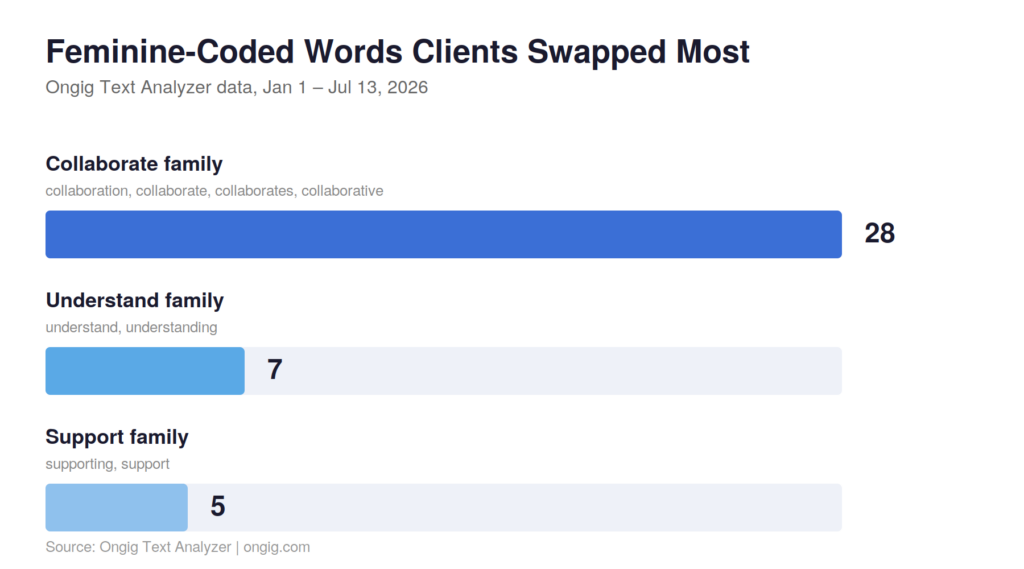
Collaboration language, in all its forms, is clearly the dominant feminine-coded pattern our clients are catching right now. Makes sense. It’s everywhere in job ads, and it’s an easy one to miss because it sounds so harmless.
One more thing worth calling out. “Committed” has shown up on this list every year since 2019. Not this time. It didn’t get swapped enough to make the cut in 2026. Small detail, but it’s the kind of thing that tells you language really does shift year to year.
If you want to attract more women, using words like the 3 above in your job postings is a good start. You might combine that move with eliminating most or all of the masculine words I wrote about in The Top 10 Masculine Biased Words Used in Job Descriptions.
For more tips on writing job descriptions, check out our How to Write a Job Description — Best Practices & Examples.
Global Research: The Weight of Words
Our own feminine-biased words data is one thing. But it’s worth zooming out to the bigger picture too.
Lightcast and UNESCO studied job postings across six English-speaking countries. They found something stark: labor force participation is 25% lower for women than men worldwide. Specifically, male-coded language shows up more in industries where that gap is widest, like STEM and manufacturing.
It doesn’t stop once women are hired, either. In fact, the same research found manager-level job postings carry noticeably more masculine-coded language than non-manager postings. That lines up with the glass ceiling. Women still hit it long after clearing the hiring hurdle.
Zoom back into our own data, and the overlap is hard to miss. For example, Lightcast and UNESCO’s research lists “support” and “committed” among the top female-coded terms globally. Both words have shown up on our own list since 2019. “Committed” held on until this year.
How to Fix Feminine-Biased Words in Your Job Posts
Knowing which feminine-biased words to fix is only half the job. Here’s how we’d apply it if we were rewriting a job post today.
If you’re overusing “collaborate,” “collaboration,” or “collaborative”: If every bullet point mentions “collaborative environment” or “collaborates cross-functionally,” you’re not signaling teamwork. You’re just repeating yourself. So, pick one or two spots where it actually matters, like a specific project or team structure, and cut it everywhere else. Instead, swap the rest for alternatives: “works with,” “partners with,” “joins forces with.”
If “understand” or “understanding” shows up a lot: ask whether you actually mean something more specific. “Understanding of SQL” is vague. “Comfortable writing SQL queries” tells a candidate exactly what you’re testing for. This swap does double duty: it reads less feminine-coded, and it also makes the requirement clearer for every applicant, regardless of gender.
If “support” or “supporting” is everywhere: this one’s sneaky because it shows up in real job functions, not just tone. “Supports the sales team” is a legitimate responsibility. The fix isn’t to delete the word. Instead, make the sentence do more work. “Supports the sales team” becomes “handles onboarding and contract renewals for the sales team.” More concrete, less coded, and honestly, more useful to a candidate deciding whether the role fits.
The pattern across all three: get specific. Vague language is where gender coding hides. As a result, the more precisely you describe the actual work, the less room there is for any single word to carry unintended signal.
FAQs on Feminine-Biased Words
1. Is gender-coded language in job descriptions still a legal or reputational risk in 2026?
It can be, depending on jurisdiction and how a company frames its hiring practices publicly. Regardless of legal exposure, gender-coded language narrows your applicant pool by discouraging qualified candidates so it’s worth fixing on business grounds alone.
2. What’s the difference between “feminine-coded” and “masculine-coded” words?
Feminine-coded words (like “collaborative,” “support,” “understanding”) tend to attract more female applicants. Masculine-coded words (like “competitive,” “dominant,” “drive”) tend to skew applications male. Neither is good or bad. The goal is balance, not swapping one bias for another.
3. Why did ‘committed’ drop off the feminine-biased words list in 2026?
Ongig’s 2026 data tracks which words clients actually swapped out using Text Analyzer, not just which words appear frequently in job postings. We built the 2019 and 2024 lists by scanning large batches of random job postings and counting word frequency.
Committed’ appeared on the list in 2019 and 2024. But clients didn’t flag and swap it often enough in 2026 to make the cut. This suggests it may already be less commonly used or less commonly caught by review processes.
4. How is this year’s data different from the 2019 and 2024 lists?
We built the 2019 and 2024 lists by scanning large batches of random job postings and counting word frequency. The 2026 data instead tracks real client behavior in Text Analyzer, specifically, which words users chose to remove or replace between January and mid-July 2026.
Why I wrote this?
Ongig is on a mission to transform job descriptions. Ongig’s Text Analyzer eliminates gender bias, other biases and, overall, makes your job ads more attractive. If you’re hiring 100+ people per year, we’re happy to show you how to gender-neutralize your job descriptions. Just click the demo request button on this page or email us at friends@ongig.com. Thanks!
