Quick Summary: Job Description Gender Bias in 2026
Job description gender bias usually comes down to a handful of repeat offenders. Ongig’s Text Analyzer tracked every masculine-coded word swap made between January 1 and July 13, 2026. The most-replaced word was “strong” (42 swaps), followed by “lead” (26) and “independently” (13). Below, we break down the full top 10 with gender-neutral alternatives for each.
How We Identify Job Description Gender Bias
We pulled this data directly from Ongig’s Text Analyzer, the same AI-powered tool that flags job-description gender bias and suggests neutral replacements. Every time a user accepted a suggested swap for a masculine-coded word, we logged it. This list reflects real edits made to real job postings between January 1 and July 13, 2026, not a one-time sample or a third-party scrape.
First, if you want to attract more female candidates, a good place to start is to eliminate your job description gender bias.
Job description gender bias is the easiest lever for you to pull to hire more women.
The 80/20 Rule is in effect here. Well, almost.
In fact, you can remove about 70% of job description gender bias by changing just 10 of the most commonly used masculine words.
The Data Behind This List
Specifically, we pulled fresh data straight from Ongig’s Text Analyzer: every masculine-coded word swap made by our users between January 1 and July 13, 2026. That’s real behavior, not a one-time scrape. It shows us exactly which words employers are actively editing out of their job postings right now.
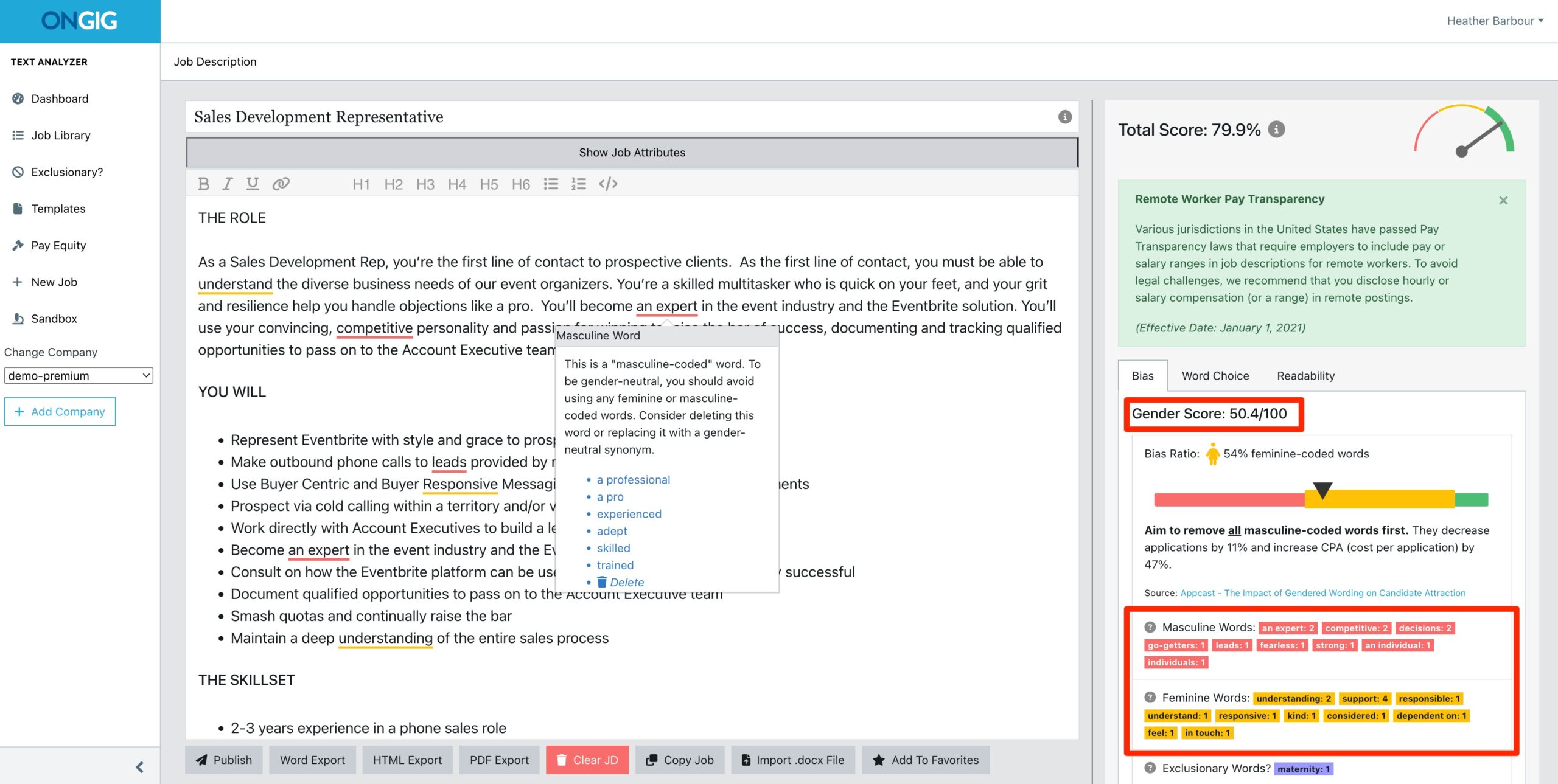
To start, below are the top 10 masculine-coded words our users swapped most in 2026. Most of these are what folks call “implicit bias” (or “unconscious bias”). In other words, your recruiter or hiring manager writing the JD didn’t mean to turn off female candidates. They just inadvertently use words that repel some women.
Simply put, fixes are easy.
As noted, I’ve listed the top 10 masculine biased words in order of how often our users swapped them out between January and July 2026.
And for each of the 10 offenders, I list a couple of the best gender bias-free synonyms to use instead.
For more tips on writing job descriptions, check out our How to Write a Job Description — Best Practices & Examples.
Enjoy!
10 Words Behind Job Description Gender Bias (2026 Data)
Below are the top 10 masculine-biased words our users swapped most in 2026. Most of these are what folks call “implicit bias” (or “unconscious bias”).
| Rank | Word | Top 10 Masculine-Biased Words, Ranked by 2026 Swaps |
| 1 | Strong | 42 |
| 2 | Lead | 26 |
| 3 | Independently | 13 |
| 4 | Strengthen | 12 |
| 5 | Competitive | 10 |
| 6 | Leaders | 10 |
| 7 | Analyze | 9 |
| 8 | Champion | 8 |
| 9 | Analysis | 7 |
| 10 | Independent | 7 |
Gender Bias Word #1: “Strong”
Swapped out 42 times in 2026.
The word “strong” is a common adjective in job descriptions. Many of you use it to describe skills/qualities you’re looking for:
“strong communication”
“strong written skills”
“strong desire”
Here are gender bias-free synonyms to use in place of “strong”.
- proven
- sound
- solid
Gender Bias Word #2: “Lead”
Swapped out 26 times in 2026.
“Lead” is used by many of you to describe managing or running something. Examples:
“Lead sales”
“Lead status review”
“Lead projects”
Lead is also used in other instances like:
“Project Lead”
“Lead Developer”
“Analytical Lead”
Gender bias-free words to use instead are:
- Run
- Manage
- Grow
Gender Bias Word #3: “Independently”
Swapped out 13 times in 2026.
“Independently” shows up when employers describe how well a candidate works without oversight. Examples:
“Must be able to work independently on multiple projects”
“Manages priorities independently and reliably”
“Comfortable making decisions independently”
This one’s masculine-coded for the same reason as “independent” below: it implies solo achievement over collaboration, which research shows reads as less appealing to female candidates.
Gender bias-free words to use instead:
- Reliably
- Proactively
- With good judgment
Gender Bias Word #4: “Strengthen”
Swapped out 12 times in 2026.
“Strengthen” is a verb employers use to describe improving a process, team, or outcome:
“Strengthen our client relationships”
“Strengthen internal reporting processes”
“Strengthen the sales pipeline”
It carries the same masculine-coded root as “strong.” Swap it for:
- Improve
- Build
- Develop
Gender Bias Word #5: “Competitive”
Swapped out 10 times in 2026.
“Competitive” is often used to describe compensation you offer or the quality of candidate you’re looking for. Examples include:
- “We offer competitive pay and bonus plan”
- “Come experience a high-energy, competitive environment”
- “You are a competitive person who plays to win”
Some gender bias-free words to use instead:
- Attractive
- Fair
- Results-oriented
Masculine Bias Word #6: “Leaders”
Swapped out 10 times in 2026.
Employers use “leaders” to describe the type of hire they want or the team structure:
“We’re looking for future leaders”
“Join a team of industry leaders”
“Leaders in this role set the tone for the department”
Try these instead:
- Experts
- Team members
- Specialists
Gender Bias Word #7: “Analyze”
Swapped out 9 times in 2026.
“Analyze” is the verb form of “analysis” (see #9 below), and shows up constantly in JDs:
“Analyze quarterly performance data”
“Analyze customer feedback trends”
“Analyze and report on campaign results”
Gender bias-free alternatives:
- Review
- Evaluate
- Assess
Gender Bias Word #8: “Champion”
Swapped out 8 times in 2026.
“Champion” is used as a verb to describe advocating for something:
“Champion our DEI initiatives”
“Champion best practices across teams”
“Champion change management efforts”
It’s a competition-coded word. Swap it for:
- Advocate for
- Support
- Promote
Gender Bias Word #9: “Analysis”
Seven swaps were logged for this word in 2026, tied for last place.
“Analysis” is used in myriad ways:
“Make recommendations based on detailed analysis”
“Provide qualitative analysis”
“Conduct data analysis”
Instead, replace with:
- Research
- Testing
- Scrutiny
Gender Bias Word #10: “Independent”
Swapped out 7 times in 2026.
Employers use “independent” or “independently” to describe a candidate who works well alone, leads a team, and/or does well without supervision. This may be interpreted as masculine-coded in contrast to teamwork and people-focused skills, which are seen as feminine-coded. Here are some examples of how “independent” might be used in a job description:
“Seeking an independent, driven individual who works well alone”
“You must be able to work independently and assertively”
“Be comfortable working independently”
Employers use “independent” or “independently” to describe a candidate who works well alone, leads a team, and/or does well without supervision. This may be interpreted as masculine-coded in contrast to teamwork and people-focused skills, which are seen as feminine-coded. Here are some examples of how “independent” might be used in a job description:
“Seeking an independent, driven individual who works well alone”
“You must be able to work independently and assertively”
“Be comfortable working independently”
Instead, consider:
- Focused
- Confident
- Competent
This word rounded out the list with 7 swaps in 2026, also tied for last.
How We Measured Job Description Gender Bias
To start, gender bias persists in every stage of employment, from inequality in hiring to unfair parental leave practices. In fact, gender inequality is a complex problem, with causes from the systemic to the social. Even so, employers can’t be expected to solve gender inequality alone, but it is our responsibility to do what we can to eliminate prejudice, bias, and discrimination in the hiring process.
Specifically, gender inequality persists in hiring in a variety of ways. For instance, some managers have unconscious biases about women. Still, that work could be undermined by individual hiring managers across the organization, even if the human resources team has training in gender bias, and even if those managers may not have the same training or buy-in.
Notably, one of the most common forms of gender bias in hiring is in the gender-coded language of job descriptions. In many cases, a job description is the first thing a candidate sees when considering whether or not to apply to work with your organization. Unfortunately, job descriptions often contain an imbalance of gendered language (for example, a majority of masculine-coded language and very little feminine-coded language) or other evidence of bias against female applicants.
Admittedly, many masculine-coded words may seem neutral upon first glance. But when taken in context, particularly when there are many of these words and phrases, they discourage female applicants and subtly communicate that your organization does not prioritize an inclusive workplace.
The Research Backing This Up
In practice, recruiting women can be fraught. As a result, female applicants pick up on hints that your workplace may not be inclusive for women. Labor market data provider Lightcast, in partnership with UNESCO, analyzed job postings across six countries and found that masculine-coded language correlates with lower female employment, especially in senior and STEM roles. Notable, two of the terms Lightcast flagged as most common, “lead” and “independent,” also top our own 2026 swap list. Similarly, a 2025 study published in PNAS, covering nearly 38,000 applicants across four separate studies, found that swapping masculine-coded words for gender-neutral alternatives increased application rates among women. It also increased applications among men who don’t strongly identify with traditional masculine traits.
In short, there are so many compelling reasons to remove biased language from your job descriptions. It makes financial sense, and it streamlines the hiring process by ensuring more qualified applicants actually apply. But most importantly, it is simply the right thing to do. Promoting job titles and job listings that are written with inclusive language shows that you don’t endorse gender stereotypes and that you’re ready to hire qualified women.
FAQs on Job Description Gender Bias
1. What are the most common masculine-coded words in job descriptions?
Based on Ongig Text Analyzer’s 2026 swap data, the most common are “strong,” “lead,” “independently,” “strengthen,” and “competitive.” These words tend to signal solo achievement and dominance over collaboration, which research links to fewer applications from women.
2. Why is “strong” considered gender-biased?
“Strong” is a masculine-coded adjective. It’s not offensive on its own, but overuse across a job posting (alongside words like “lead” and “competitive”) adds up to language that reads as male-coded, which can quietly discourage qualified women from applying.
3. How do I check my job descriptions for gender bias?
Run your job posting through an AI-powered tool like Ongig’s Text Analyzer. It flags masculine- and feminine-coded language automatically and suggests neutral swaps. That way, you don’t have to manually review every line.
4. Does removing gender-biased language actually increase applications?
Yes. Lightcast and UNESCO found masculine-coded language correlates with lower female employment. In addition, a 2025 PNAS study of nearly 38,000 applicants found that swapping in gender-neutral language measurably increased application rates from women.
Why I wrote this
Ongig’s Text Analyzer reviews the text of job descriptions in search of gendered language and other unconscious bias. Our AI-powered tool pinpoints problematic areas and suggests gender-neutral and unbiased replacements for existing language.
The 2026 data above came straight from real Text Analyzer usage. It couldn’t be easier to make your job descriptions inclusive to all. Reach out to us today for a demo and see what’s hiding in your own job postings.
If you enjoyed this article, you might check out these 4 Diversity tools to write more inclusive content.
Learn more about job description gender bias and how Ongig’s Text Analyzer can help you eliminate it.
