
- 14 Best Practices for Job Description Management Across Large Hiring Teams - February 10, 2026
- How To Design a Job Architecture That Supports Career Paths and Pay Bands - February 5, 2026
- How to Build a Talent Pipeline That Supports Rapid Product / Engineering Scaling - December 15, 2025
Nowadays, companies grow much faster than their organizational structures do.
This leads to the creation of new teams and job titles on the fly. Promotions happen without clear rules.
Over time, confusion sets in. What happens?
- Employees do not know how to grow.
- Managers struggle to explain pay decisions.
- HR ends up negotiating exceptions instead of managing systems.
This is exactly where an organizational chart becomes critical. Why? The answer is simple.
Well-designed job architecture frameworks create clarity across roles, levels, career paths, and pay bands. There is more than job titles, though. They give:
- Employees a visible future
- Leaders a shared language
- HR a strong foundation for fair and scalable decisions
For HR leaders and VPs of HR, these are no longer optional. It is a core people infrastructure. Interesting, right?
Let’s walk through how to design the architecture properly to get the most out of it.
What job architecture really is and why it matters
Job architecture is the structured framework that defines how jobs are organized across the entire organization. Sounds simple, but is it simple?
What does it actually do?
It answers questions employees ask every day.
- What level am I at?
- What is the next step for me?
- What skills do I need to grow?
- How does my pay compare internally?
A complete architecture includes:
- Job families
- Job levels
- Role definitions
- Career paths
- Pay band information
Without it, companies rely on individual judgment. That often leads to inconsistency in workforce planning, and:
- Job titles become inflated.
- Pay gaps widen.
- Career growth feels random.
It directly address this problem by making growth visible and achievable, while the job function stays the same.
The core building blocks of job architecture
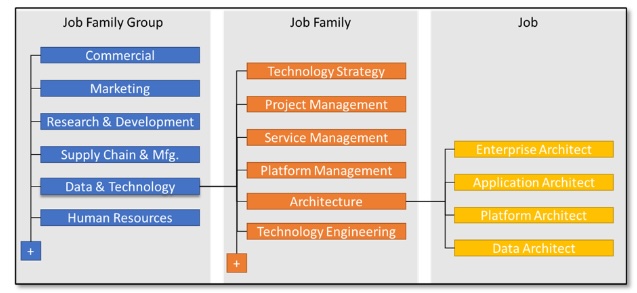
All effective job architectures are built using the same fundamental components.
When one piece is missing, the system stops working as intended.
Job families
Job families will group roles that share the same or similar skills, knowledge, and types of work. In addition, they help structure the organization in a logical manner.
Common examples include:
- Engineering
- Sales
- Marketing
- Finance
- Human Resources
Job families should feel intuitive to employees. If people cannot easily identify where they belong, the structure is too complex.
Job levels
Job levels will define progression across and within all job families. They describe increasing scope, complexity, and organizational impact.
Whether it’s a trendy job title or not, a typical structure might include:
- Level 1: Entry or Associate
- Level 2: Professional
- Level 3: Senior
- Level 4: Lead or Manager
- Level 5: Director
- Level 6: Executive
(You can use this as a level guide)
The most important rule is consistency with job titles.
A Level 3 engineer and a Level 3 marketer should operate at similar impact levels. Their daily tasks may differ, but their influence on the business should be comparable.
JobSpikr’s guide shows that organizations with clearly defined levels improve workforce planning accuracy by up to 40%.
Job roles
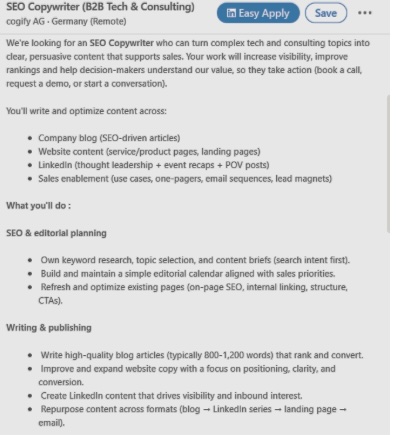
Job roles sit at the intersection of job families and job levels. They define what someone actually does.
Examples include:
- Software Engineer III
- Marketing Manager II
- HR Business Partner IV
Clear job descriptions prevent title confusion and reduce internal comparisons based on names rather than substance.
Here’s an example of a job description.
Designing career paths that employees can actually follow
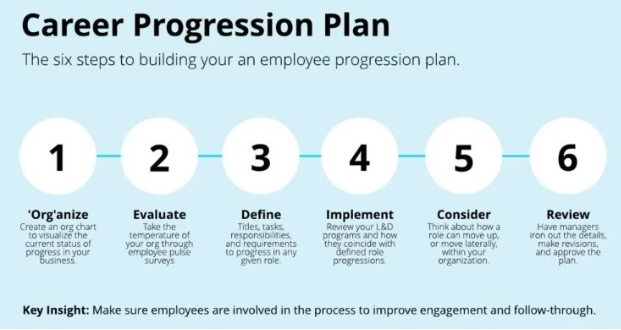
Career paths are where the architecture becomes real for employees. If people cannot see how they grow, the career framework fails.
Speaking of career pathways, one of the trickiest parts when building a good job architecture is figuring out how employees can prove they’re ready to move up to the next level. It’s not enough to just list the skills people need for available job roles—companies also have to give employees real ways to learn and show they have those skills.
Companies nowadays use certification programs to design career paths, while some others rely on project portfolios or manager assessments. For technical roles, tools like Virtual IT Training Labs let employees practice with actual software in a controlled setting where their work can be measured objectively.
The key is making sure there’s a clear connection between what someone learns, how they prove it, and which pay band or role they qualify for next. Without these concrete skill-building and validation methods, career pathways feel more like vague suggestions than actual roadmaps employees can follow.
Vertical career growth
Vertical career levels or growth is the most familiar path. It involves increased responsibility, broader scope, and higher pay.
For example, career levels can look like this:
- HR Generalist → HR Manager → HR Director
Each step should clearly show what changes:
- More complex decisions.
- Wider business influence.
- Greater accountability.
Employees should understand why a role sits at a higher level, not just that it does.
Horizontal career growth
Not all growth needs to be vertical. Many employees want to expand their skills, but they don’t want to manage people. A skills-based approach should support lateral movement between related roles and also focus on future skills.
Examples include:
- HR Operations → HR Analytics
- Content Marketing → Product Marketing
This approach improves retention and builds organizational capability.
Dual career ladders
Dual career ladders are essential in modern organizations, especially in technical and specialist roles. They allow employees to grow as individual contributors or people leaders.
Both paths should reach equivalent levels and pay bands.
A Principal Engineer should not earn less simply because they do not manage a team. A good organizational structure makes this equality visible and defensible.
Connecting job architecture to pay bands
Pay is where trust is built or broken. Skills-based pay provides the structure that makes pay fair and explainable.
Why pay bands matter
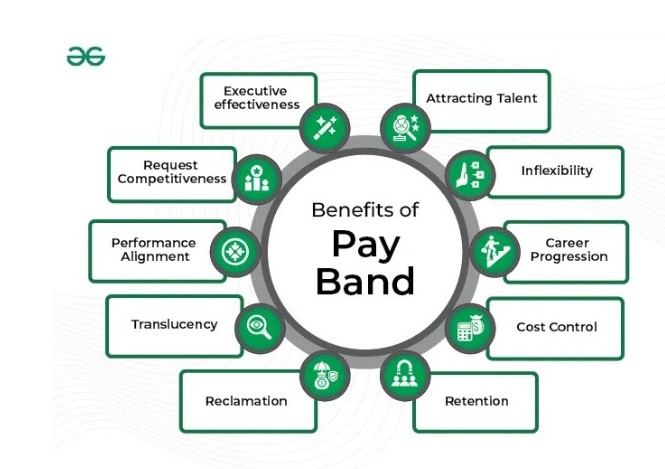
Pay bands reduce randomness in compensation decisions.
They provide boundaries while still allowing flexibility.
Strong structures help organizations:
- Reduce bias
- Improve pay equity
- Speed up approvals
Payscale research shows that in the tech job market, salaries will drop from 4% from last year to 3.5% this year (2026).
Mapping levels to pay ranges
Each job level should map directly to a pay band.
For example:
- Level 2: €45,000–€60,000
- Level 3: €60,000–€80,000
- Level 4: €80,000–€110,000
Bands should be wide enough to reward performance, but tight enough to protect internal equity.
Pay the level, not the title
Titles can vary widely across organizations, while levels provide consistency.
Job architecture shifts conversations from emotion to structure. That makes pay decisions easier to explain and easier to defend.
Using market data without letting it break your structure
Market data is important, but it must be used carefully.
Match roles, not job titles
Market surveys are full of inconsistent titles. Never use job names to match roles or job profiles. The best way to go is to always match roles based on:
- Scope
- Skills
- Decision authority
While the core principles of such architecture remain the same, the application varies significantly by industry. For instance, the job levels in a corporate tech firm will look very different from those in a clinical setting.
Consider the structure required for a teen mental health facility. In this environment, the architecture must account for highly specialized clinical roles—such as adolescent psychologists and licensed clinical social workers—as well as administrative and operational staff.
Use market anchors
Select a small set of benchmark roles, and anchor each job family to reliable market data. What’s next is to cascade ranges internally.
This approach keeps the organization’s architecture stable while still responsive to market changes.
Governance: Keeping job architecture healthy over time
Job architecture is a living system. Without governance, it slowly breaks down.
Clear career paths reduce uncertainty, but compensation pressure still affects how employees feel outside of work. When people are stressed about personal finances, it often shows up in performance and retention.
Access to options like a debt consolidation loan can ease that pressure, making it easier for employees to focus on growth rather than short-term survival.
Establish clear ownership
Create a job architecture framework or even a compensation committee, and include:
- HR leadership
- Compensation experts
- Business leaders
This group reviews and approves structural changes.
Control exceptions
Exceptions should be rare and documented.
Uncontrolled role creation undermines the entire framework and might lead to a lack of transparency.
SHRM’s survey found that almost half (49%) of HR executives are open with their employees about their pay.
Review annually
At least once a year, review:
- Role alignment
- Level consistency
- Pay band compression
Small adjustments can help prevent large-scale corrections later.
Communicating job architecture clearly to employees
Even the best architecture fails if no one understands it.
Transparency builds trust.
For a company like Abacus Global, designing an architecture that supports clear career paths and pay bands is essential for maintaining employee satisfaction and retention.
When they implemented a structured framework, it ensured that employees had a transparent understanding of their career progression and the compensation structure tied to each level.
A well-defined architecture enables the company to create clear job families, align roles with corresponding skills and responsibilities, and establish fair pay bands that reflect industry standards
What employees should see
Organizations should share:
- Job families
- Job levels
- Career path options
- Pay philosophy
Employees do not need to see every salary structure, but they need to understand how companies make decisions.
Keep language simple
Avoid complex HR terminology and explain levels using real-world impact.
For example:
“This level focuses on execution.”
“This level focuses on strategy and influence.”
Common job architecture mistakes to avoid
Many organizations repeat the same errors.
Avoid these early.
Too Many levels
More levels do not create more opportunity. They slow down potential promotions and further frustrate your employees. Most organizations function well with six to eight levels. Adding more means, along with more levels, you’d be adding more frustration. Don’t do it.
Confusing performance with level
Levels define role scope. On the other side of the spectrum, performance defines how well someone operates within that scope. The difference is crucial to understand.
Why?
High performers should move within pay bands before advancing to higher levels.
Copying other companies
Templates are useful starting points, but job architecture must reflect your organization’s strategy, size, and culture.
Blind copying creates misalignment and may cause more harm than good. Be creative, come up with a template that suits your organization, and go with it.
A real example of job architecture done right
A mid-sized SaaS company with 600 employees faced growing pains. They struggled with title inflation, pay inconsistency, and rising attrition.
They redesigned their job architecture.
Key actions included:
- Defining five job families
- Standardizing six levels across all families
- Introducing dual career ladders
- Aligning pay bands to market benchmarks
Final thoughts: Job architecture is a strategic advantage
Job architecture isn’t just a random HR document stored in a folder; it’s so much more. It’s a mechanism that brings things together, provides organizational order, and fills the existing gaps within the system.
It is a strategic system.
- It shapes careers.
- It influences pay fairness.
- It builds trust.
Design job architecture well so you can provide your employees with clear, strong confidence.
Moreover, job architecture provides leaders with consistency while giving HR even more credibility. If your organization is scaling, changing, or struggling with fairness, this is the place to start.
Design your job architecture with intention.
Your people will notice.
Visit Ongig’s blog for more tips.
Author Bio:

Luca Ramassa is Outreach Specialist at LeadsBridge, passionate about Marketing and Technology. His goal is to help companies improve their online presence and communication strategy.
