When a company opens a new region or ships a new product, the legal exposure and the margins start moving at the same time, and so does the actual running of the thing. Each gets its own hire, and the gaps between those hires are exactly where a deal or a filing falls through.
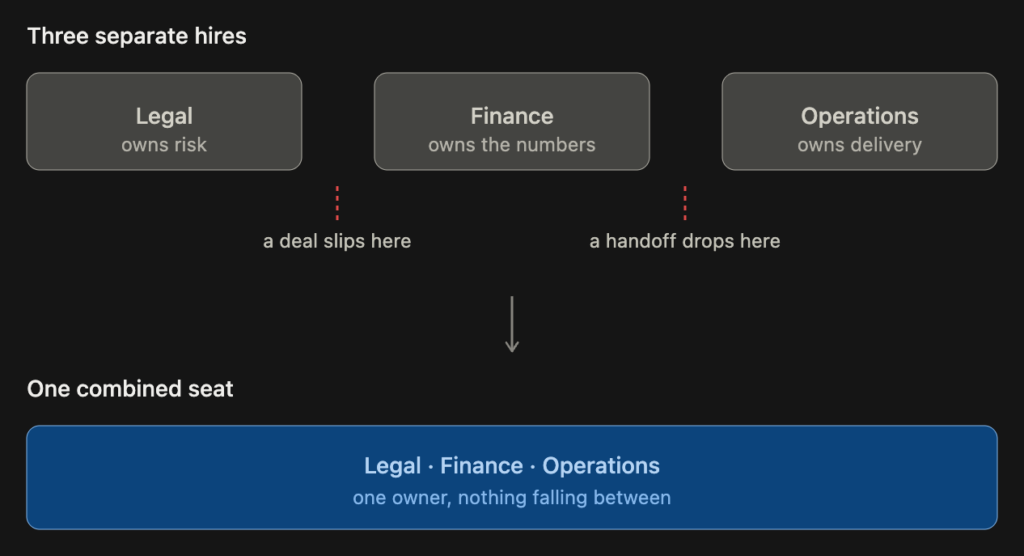
So the job gets folded into one seat. Risk and revenue end up with a single owner, and so does the day-to-day, and the point is to stop them drifting apart while nobody watches the middle.
The posting for a seat like that has a narrow task: find the handful of people who can actually do it. Most who apply can’t, and a loose description won’t surface the difference until you’re an hour into an interview. The ones you want read for something specific before they apply — what they’ll get to decide, and how the company will know they did well.
What the Job Owns
No two companies build it the same way.
At one it’s a COO who went to law school, so vendor contracts and unit economics both cross their desk. At another, the title is Head of Compliance and Operations, and the person spends half their time beside Finance on controls and the forecast. A fintech or healthtech startup still wrestling with licensing and audits might write it up as Director of Risk, Finance, and Ops.
The thread through all of them is range.
The person has to hold their own in a board deck and an audit, then stand with the team doing the work and be useful there too.
This isn’t a hunch.
The World Economic Forum’s 2023 Future of Jobs Report has governance, risk, and compliance skills rising alongside data and operations leadership, hardest in heavily regulated industries. Functions that used to sit apart are collapsing into each other.
The Three Skill Sets
One head has to hold three skill sets at once.
Legal is the contract work end to end, the commercial negotiations, and ownership of privacy and data governance, with policy drafting folded in. Under all of it runs regulatory awareness — the instinct to spot a problem while it’s still small enough to fix, before it becomes the thing everyone’s in a room about.
Finance is quick to list and slow to master. Owning the budget and building the forecast. Modeling cost and margin, and running the internal controls, which means SOX-lite thinking at a startup and the whole apparatus at a public company.
Jeffrey Zhou, CEO and Founder of Fig Loans, runs a financial technology company that issues installment loans and credit-building products to borrowers most lenders pass on.
He says, “In lending, legal, finance, and operations are the same decision wearing three hats. A single underwriting call is a compliance question and a margin question and an ops question, all at once. I want the person who has felt a compliance call reshape the unit economics in one afternoon and made it anyway.”
Operations covers the processes that have to hold up once people actually lean on them, plus the vendors and the SLAs and the programs that run across teams who don’t naturally talk to each other. Then there’s whatever the industry itself demands on top.
Fintech means living in KYC and AML. Healthcare means HIPAA, no softening it. The more regulated the ground, the more plainly the posting has to spell that out, because no candidate reads it between the lines.
How to Write the Posting
Start with the title. People get precious about it, and it matters the least, as long as you don’t get cute.
Say what the job is, in words someone would actually type into a search bar. VP of Legal, Finance, and Operations works. Head of Compliance and Operations, fine. “Ops Ninja” is where it goes wrong, because nobody searches that and the people you want have already scrolled past.
The summary is ten seconds.
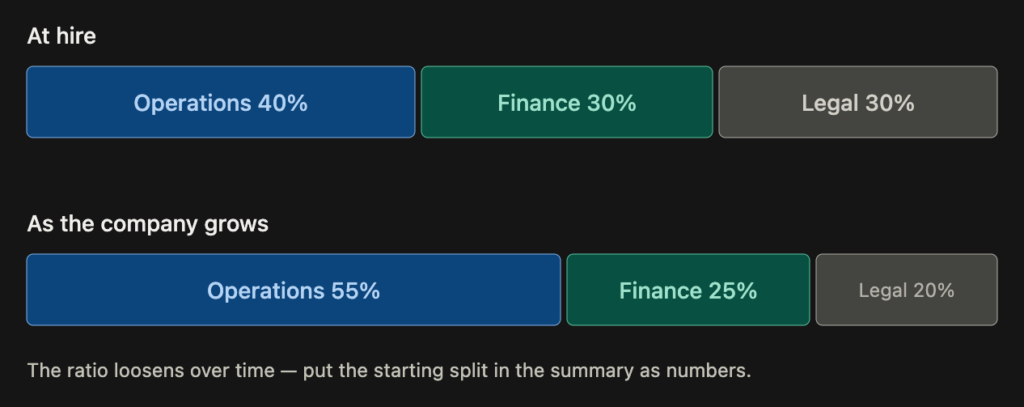
That’s how long a senior person spends deciding whether to keep reading. Tell them what they own, why it matters, where they sit, where it goes. If the job is split across functions (and these always are), put the split in numbers right there. A mushy summary is how you end up with fifty applicants who were never right.
Then responsibilities, which everyone misses.
You can spot a bad one instantly.
It’s all “oversee” and “support” and “help drive,” and a senior operator reads it and still doesn’t know what they’d be on the hook for. Pin every line to a real decision or something they’ll deliver, and hang it on something the company already does on a schedule. Month-end close. The board meetings nobody’s ever quite ready for.
Legal’s a good example of doing it right. The contract lifecycle is theirs (templates, redlines, the playbooks under them), and outside counsel only comes in where the spend is worth it.
Once a role covers this much ground, most of that work is living inside contract lifecycle management software anyway, which is the difference between version history in one place and redlines buried in someone’s inbox from three weeks back. And when a regulation changes, writing the policy people can actually follow, plus the training, is on this desk too.
A couple of things decide whether the section works.
Put the outcomes that matter up top and let the rest fall underneath, because when every line looks equally important, the candidate reads it as nobody having decided what the role is for. Tell them who they’ll be in meetings with.
Be straight about where their sign-off stops (vendor contracts up to some number), since that’s the real thing seniority buys.
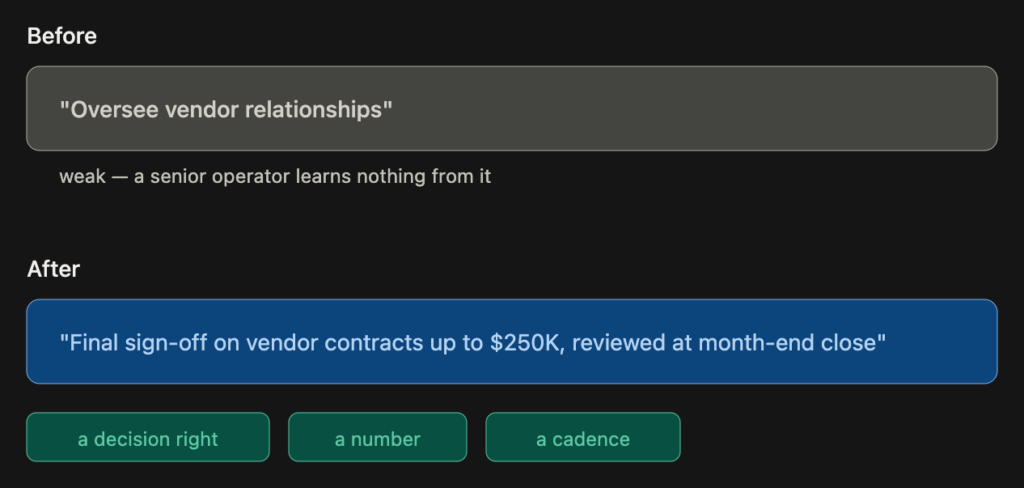
And give them one thing with a deadline. “Tiered vendor policy live in ninety days” says more about the job than another paragraph of adjectives.
Skills, Tools, and Temperament
How precise you are here decides who bothers applying.
Credentials first. What you’re really asking for:
- A JD or a CPA, maybe an MBA, or the version someone built on the job without ever collecting the letters
- CIPP/E if there’s real privacy work, CAMS if there’s AML, but only where the job actually touches it
- Eight to twelve years across the functions, four or more of them running a team
Then the tools, because that’s what people search on. List the real ones:
- NetSuite or SAP for ERP
- Ironclad or DocuSign CLM on the contract side
- Looker or Power BI for reporting
- OneTrust for GRC
Gavin Yi, CEO and Founder of Yijin Solution, runs a precision manufacturing and parts-sourcing company handling CNC machining and supply for B2B clients across engineering-heavy industries.
He says, “A process is only as good as the slowest person who has to follow it. The leaders I keep build something a new hire can run on day three, not something elegant only they understand. When procurement, quality, and compliance answer to one person, the handoffs stop dropping things.”
Knowing how to judge one tool against another is its own skill, and it doesn’t stop at the corporate stack. Someone weighing a LandInsights alternative is checking whether the parcel data holds up and what happens to their exports if they switch. Same call this role makes on a CLM or a reporting platform.
The soft skills do more of the lifting, and they’re harder to pin down. Structured problem-solving. Writing that stays clear when everything around it is on fire. And the one people undervalue most is taking something tangled and handing it back simple.
The Company Itself
Someone looking at a role this wide is sizing up the company as hard as it’s sizing up them.
A paragraph does it. What the business does and who it’s for, plus a rough sense of where the revenue stands and where it’s headed. The regulatory picture matters more here than it would almost anywhere else, since something like healthcare or cross-border data can change what the job actually is.
Nick Wiese, Regional Vice President at Alpha Heating & Air, oversees HVAC, electrical, and plumbing operations across a multi-branch home-services company.
He says, “The posting that works tells the truth about the day. In the trades, we learned the hard way that a description hiding the on-call weekends just buys you a hire who quits in month two. A broad corporate role is the same. Put the hard parts on the page, and the person who shows up knows what they signed for.”
Then there’s getting the thing found at all.
The words a candidate types should sit inside your sentences, not stacked in a keyword block at the bottom (compliance, contracts, FP&A, procurement, and the rest). Industry terms work the same way, and only the ones that actually apply.
Location and work model go near the top. Put the pay range in too, because salary ranges pull more applications and plenty of jurisdictions require them now, and leaving it off just reads as something to hide.
Prabhath Sirisena, Co-founder & CPO of Hiveage, sees the missing pay range as the first thing a strong candidate notices.
“Senior people read a posting backwards from the bottom half the time,” he says. “No range means either the company hasn’t figured out what the role is worth, or they have and don’t want to say it out loud. Either read costs you the candidates who have other offers already in hand and don’t need to find out the hard way.”
One Last Pass Before It Goes Live
Writing a role this broad means holding the language straight across three functions at once, and the thing that narrows your pool is the easiest thing to miss in your own draft. Maybe a gendered word you didn’t catch. Maybe a title nobody’s actually searching, or a must-have list that’s crept up on you until it’s a wall.
Ongig reads the posting for exactly that and flags it before the role goes live, so what you publish is the version you actually meant to write.
