
- How to Write a Job Description — Best Practices & Examples (2026 Update) - February 26, 2026
- 10+ Examples of Top Companies with Autistic Hiring Programs (2026) - February 23, 2026
- What I’ve Learned About AI, Rigid SaaS, and Job Content Since Joining Ongig in 2019 - February 17, 2026
If you’re selling HR tech in Canada — especially Quebec — your tool needs to speak French.
That’s not a suggestion. It’s the law.
Quebec’s Bill 96, which went into effect in 2022, updated the province’s Charter of the French Language. One of the big headlines? All software used by employees must be available in French. That means HR tools, ATSs, CRMs, onboarding platforms — anything people interact with at work — need to offer a user interface in French. Not just job seeker-facing pages, but the admin side too.

A French User Interface…The Job To Be Done
We’ve been getting a steady stream of interest about this. A few of our customers in Canada (and potential new ones) flagged it recently. They are trying to stay compliant.
That’s why we’re building it.
We’re actively adding French UI capabilities to Ongig’s job description management tool. The goal is simple: make it as easy to switch to French as it is to toggle dark mode on your phone.
Because here’s what we’ve learned from our conversations with teams in Quebec:
- The law covers the software the employee uses to do their job. That includes HR tech.
- You can’t just offer English with a PDF French translation on the side. It has to be in the tool.
- French must be as good — if not better — than the English version.
The Cost of Waiting: Bill 96 Fines Can Stack (Fast)
If you’re thinking, “We’ll get to French UI later,” Quebec’s law has a way of turning later into a line item.
Under Quebec’s updated Charter of the French language (via Bill 96), offences can trigger fines of $3,000 to $30,000 for organizations (with a separate range for individuals). (source: Publications du Québec)
And it doesn’t stop there:
- Repeat offences escalate: fines can be doubled for a second offence and tripled for subsequent offences.
- It can compound daily: if an offence continues for more than one day, each day can count as a separate offence.
So if your product’s employee-facing UI (admin dashboards, editor screens, settings, tooltips, system messages) isn’t available in French for Quebec users, this isn’t just “a compliance risk.” It has a real dollar sign attached.
A practical way to think about it: even one non-compliant workflow that persists can create repeat exposure—especially if the same gap exists across multiple modules, teams, or locations.
So, our product team is getting to work. We already offer something for the public-facing side. Right now, our clients can translate their JDs from English to other languages and export or sync them to their ATS.
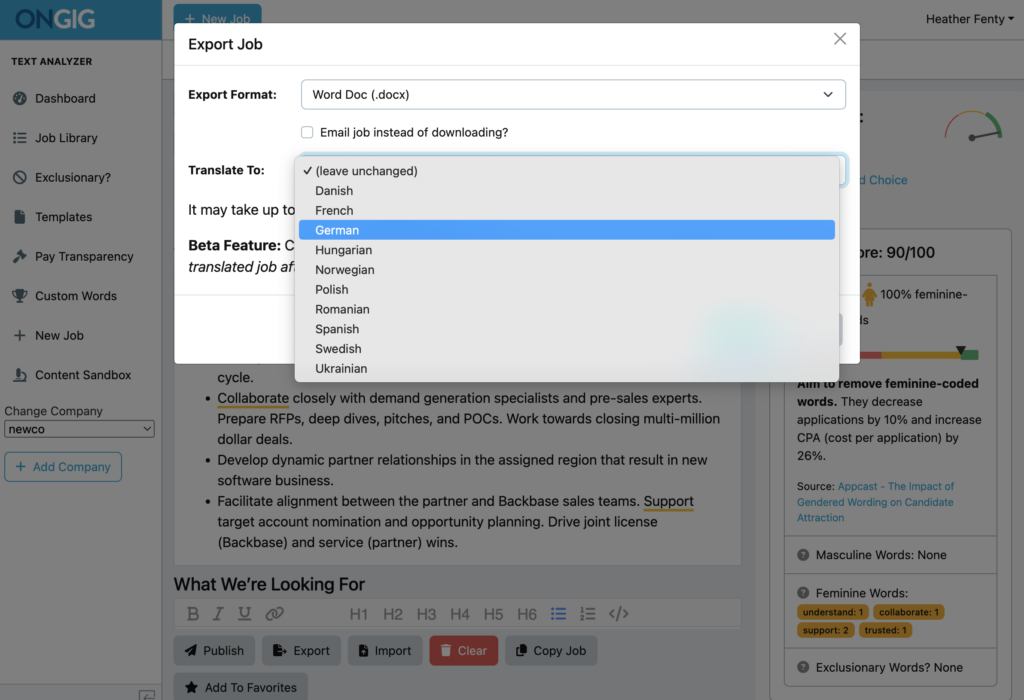
Next up: giving recruiters and hiring managers the option to switch the dashboard and editor UI to French, too. We’re talking menus, tooltips, instructions (all of it).
It’s Not Just Quebec
This law might be Quebec-specific (for now), but the mindset shift is bigger. Making software accessible — linguistically and otherwise — is becoming a requirement.
And if you think this is just a Canada thing, think again. We’ve seen multilingual job seekers in the U.S., too.
Localization isn’t just about compliance. It’s about inclusion. And good UX.
What It Means For You
If your team uses tools that don’t offer a French interface, you might be out of compliance in Quebec. But more importantly, your recruiters and hiring managers might be frustrated — or shut out entirely.
If you’re building software in the TA space, now’s the time to check your UI language settings. Can users switch to French easily? Is the translation good quality, or clunky and robotic?
If not, it might be time to prioritize this in your roadmap.
What We’re Doing Next
We’re starting with French, but we’re treating it as a blueprint. Our system is being built with multilingual support baked in.
Once French UI is live, we’ll be ready to expand into other languages when customers ask. Spanish, German, Italian? Bring it on.
The key is building for flexibility, so we’re not scrambling every time a new law (or customer) needs a new language.
Why I Wrote This
We’re building French UI support because our customers need it to stay compliant — and serve their teams better. If you’re hiring in Quebec (or even thinking about it), this law applies to you. Request a demo to see how we’re making it easier.
FAQs
Is French UI legally required in Quebec?
Yes. Bill 96 strengthened the Charter of the French language and added penalties for non-compliance. For organizations, fines can range from $3,000 to $30,000, can double/triple for repeat offences, and can apply per day if the offence continues.
Does this apply to recruiting tools?
Absolutely. ATSs, job description software, HR platforms — anything employees use to do their job.
Is translation enough?
No. The French version must be fully functional, not just a translation add-on.
What if we operate outside Quebec?
The law applies if you have operations or employees in Quebec, even if you’re headquartered elsewhere.
How can Ongig help?
We’re building full French UI support for job description creation and editing — so you stay compliant and inclusive.
