If you’ve tried to keep job descriptions up to date across dozens (or thousands) of roles, you know the drill: scattered files, version sprawl, a never‑ending Slack thread trying to nail down what “senior” really means.
Job descriptions used to be static. Now they’re living documents. Shifting alongside new skills, new tools, new trends, and new laws!
Three big trends are turning the heat up:
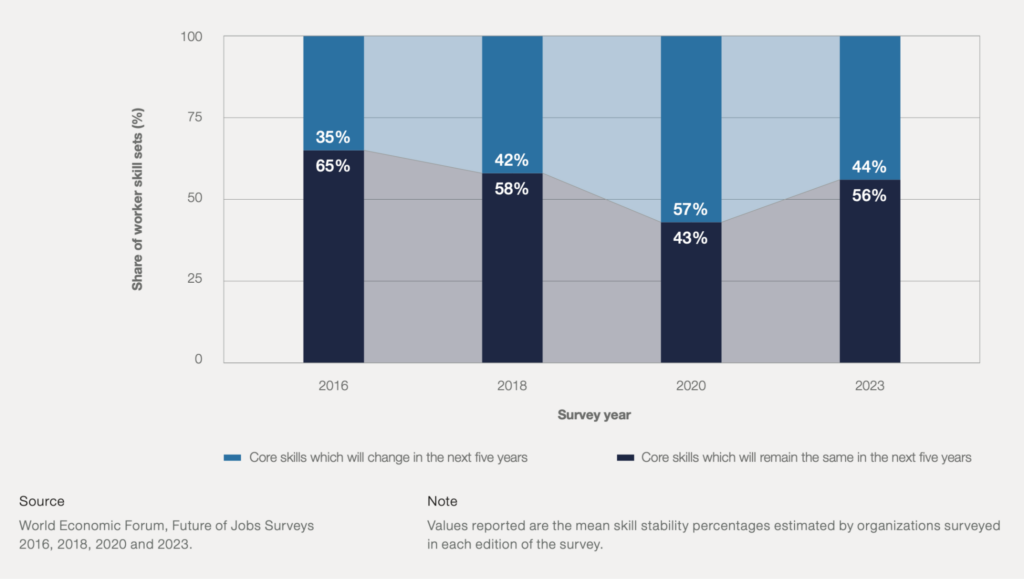
- Skills are evolving faster than org charts change. The World Economic Forum (WEF) estimates that nearly 45% of workers’ skills will be disrupted in the next five years, reshaping role requirements at a steady clip.
- Regulations keep expanding. Especially around pay transparency and accessibility. Several U.S. states now require employers to post salary ranges. More and more companies or organizations are joining in.
- Hybrid teams and cross‑functional work also blur job boundaries. A role in marketing might now demand SQL. An operations role might need AI prompts. Titles aren’t enough anymore.
That’s why automation is stepping in. By 2027, the most effective HR teams won’t just write clearer descriptions. They’ll automate reviews and approvals end to end. That way, job content stays accurate, complete, consistent, and compliant at scale.
This page covers job description management in 2027 and beyond. Read on to learn how to automate reviews and approvals across thousands of roles.
The Importance of Job Descriptions and the Role of Automation
Why job descriptions are important in organizational success
A solid job description drives everything that follows: hiring, onboarding, performance, pay, career growth. When they’re clear and up to date, you get a better candidate fit. You ensure faster hiring cycles and a smoother employee experience.
- For talent acquisition: Language and structure affect who applies and who opts out. However, clarity and relevance in job ads can meaningfully shift application conversion rates. Day one is easier when expectations match reality. Why? Good descriptions feed better onboarding plans and reduce early attrition.
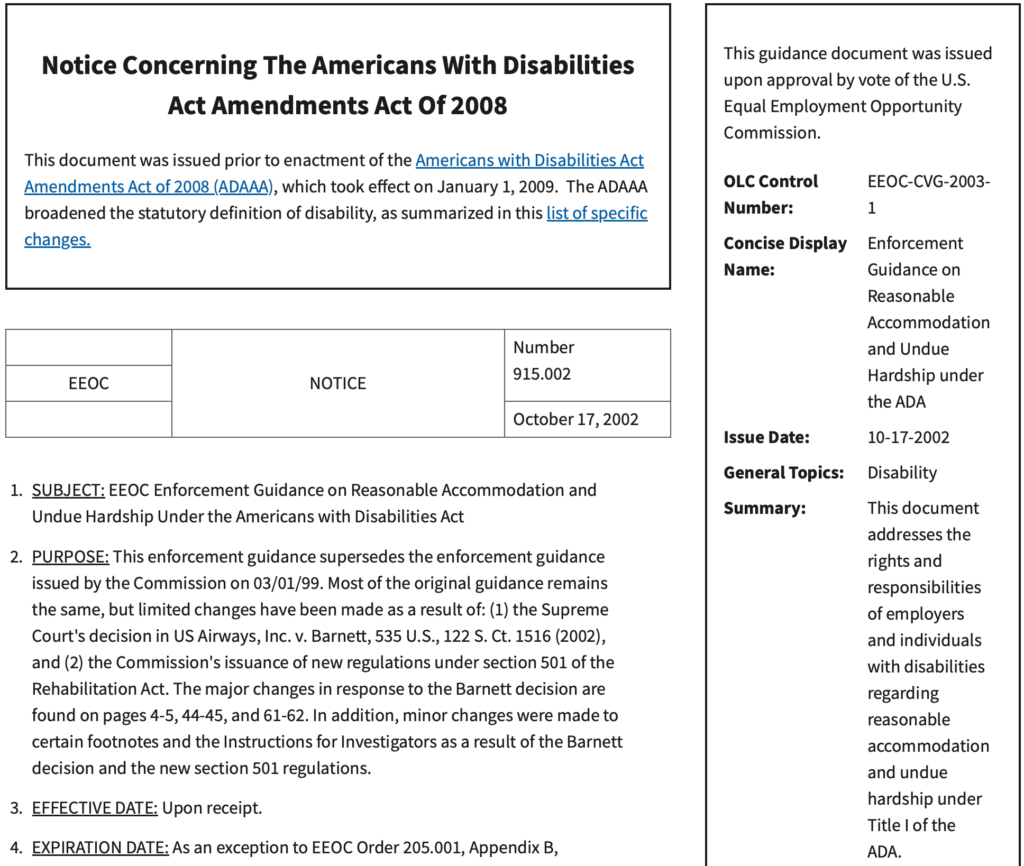
- On the legal side: Accurate essential functions support ADA accommodations and consistent classification. The EEOC notes that while job descriptions aren’t required, they’re useful for clarifying essential duties in accommodation discussions:
In fulfillment and logistics, clear job descriptions help ensure employees understand their responsibilities…from inventory management and order processing to shipping and warehousing!
Learn from Greg McRoberts, Founder of Verde Fulfillment USA. He emphasizes why keeping these expectations accurate matters as teams grow and operations become more complex.
McRoberts says, “Outdated job descriptions can create confusion around responsibilities and performance expectations. Keeping them accurate helps teams stay aligned and reduces operational errors, making it easier to hold people accountable as the business grows.”
When the job content is wrong or out of date, the consequences add up:
- Escalating time‑to‑fill
- Mis-hires
- Rework across HR and Legal
- Pay equity issues
- Compliance gaps’
Job description management isn’t housekeeping. It’s core to business execution.
The role of automation in job description management
Automation here means using software to handle predictable, rules-based steps. Think of drafting support, routing, approvals, versioning, audits, and updates. That way, people can focus on decisions, not logistics.
Three layers are working together:
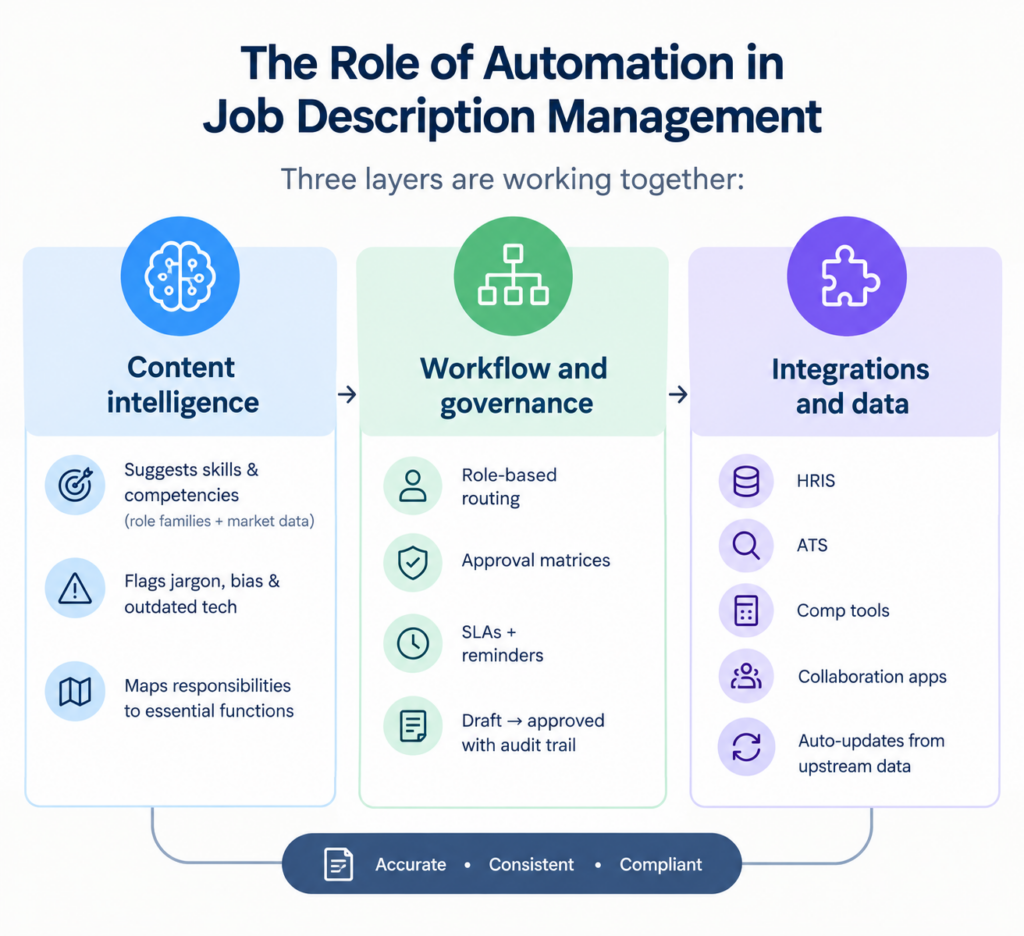
Image source: generated by the author via ChatGPT
- Content intelligence: AI suggests skills versus responsibilities based on role families and market data. It also flags jargon, bias, and outdated tech. Lastly, it maps responsibilities to essential functions.
- Workflow and governance: Role‑based routing, approval matrices, service-level agreements (SLAs), and automatic reminders guide each description. From draft to approved status, with a clear audit trail!
- Integrations and data: Connections to your HRIS, ATS, comp tools, and collaboration apps keep everything in sync. They kick off updates when upstream data changes.
Job descriptions are foundational documents. Yet many organizations still manage them through disconnected files and informal updates. Take healthcare provider in online wellness niche, for instance:
A telehealth company offering TRT online might need job descriptions for healthcare providers and patient support teams. The job descriptions have to clearly explain what a health practitioner specializing in testosterone replacement therapy does.
That’s where automation comes in. It helps keep roles, responsibilities, qualifications, and compliance requirements consistent across roles.
How To Implement Automated Job Description Management
Here’s how to get started with automating your job descriptions:
- Map your current state first. Inventory every job family and title, including duplicates and regional variants. Identify your “golden source” for each element: duties, skills, pay range, location, FLSA status. Measure baseline metrics: average days to approve, revision count per doc, percentage of stale descriptions.
- Define your job architecture and templates. Standardize sections: mission, responsibilities, essential functions, skills/competencies, physical requirements, pay range, work location. Align with a skills taxonomy (e.g., O*NET or ESCO) to tag roles consistently.
- Choose the right platform. Prioritize AI‑assisted authoring, bias and readability checks, dynamic workflows, audit logs, and integrations with HRIS/ATS and Slack/Teams. Confirm security and compliance: permissioning, SOC 2, SSO, clear data retention policies. Pick the best job description software.
- Design smart workflows. Use conditional routing. Union roles, safety‑sensitive jobs, or remote/hybrid arrangements trigger specific reviewers. Add SLAs and automatic nudges to keep tasks moving without nagging.
- Pilot with a focused scope. Pick two or three job families with high hiring volume and/or frequent changes. Also, compare cycle times, edit counts, and stakeholder satisfaction before and after. This helps you analyze the work scope and optimize your job postings.
- Train and support your team. Teach authors how to use AI suggestions while making their own judgment calls. Share examples of great descriptions for a clear reference point. As AI is writing more job descriptions, make sure to check for bias and accuracy.
- Measure and tune continuously. What to track? Average time to approve, number of review loops per doc, compliance coverage, and percent of stale content. Retire unused titles. Merge duplicates. Tighten templates as patterns emerge.
Case Studies: Successful Automation of Job Description Management
Here are three real‑world patterns we see when teams automate, along with the results you can expect.
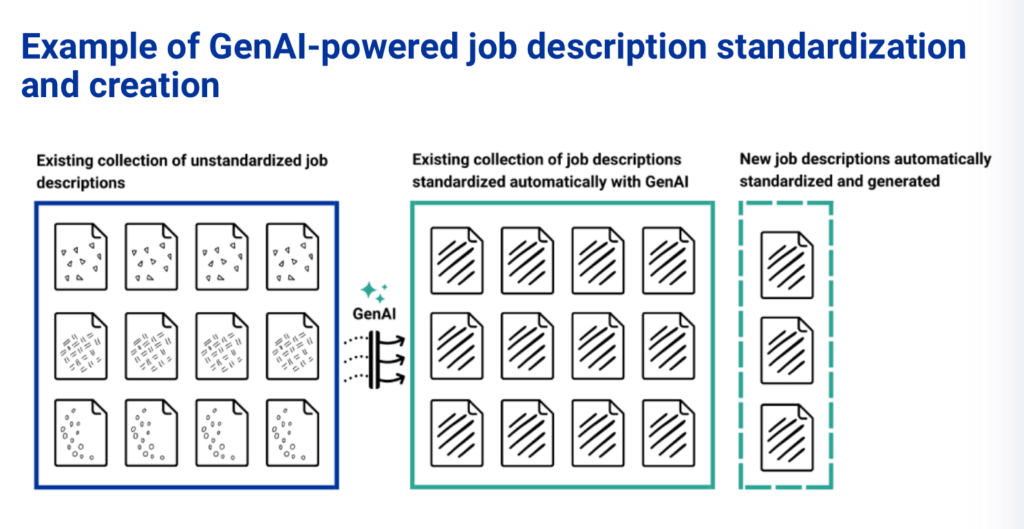
Case Study 1. Enterprise standardization via GenAI
A multinational enterprise used a generative AI job-description engine to standardize hundreds of inconsistent job descriptions across global teams. The system reduced drafting time from four to six hours to under five minutes per role. It improved consistency in job requirements and grading. Plus, it flagged potentially biased language before HR review.
Case Study 2. Integrated ATS and screening continuity
A growing mid-market company integrated AI-generated job descriptions into its HR platform. The goal was to align job requirements with resume screening and interview scorecards (even offer generation). This reduced manual data entry and version-control errors while improving candidate-role alignment and job-description updates.
Case Study 3. Template-led document and contract automation
An operations-focused firm implemented DigiCatalysts’ document automation workflow. It sought to generate job descriptions and employee agreements using standardized business rules and structured inputs. The approach reportedly achieved 100% template compliance, while reducing HR admin workloads and retaining human review for pertinent documents.
These aren’t outliers. They’re what tends to happen. That’s when you stop relying on email threads. That’s when you start using a system that remembers the rules for you.
Future Trends: Innovations in Job Description Management
By 2027 and beyond, job description management will keep growing more dynamic and more connected. Here’s what to expect:
- Skills‑first models will go mainstream. Descriptions will pair stable responsibilities with flexible skills that update based on market signals and internal demand. Real‑time market and compliance feeds will inform ranges with live salary benchmarks. Regulatory changes will automatically trigger targeted updates and approvals.
- AI copilots will work alongside human oversight. What’s great is that large Language Models (LLMs) will be capable of drafting first passes, summarizing changes, flagging risky language, and suggesting inclusive alternatives. However, it’s still your HR personnel who will call the final shots before posting job ads.
- Deeper integrations across the HR stack will change job content. They will ripple instantly to leveling guides, career frameworks, postings, and performance expectations. Storing descriptions as structured data (not static documents) will enable new analytics like skill gaps, pay equity checks, workforce planning, and employee demand.
The future job description will be less like a static PDF. It will be more like a living profile, fed by job description data and tended by people. Part encyclopedia entry, part roadmap!
Embracing Automation for Optimized Job Description Management
If your job descriptions are slow to update or hard to trust, you aren’t alone here. However, your entire hiring process doesn’t have to stay that way. The solution? A clear template and an approval matrix!
Automation won’t replace your judgment. It will free up your time for the decisions that matter. That said, start with your highest‑change job families. Build governance that focuses experts on the right moments. Let AI help with the heavy lifting. AND keep people making the hard calls!
To get started, pick a pilot group and map your first workflow. The sooner you start, the sooner your teams get faster reviews and cleaner approvals. Most importantly, the reliable source of truth for every role!
Ready to automate job description management? Ongig’s automated software allows you to draft and edit job descriptions as well as publish and optimize job postings. Request a demo today!
