
- How to Write a Job Description — Best Practices & Examples (2026 Update) - February 26, 2026
- 10+ Examples of Top Companies with Autistic Hiring Programs (2026) - February 23, 2026
- What I’ve Learned About AI, Rigid SaaS, and Job Content Since Joining Ongig in 2019 - February 17, 2026
We don’t just read job posts. We imagine our future in them. That’s why my recent viral LinkedIn post about how fast a job goes from dream to disappointment “blew up”. I didn’t expect it to resonate like that. But now I see exactly why it did.
I wrote:
“Most of us don’t realize how quickly a job description can shut someone out.
A “must thrive under pressure” line can read as: You’ll be doing five jobs with no support.
A “cultural fit” requirement often means: We want people who act like us.
None of that invites great talent in.When I’m reviewing job descriptions, I always ask myself: What are we unintentionally communicating?
If a job posting never mentions flexibility, alternate ways of working, or communication options, it’s easy for candidates to assume those things don’t exist.
The good news is that small shifts can make a real difference. Use clear language. Make fewer assumptions. Be more transparent.
When we strip out the “clever” language and say plainly what the work is and how people will be supported, everybody wins.”
So far, the post pulled in:
- 4,700+ impressions
- 20+ reactions
- 4 comments
These are not huge numbers, but for me, this is a viral LinkedIn post!
People weren’t just agreeing they were relieved someone said it out loud. It clearly struck a nerve. Which brings me to the “jobs to be done” theory.
People Don’t Want a Job. They Want a Feeling.
In hiring, we talk a lot about skills, responsibilities, and culture fit. But what most candidates are really chasing is a feeling. Fulfillment. Stability. Growth. Belonging. Identity.
Clayton Christensen’s “jobs to be done” framework nails this. It’s the idea that people “hire” a product — or a job — to do a job for them. Like helping them feel confident. Or like they’re making a difference. Or providing for their family without burning out.
But when the job only delivers on the surface-level stuff (title, paycheck, vague perks) and not the emotional job it was “hired” to do… disappointment creeps in. That’s what my post tapped into. That letdown. That slow, creeping “ugh.”
So, What Does This Mean for Talent Acquisition?
If you’re in TA, recruiting, or comp — this is your north star: help people hire the job that delivers what they’re really looking for.
And that starts with how we write job descriptions. They can’t just be task lists and legal disclaimers. They have to speak to the why. They have to answer the question candidates are silently screaming: “Will this help me be who I want to be?”
That’s not woo-woo. That’s practical. Because the companies that get this — the ones that tie job roles to real human aspirations — are the ones people stay at. Brag about. Recruit for. And refer their friends to.
How to Write for the Job Behind the Job
Here’s what I’ve seen work (and what Ongig helps teams do every day):
- Start with the mission — but make it specific. Don’t say “make the world better.” Say what problem this job helps solve, and why it matters.
- Show the emotional outcome — Will this job help someone grow? Lead? Build something meaningful? Say that out loud.
- Acknowledge reality — Not everything is glamorous. Be honest about challenges, too. People appreciate transparency more than perfection.
- Use plain language — Cut the jargon. If you wouldn’t say it in conversation, don’t put it in a job post.
One commenter on my post said, “This post should be printed and posted in every HR department.” I think that’s because it reminded people to lead with empathy. Not just efficiency. That’s the shift we need.
What People Actually Said
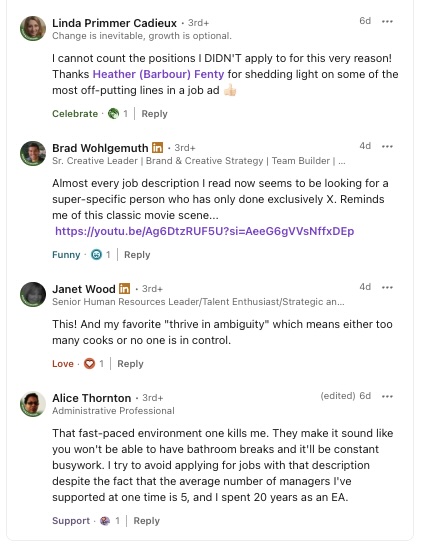
- Linda Primmer Cadieux (Personal Growth Coach): “I cannot count the positions I DIDN’T apply to for this very reason! Thanks Heather (Barbour) Fenty for shedding light on some of the most off-putting lines in a job ad 👍🏻”
- Brad Wohlgemuth (Head of Marketing & Brand): “Almost every job description I read now seems to be looking for a super-specific person who has only done exclusively X. Reminds me of this classic movie scene… watch it here.”
- Janet Wood (Senior HR Leader): “This! And my favorite “thrive in ambiguity” which means either too many cooks or no one is in control.”
- Alice Thornton (Admin Professional): “That fast-paced environment one kills me. They make it sound like you won’t be able to have bathroom breaks and it’ll be constant busywork. I try to avoid applying for jobs with that description despite the fact that the average number of managers I’ve supported at one time is 5, and I spent 20 years as an EA.”
Why I Wrote This
This blog was inspired by a viral LinkedIn post I wrote that clearly hit a nerve with lots of people. If you’re in charge of job descriptions, hiring strategy, or employer branding — and want to better connect what you’re hiring for with what people are actually seeking — Ongig can help.
Request a demo to see how Ongig makes it easy to write job descriptions that resonate with the real jobs people are trying to get done in their lives.
FAQs
What is “jobs to be done” in recruiting?
It’s the idea that people choose jobs not just for tasks or pay, but to fulfill deeper needs — like purpose, growth, or stability.
Why did this viral LinkedIn post go viral?
It named a truth people feel but don’t often say: that jobs can quickly go from exciting to exhausting when expectations don’t match reality.
How can job descriptions reflect what candidates really want?
By tying responsibilities to outcomes, showing real impact, and writing like a human — not a legal department.
What’s the link between job posts and retention?
When a job delivers what it promised — especially emotionally — people are more likely to stay and thrive.
Can Ongig help with this?
Yes. Ongig’s job description software helps you write inclusive, compelling job posts that speak to both the head and heart.
