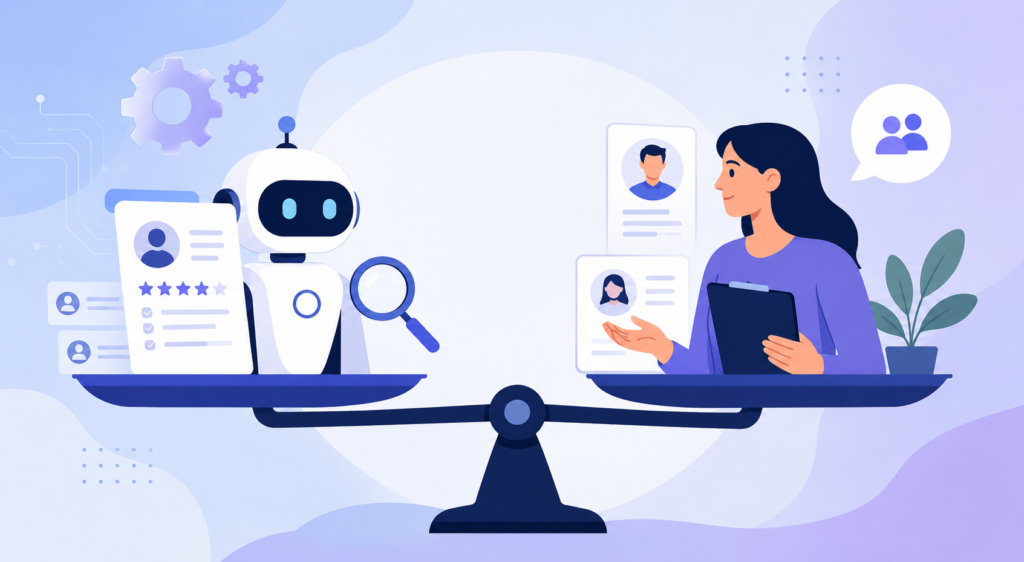
It’s time to unpack a hot topic lingering on the minds of employers and recruiters: “How can our company balance AI and human recruitment?”
It’s a critical TA question that deserves practical answers! Especially since automated recruitment becomes increasingly prevalent. In fact, 35% to 45% of companies have already adopted AI in their core hiring process.
So, let’s shed some light on the subject with the best practices of AI in recruitment for 2026. And perhaps more importantly, share how your team can optimize hiring quality by pairing automated and traditional recruitment practices.
Here’s a list of the questions we’ll attempt to answer in the article:
- What is the state of AI recruitment in 2026?
- How can AI be used in recruitment?
- Is AI taking over recruitment jobs?
- Is it ethical to use AI in recruitment?
- Which AI tool is best for recruitment?
What is the state of AI recruitment in 2026?
AI is probably not vanishing in the foreseeable future. Why? Because to a sizeable extent, the technology works.
HR managers have witnessed encouraging results, particularly in larger companies that handle thousands of candidate profiles and applications every month. AI recruitment solutions enable organizations and recruiters to hire at scale. It’s little wonder that market experts expect the enterprise sector of AI recruitment to grow at a CAGR of 6.8% between 2020 and 2032.
How can AI be used in recruitment?
Noelle London, CEO and founder of employee data platform Illoominus, shares, “AI is no longer operating quietly in the background as an administrative tool. It is increasingly functioning as a gatekeeper to employment.”
AI can help enterprises in many recruitment areas since it expedites candidate data management. This slashes the time, cost, and effort required to contextualize large pools of candidate data, a strategic step in hiring.
Recent agentic AI breakthroughs have also begun to push the boundaries of modern recruitment by adding fully autonomous non-human members to the TA team. Global HR technology studies report 87% of enterprise organizations have integrated agentic AI tools in their TA pipelines.
Yet, it can’t be stressed enough just how important it is to moderate automated recruitment with a human-in-the-loop (HITL) approach. That means you’ll still need active human participation to make the TA decisions that matter.
The following sections highlight strategic use cases of AI in recruitment and tips to balance it with human intervention.
How to use AI in candidate sourcing?
The jury is out; 46% of recruiters find it difficult to source for the best candidates. It makes sense since industry norms always shift, along with job market expectations. That’s where AI can swoop in to boost TA success by replacing (error-prone) manual candidate data inputs and engagements with automated analytics.
AI candidate sourcing solutions can instantly qualify and shortlist talent with objective search criteria to find the perfect job fit. Plus, these solutions access refreshed job seeker data. With AI, you’ll continuously win talent by offering the most suitable role at every stage of their career. And yes, this also applies to passive job seekers that make up 70% of candidates.
Forward-thinking employers could also turn to AI sourcing solutions for predictive workforce planning by staying ahead of skill gaps.
Where can the human magic come in?
While an AI candidate sourcing solution offers an insightful first-round of talent scouting, it shouldn’t be a quick-fix replacement for decision-making. TA teams should still exercise their expertise by reading between the lines of talent profiles. That means evaluating the nuances: a shortlisted candidate’s soft skills, testimonials, and cultural match before finalizing a hire.
How to use AI in interview scheduling?
Interviews can be the bane of recruiters and candidates. Poor interview scheduling practices can do a real number on the candidate experience. It’s worst when you factor in the lengthy process with seemingly endless rounds. 42% of candidates have withdrawn from a hiring process purely due to interview scheduling issues.
Automated scheduling with AI enhances candidate engagement throughout interviews with a transparent and accurate approach. These solutions offer self-scheduling links, reminders, and prompt status updates. Doing so gives job seekers the freedom to apply for their preferred roles while staying in the loop.
In fact, AI technology makes it possible to exceed interviewee expectations in 2026. For example, while job seekers expect the first response to an application within seven days, AI does it within 48 hours. Similarly, while candidates seek a scheduled interview within 2-6 days of contact, AI provides a self-scheduling link within the day!
Where can the human magic come in?
Sure, AI can systematically sort and schedule mult-round interviews to near-perfection. But did you know that 25% of hires trust employers less if they are using AI to evaluate their information?This frustration probably includes automated scheduling since it involves candidate data and engagement.
The good news is that human teams can minimize the trust issues with some interview scheduling etiquette. For instance, checking for tone by vetting automated messages. Your scheduling solutions could lose points for an impersonal “Do not reply to this automated email” line or muddled up names and salutations.
How to use AI in resume screening?
Resume screening is all about identifying the skills, certifications, and experience needed for a role. With that said, manual reviews would be a herculean task for enterprises that deal with thousands upon thousands of applications (just for a single vacancy).
Automated resume screening scans CVs for data points that match an employer’s role criteria. A quality resume screening solution analyzes a CV’s format and content quality in seconds. These systems also score profiles to prioritize candidate engagement and flag issues like keyword stuffing (a common ploy in exaggerated resumes).
Where can the human magic come in?
Empathy remains a necessary component in the talent selection process. Where possible, TA teams should continue to manually scan resumes for “points of note” such as career gaps to better understand prospective hires. While AI does a great job of summarizing the “what,” it lacks contextual analytics for the “whys” needed to truly tap into the full potential of the workforce.
How to use AI in JD vetting and career sites?
Crafting thousands of JDs and publishing them across job boards and career sites could silently cost you valuable hires. That’s because each JD poses the risks of readability issues and subconscious bias. Less-than-optimized JDs can bore or repel candidates, which tarnishes your employer branding.
Every published JD increases the chances of hidden content issues passing undetected, which compromises your hiring ROI.
An AI JD-vetting solution analyzes and fixes biases, poor readability, and formatting issues (e.g., checking for key JD sections like benefits and salary). These AI-driven platforms also equip enterprise TA teams with organized JD libraries that they can upload with a click at scale.
Where can the human magic come in?
AI excels at fixing the grammar, vocabulary, and syntax of your JDs. That way, you can improve readability and eliminate biases in gender, education, ableism, and more.
But, then there’s the question of workplace culture and how to promote it as a unique employee value proposition (EVP). AI can’t reliably capture your company’s cultural element. After all, it’s an ongoing process influenced by leadership decisions, industry changes, and economic conditions.
That’s where human teams should step in to enhance AI-polished JDs with authentic storytelling that speaks to the heart. For example, listing inclusion strategies based on your company’s goals, like championing intersectionality among underrepresented groups.
Is AI taking over recruitment jobs?
The short answer is no, and probably never. But the technology does affect the rules of the recruitment game. AI is essentially a transformative tool that reduces human error when managing mountains of complex candidate data. As long as companies are hiring people, there’ll always be a vital need for a human touch throughout the TA pipeline.
With that said, there have been major AI-led changes to recruitment and the world of work as a whole.
Aside from adopting AI tools, hiring teams are redefining TA priorities. AI-related job postings in the US rose 95 percent in the first half of 2026. These trends have seen recruiters/employers shifting their hiring agenda toward a smaller pool of high-value, in-demand skills surrounding AI.
Is it ethical to use AI in recruitment?
AI can be used ethically as long as it follows proper safeguards and compliance, as seen with the rise of explainable AI (XAI). XAI explains how an AI system/algorithm arrives at a decision, such as prioritizing one candidate over another in an automated ATS. This supports ethical and logical decision-making rather than presenting random solutions as a “black box.”
Your hiring team can ensure legal and ethical use of AI recruitment by:
- Always keeping a human-in-the-loop
- Clearly declaring AI use in the hiring process
- Routinely conducting audits on training data to maintain bias-free and responsible TA practices
- Vetting AI vendors to ensure that they pass the latest compliance tests and standards
- Training and upskilling TA and recruiters in AI literacy and best practices
Which AI tools is best for recruitment?
Finding the best AI tool to fix your recruitment problems can be tricky with an increasingly saturated software marketplace. To help you there, we’ve curated applied AI recommendations based on category:
Ashby (candidate sourcing): Ashby’s automated HR solution includes an intuitive candidate sourcing feature for shortlisting suitable hires. The platform supports advanced search queries that enable users to quickly discover candidates with specific skillsets across their database. Ashby has dedicated forms for fostering talent communities alongside multichannel outreach sequences for diversifying and elevating candidate engagement.
X0PA AI (candidate screening): The solution uses an intelligent candidate matching algorithm that reduces manual candidate reviews by as much as 80%. X0PA AI’s BRIQ scoring model uses the latest developments in NLP and large language models (LLMs). The technology thoroughly assesses application context and compares talent with 250+ million global profiles before matching them to your JD requirements.
TheHireHub.AI (interview scheduling): TheHireHub.AI uses AI technology to seamlessly coordinate candidate and interviewer availabilities. Their comprehensive list of smart features includes automated interview reminders, self-scheduling links, and timezone detection.
Ongig (JD vetting): Ongig is a trusted JD-vetting platform that eliminates inherent biases and restructures content to attract top-tier candidates. The company’s Text Analyzer solution integrates smoothly with existing ATS/HRIS, minimizing disruptions during onboarding.
With Text Analyzer on their side, your hiring teams can:
- Manage a one-stop JD library accessible via the cloud
- Write/rewrite existing JDs in seconds with a built-in readability guide and exclusionary language detection
- Enforce workflow and audit control to monitor changes throughout the content lifecycle and approval pipeline
- Publish job listings and JDs at scale with smart templating and 2-way ATS integration
Why I Wrote This?
Ongig stands alongside enterprise leaders and recruiters at the forefront of the ongoing AI conversation. Our Text Analyzer tool optimizes JDs with the accuracy and scalability of AI innovation. The platform uses algorithms based on the latest job seeker trends to create engaging JD content that convinces and converts top hires.
In other words, your team can wave goodbye to boring and biased JDs without the guesswork!
Request a Text Analyzer demo today to experience the winning synergy between humans and AI in hybrid recruitment.
Shout-Outs
- SHRM Labs – The Evolving Role of AI in Recruitment and Retention
- Demand Sage – AI Recruitment Statistics 2026 [Global Data & Trends]
- Gallagher & Kennedy – The Washington Times Quotes Haley Harrigan on Growing Use of AI in Hiring and Workforce Decisions
- Recruiterflow – AI Sourcing in 2026 – Complete Guide
- Hirium – AI Interview Scheduling Etiquette: What Candidates Actually Expect in 2026
- Gartner – Gartner Survey Shows Just 26% of Job Applicants Trust AI Will Fairly Evaluate Them
- Ashby Platform
- X0PA AI Recruitment Software
- TheHireHub.AI
- SHRM – How AI Is Reshaping Talent Acquisition in 2026?
- The Business Times – Recruiters shift focus to specialised AI jobs to stay relevant
- Cadient – Understanding Ethical AI in Recruitment
- My Recruitment Agency – Agentic AI in Recruitment: The Ultimate 2026 Guide
- IBM – What is human-in-the-loop?
- CVVIZ – Recruitment Statistics 2026 (Updated) : Recruiting Trends and Insights
