Every recruiting team has work they hate doing. The funny thing is most teams have been doing it so long they stopped questioning whether it needs to exist at all.
That’s exactly where AI gets interesting—not by replacing people, but by replacing busywork.
For the past year, most conversations around AI in HR have focused on content. Can AI write job descriptions? Can it summarize resumes? Can it generate interview questions?
Those are useful questions. But I think they’re the wrong ones.
The better question is this:
What work are your people doing every single day that no person should have to do?
That’s where AI has the biggest opportunity.
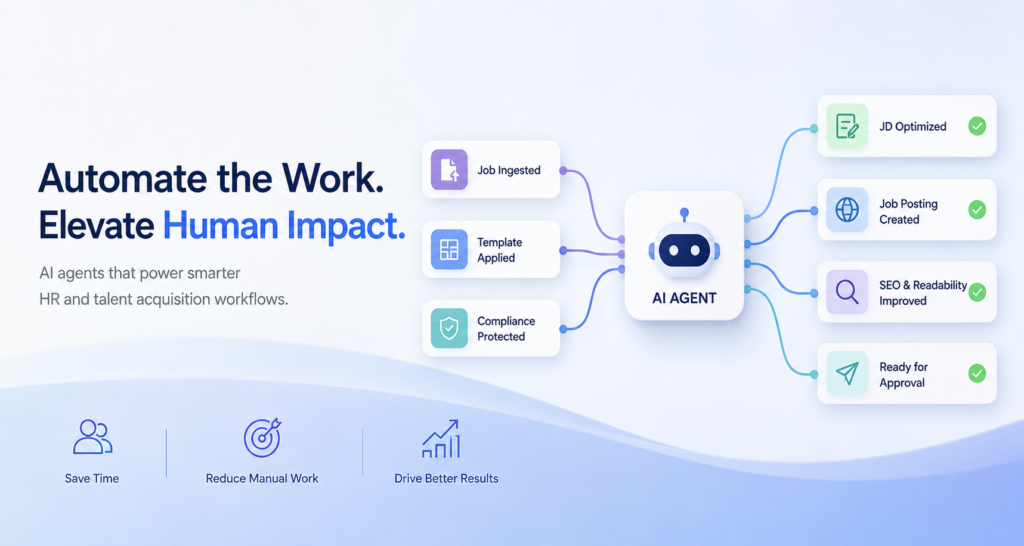
Stop Looking at Tasks. Start Looking at Workflows.
Most HR and talent acquisition teams don’t have one massive problem.
They have hundreds of tiny ones.
Someone copies a job out of the ATS.Someone pastes it into another system.Someone finds the correct template.Someone checks the formatting.Someone adds legal language.Someone rewrites sections.Someone publishes it.
Each step only takes a few minutes.
Until you multiply it by hundreds—or thousands—of jobs every year.
That’s when “just a few minutes” quietly becomes someone’s full-time job.
Imagine If Nobody Had to Touch It
Let’s use job descriptions as an example.
Today, creating a job posting often looks something like this:
- Import the job from your ATS
- Select the correct job template
- Insert required compliance language
- Lock sections that shouldn’t change
- Rewrite content for readability
- Optimize for search
- Add employer branding
- Create the external job posting
- Publish
Now imagine the entire workflow happens automatically.
- A new job arrives.
- AI identifies the job family.
- The correct template is applied automatically.
- Required legal language is inserted.
- Locked sections stay protected.
- AI improves editable content.
- A polished job posting is created.
- The finished version is sent for approval.
The recruiter never had to build it from scratch. Instead of creating the work, they’re reviewing it. That’s a much better use of their expertise.
The Best Automation Is the One Nobody Notices
Here’s a simple exercise. Think about yesterday.
- Where did you copy and paste information?
- Where did you click the same button over and over?
- Where were you waiting for someone else before you could move forward?
- What process felt completely predictable?
Those moments are hiding automation opportunities.
They’re usually not exciting. They’re repetitive. They’re consistent.
And that’s exactly what AI is becoming really good at.
From AI Features to AI Agents
There’s another shift happening.
Companies aren’t just adding AI features anymore. They’re beginning to build AI agents.
There’s an important difference. An AI feature helps you complete a task. An AI agent completes the task for you.
Think about what that could look like in recruiting:
- A hiring manager approves a new role.
- The AI agent imports the job.
- It selects the right template.
- It protects compliance language.
- It optimizes the content.
- It generates the job posting.
- It checks for missing information.
- It routes the finished draft for approval.
No one had to remember what came next. The workflow just happened.
Start Small
When people hear “AI automation,” they often picture replacing entire departments.
That’s usually the wrong place to start. Instead, ask yourself:
What’s the most annoying five-minute task your team repeats hundreds of times every month?
Automate that first. Then find the next one.
Eventually, you stop automating individual tasks. You start automating entire processes.
Questions Worth Asking Your Team
If you’re trying to identify opportunities, start with these questions:
- What work do we only do because “that’s how we’ve always done it”?
- Where do we move the same information between systems?
- Which approvals create the biggest bottlenecks?
- What work requires very little human judgment?
- What would we happily stop doing tomorrow if software could do it accurately?
The answers might surprise you.
Why I Wrote This
At Ongig, we’ve spent years helping HR and talent acquisition teams simplify job description management and job posting workflows.
Now we’re asking an even bigger question: What repetitive recruiting work could disappear altogether?
Whether it’s automatically applying templates, protecting compliance language, optimizing content, or turning job descriptions into polished job postings, the goal is the same: give recruiters more time to hire people instead of managing the process. If you’d like to see how Ongig is evolving to support smarter automation, request a demo and see it in action.
FAQs
Can AI completely automate HR processes?
Not entirely. Tasks requiring judgment, coaching, and relationship-building still need people. But repetitive, rules-based workflows are increasingly great candidates for automation.
What’s the difference between AI automation and AI agents?
Traditional automation follows predefined rules. AI agents can make decisions within a workflow, allowing them to complete multiple connected tasks with minimal human involvement.
What’s the best HR process to automate first?
Start with repetitive work like formatting job descriptions, applying templates, checking compliance language, or moving data between systems.
Will AI replace recruiters?
No. AI is far more likely to reduce administrative work so recruiters can spend more time with candidates and hiring managers.
How can Ongig help automate recruiting workflows?
Ongig helps automate many of the repetitive steps involved in creating, optimizing, managing, and publishing job descriptions, making recruiting teams faster and more consistent.
