Job descriptions rarely fail overnight. They slowly drift out of sync as teams grow, priorities shift, and hiring accelerates. Why? It’s simple:
- One department updates a role.
- Another copies an old version and tweaks a few lines.
- A third creates something entirely new.
Before long, nothing matches.
- Candidates see conflicting expectations.
- Recruiters spend time rewriting instead of hiring.
- Hiring managers disagree on what they actually need.
This is the reality for large organizations. Because of this, managing it became so important.
Let’s walk through the best practices that actually work at scale.
Importance of job description management
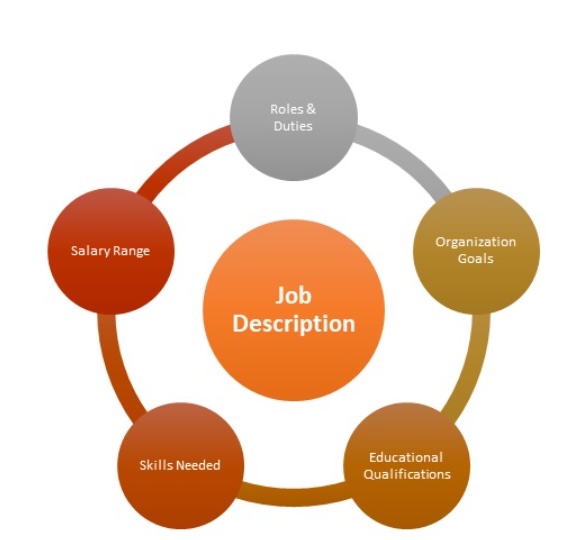
Strong job description management creates consistency across teams. It also improves hiring speed and protects your employer brand. It also helps large hiring teams scale without creating confusion or unnecessary friction.
For Human Resources Directors and Talent Acquisition Leaders, this is not operational busywork. It is a foundational hiring system.
These are the best practices you can implement.
1. Centralize it in one source of truth
The fastest way to break it down is to let it live in multiple places.
Confusion becomes unavoidable when different versions exist across shared drives, like:
- ATS notes
- Spreadsheets
- Email threads
When this happens, recruiters stop trusting the content. Besides, hiring managers ask for exceptions, and candidates receive mixed signals.
Effectiveness starts with centralization.
There must be one official version of every one of them:
- One system.
- One place where updates happen.
- One version that everyone trusts.
This could be an HRIS, an ATS module, or a dedicated job content library. The specific tool matters less than the discipline behind it.
2. Standardize the structure across all teams
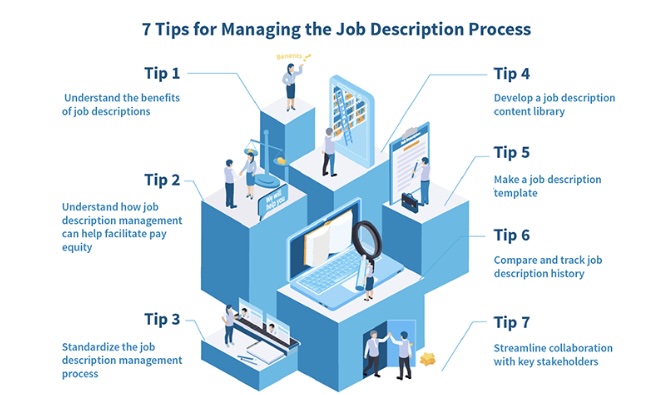
In large hiring teams, inconsistency slows everything down.
When each department writes descriptions in its own style, recruiters must relearn expectations for every role.
Candidates struggle to compare opportunities, while leadership loses visibility into role alignment.
Managing it works best when every description follows the same structure.
This does not mean making every role sound identical. It means you should create a familiar framework that improves readability and understanding.
A proven structure includes:
- A short role summary that explains the purpose
- Clear job responsibilities focused on outcomes
- Required skills that truly matter
- Preferred skills that add value
- Reporting lines and level context
When managing role descriptions across large hiring teams, it’s essential to maintain consistency, streamline collaboration, and ensure alignment with organizational goals.
A strategic portfolio management platform can play a significant role in this process by providing a centralized system for managing and organizing descriptions in a structured, transparent way. This platform allows HR teams to oversee job roles across departments, track revisions, and ensure that all position-based descriptions align with the company’s talent strategy.
By treating these descriptions as part of the larger portfolio of talent management, teams can ensure that they not only meet compliance and internal standards but also stay agile, adjusting job roles as business needs evolve.
LinkedIn data shows that large companies make it challenging for 73% of SMBs to find real talent.
Standardization improves clarity without removing flexibility.
3. Define clear ownership and approval rules
Role description management breaks down quickly when ownership is unclear.
In many organizations, everyone edits these descriptions, but no one owns them. This leads to endless feedback loops, last-minute changes, and approval bottlenecks.
Clear ownership solves this.
A strong model usually looks like this:
- HR owns structure, tone, and compliance.
- Hiring managers’ own role accuracy and expectations.
- Talent Acquisition owns candidate clarity and market alignment.
Approval steps should be defined and limited. If five people must approve every change, speed disappears.
Clear rules keep role description management efficient and scalable.
4. Align job descriptions with job architecture and levels
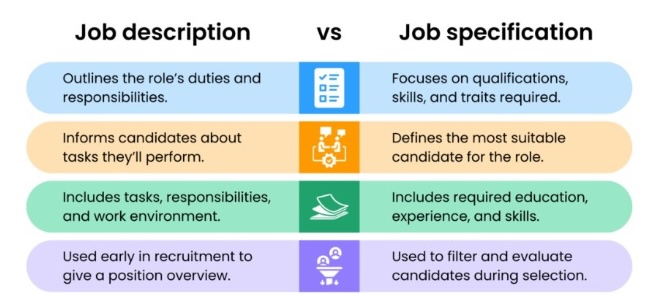
Role descriptions should never exist in isolation. They must align with job families, levels, and internal role frameworks. This is one of the most overlooked areas.
Moreover, if role descriptions don’t match job levels, problems will appear quickly, including:
- Employees are questioning the fairness.
- Candidates feel misled.
- Compensation discussions become difficult.
Each description should clearly reflect:
- The job family it belongs to
- The level of responsibility and impact
- How it differs from adjacent levels
Job responsibilities should scale meaningfully by level, not just grow longer. Strong role description management reinforces fairness and internal consistency.
5. Write job descriptions for candidates, not just internally
Many of these descriptions are written as internal documents. These include company-specific language, acronyms, and assumptions that only insiders understand. This leaves candidates to guess.
Effective role description management puts the candidate first. This means:
- Writing in plain language
- Explaining real outcomes
- Describing how the role contributes to the business
Instead of abstract phrases, focus on practical impact.
Clear language attracts better matches and reduces screening noise.
6. Build compliance and risk checks
In large hiring organizations, role descriptions are not simple hiring tools. They are also legal documents.
This is where role description management often gets overlooked.
Role descriptions influence pay equity, classification, and compliance decisions. If they’re inaccurate or inconsistent, the risk will increase quickly.
Strong role description management includes built-in compliance checks.
This means reviewing the descriptions for:
- Proper exempt vs. non-exempt language
- Consistent responsibility scope
- Alignment with pay bands and job levels
- Region-specific legal requirements
In global organizations, this becomes even more important.
Different countries have different labor laws, while different regions have different expectations.
By embedding compliance review into role description management, HR teams reduce legal risk without slowing hiring. It also ensures that the descriptions accurately reflect the work performed, not outdated assumptions.
7. Connect it to employer branding
Job descriptions are often the first real interaction candidates have with your company. What they do is they shape perception immediately.
If the descriptions feel inconsistent, unclear, or overly generic, the employer’s brand suffers. Yet, if they feel human, clear, and aligned, the trust will increase.
This is why role description management should connect directly to employer branding.
Tone matters.
Clarity matters.
Consistency matters.
Best practice is to define a shared voice for role descriptions. Think of:
- Not marketing-heavy.
- Not overly corporate.
- Clear, professional, and human.
Strong role description management ensures that every role reinforces the same message. This message is about who you are as an employer, no matter which team is hiring.
8. Keep job descriptions focused, not overloaded
Long descriptions do not signal importance. They signal confusion.
The result? Candidates skim. They won’t read through exhaustive lists of job duties and tools.
Great role description management prioritizes clarity over completeness.
A good rule of thumb for great job description templates includes:
- 5 to 7 meaningful responsibilities
- A short list of required skills
- A clear distinction between must-haves and nice-to-haves
Focused descriptions respect candidates’ attention and improve conversion rates.
9. Build a regular review and refresh cycle
Role descriptions age faster than most HR leaders expect.
Tools change.
Processes evolve.
Business priorities shift.
Without a review cycle, descriptions can quickly become outdated.
Best practice includes:
- Annual reviews for core roles
- Semi-annual reviews for high-volume roles
- Pre-hiring reviews for leadership roles
There’s no need for these reviews to be complex. All they need to do is ensure that descriptions reflect reality.
For organizations operating in specialized sectors, role descriptions are more than just a hiring tool—they are essential for legal and regulatory compliance.
Consider the complexity of managing a youth treatment center. In this environment, every role description must be perfectly aligned with state licensing requirements, HIPAA regulations, and clinical safety protocols.
Large hiring teams in these facilities often struggle with “version sprawl,” where outdated descriptions could lead to credentialing errors or safety gaps.
Deloitte research shows that managerial roles aren’t obsolete and that they drive 15% higher financial performance. Outdated role definitions reduce workforce agility because teams struggle to adapt roles quickly.
Regular updates keep role description management relevant and useful.
10. Train hiring managers
Hiring managers influence role descriptions more than anyone else.
Yet most have never been trained on how to write them.
This leads to unrealistic requirements, overly narrow profiles, and biased language. All of these hurt hiring outcomes.
The entire process should be simple.
Provide:
- Clear templates
- Writing guidelines
- Examples of strong role descriptions
Even brief training and development sessions make a difference. Besides, better inputs lead to better outcomes.
11. Integrate job description management with your ATS
When descriptions live outside the ATS, inefficiency creeps in.
Recruiters copy and paste content.
Versions drift.
Mistakes happen.
Best-in-class role description management integrates directly with the ATS.
This allows them to flow seamlessly into:
- Requisition creation
- Approval workflows
- Job postings
Integration turns role description management into a workflow, not a workaround.
12. Use data to continuously improve job descriptions
Data shapes the strongest job descriptions. Yet, their evolution is result-based, not opinion-based.
Job description management should track performance indicators such as:
- Application volume
- Candidate quality
- Time to fill
- Drop-off points
If a role consistently underperforms, you should review the job description first.
Data turns job description management into a strategic lever.
13. Secure recruiting data against AI-driven threats
As AI becomes more embedded in recruiting, HR teams face new security risks, particularly deepfake resumes, synthetic candidate profiles, and AI-generated impersonation during interviews. These threats put sensitive recruiting data and hiring decisions at risk, including:
- Candidate identities and credentials
- Interview recordings and assessment data
- Internal hiring criteria and decision frameworks
A comprehensive cybersecurity solution helps protect recruiting systems from AI-driven fraud by securing applicant tracking systems (ATS), interview platforms, and internal communication tools. With strong identity verification, encrypted data storage, access controls, and real-time monitoring, organizations can detect manipulated content, prevent unauthorized access, and reduce the risk of deepfake-enabled hiring fraud—ensuring trust and integrity throughout the recruitment process.
14. Keep all teams aligned at scale
In large hiring teams, clear job description management depends on consistent internal communication and a shared understanding of roles.
Many organizations rely on trusted employee experience apps to support this, using employee experience services and tools to keep hiring managers, recruiters, and leadership aligned as descriptions evolve.
Top-rated employee experience software, such as Blink, helps centralize updates, surface changes quickly, and reduce confusion across departments, especially when multiple teams share the same roles.
When internal information flow is smooth, job descriptions remain accurate, relevant, and easier to manage at scale.
Wrap up
Job descriptions are hiring infrastructure.
Strong job description management creates clarity, speed, and fairness across large hiring teams.
- It improves candidate experience.
- It reduces internal friction.
- It helps organizations grow with confidence.
Without structure, complexity wins. With the right practices in place, job description management becomes a powerful advantage.
Build it carefully, and maintain it consistently. Let your hiring teams scale without losing alignment.
Head to Ongig’s blog for more free resources.
Author Bio:

Luca Ramassa is Outreach Specialist at LeadsBridge, passionate about Marketing and Technology. His goal is to help companies improve their online presence and communication strategy.
