Most people think AI in hiring and recruiting started with ChatGPT. It didn’t.
Long before prompts and instant rewrites, we were sitting in a conference room at Google talking about APIs, structured job data, and hiring workflows.
In 2023, AI in hiring and recruiting exploded into the mainstream. Suddenly, every HR tech company had a “ChatGPT-powered” feature. Every demo included job description rewrites in seconds. Every sales deck had “AI-driven” near the top.
But here’s what most people miss: The real work behind AI in hiring and recruiting with structure.
Before ChatGPT, AI in Hiring and Recruiting Meant APIs
Back in 2017 and 2018, AI in hiring and recruiting looked very different.
- No conversational interface.
- No viral screenshots.
- No one typing “rewrite this job description” into a box.
Instead, we were working on things like:
- Structured job data
- Machine learning-powered job discovery
- APIs connecting ATS systems to search engines
- Automation to improve candidate matching
In October 2017, I spoke at Google’s booth at HR Tech about hiring technology and job content.

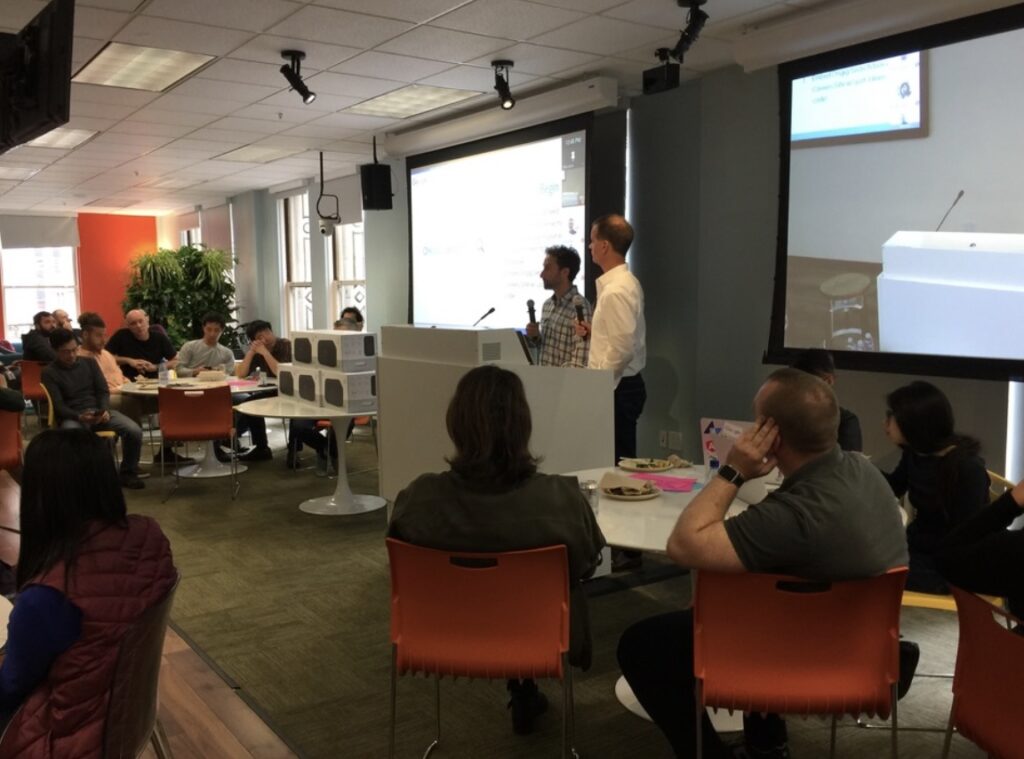
Then in May 2018, Kevin Lanik and I were invited to Google’s San Francisco office. We met with the Cloud Job Discovery team (engineers, product managers, designers, customer success, and sales). The whole crew.
They asked us to share how we were using their API. What we liked. What frustrated us. What could be better. We were trying to solve one specific problem:
How do you make job content usable, searchable, structured, and scalable?
And that problem hasn’t changed, even with today’s AI in hiring and recruiting tools.
The Real Bottleneck in AI in Hiring and Recruiting
Today, most conversations about AI for job descriptions focus on rewriting.
- Make them shorter.
- Make them more inclusive.
- Optimize them for SEO.
All good things. But even back in 2018, sitting in that Google conference room, we knew something important:
The real bottleneck wasn’t just writing. It was workflow.
Let me ask you a few questions:
- Where are your job descriptions stored right now?
- Who owns them?
- How are they approved?
- How do updates roll out across regions?
- How do you keep your ATS, career site, and recruiters aligned?
If your job content lives in Word docs, email threads, and five versions of the same file, no AI hiring platform will magically fix that.
AI can generate words. It can’t fix bad infrastructure.
3 Lessons About AI in Hiring and Recruiting That Still Apply
1. AI is only as good as your structure.
Whether you’re using APIs or ChatGPT-style tools, AI in hiring and recruiting depends on clean, consistent data.
If your job titles vary by region…
If responsibilities aren’t standardized…
If requirements are inconsistent…
Your outputs will be inconsistent too. Garbage in, garbage out still applies.
2. Governance matters more than generation.
Today anyone can use AI to rewrite a job description in seconds.
That’s not the risk. The risk is inconsistency. We’ve seen TA teams accidentally create:
- Multiple versions of the same role
- Conflicting pay ranges
- Compliance exposure across states or countries
- Brand voice drift across business units
Speed without control creates chaos.
3. Draft → Approve → Publish is the real system.
The most overlooked part of AI in hiring and recruiting is the workflow.
The teams that get the most value from AI tend to:
- Centralize job content in one place
- Standardize templates
- Build approval workflows into the system
- Sync cleanly with their ATS
- Publish consistently to their career site
That was true before ChatGPT. It’s even more true now.
What ChatGPT Changed About AI in Hiring and Recruiting
ChatGPT changed one big thing: accessibility. What used to require technical integration now takes a prompt. That’s powerful. But here’s the twist: Content generation is no longer the differentiator.
Everyone has access to AI in hiring and recruiting tools now. What separates strong TA teams is:
- Control
- Consistency
- Workflow integration
- Data governance
The teams that win with AI in recruiting are the ones who manage the system behind the generation.
How to Evaluate AI in Hiring and Recruiting Tools
If you’re evaluating AI in hiring and recruiting right now, here’s the wrong question:
“Can it rewrite this job description?”
Here’s the better one:
“Does this help us control and manage job content from draft to publish?”
Because that’s the real work.
Why I Wrote This
I wrote this because the conversation around AI in hiring and recruiting is loud right now. And when hype gets loud, fundamentals get ignored.
At Ongig, we focus on the system behind the words. Centralizing job content, building approval workflows, standardizing templates, and syncing cleanly with your ATS and career site.
If you want to see how that works in practice, request a demo here. We’ll show you how to take control of job content end-to-end — with AI in hiring and recruiting as part of the workflow, not a band-aid on top of it.
FAQs
What is AI in hiring and recruiting?
AI in hiring and recruiting includes machine learning, automation, and generative AI tools that help with sourcing, job descriptions, candidate matching, and workflow optimization.
Did AI in hiring and recruiting start with ChatGPT?
No. AI has been used in hiring for years through structured job data, APIs, search algorithms, and matching tools.
What’s the biggest risk of AI in hiring and recruiting?
Inconsistency and compliance risk if there’s no centralized governance or workflow control behind the content.
How can TA leaders get the most value from AI in hiring and recruiting?
By combining AI generation with structured templates, approval workflows, centralized libraries, and ATS integration.
