Salary benchmarking is only an input. What you do with it, where you place it, how you phrase it, and what you wrap around it, is what makes a candidate accept your offer instead of another company’s.
This matters more than ever, as 72% of employers are reporting difficulty finding skilled talent, according to ManpowerGroup’s 2026 Global Talent Shortage Survey. When most of the market is chasing the same candidates, the offer you put in front of them has to do more work than it used to.
I run HR DataHub, so I spend my days looking at what employers are advertising right now, not what they reported on a survey last year. In this guide, I’ll show you how to carry a benchmark through to the ad and the offer, so the right people apply, and more of them accept.
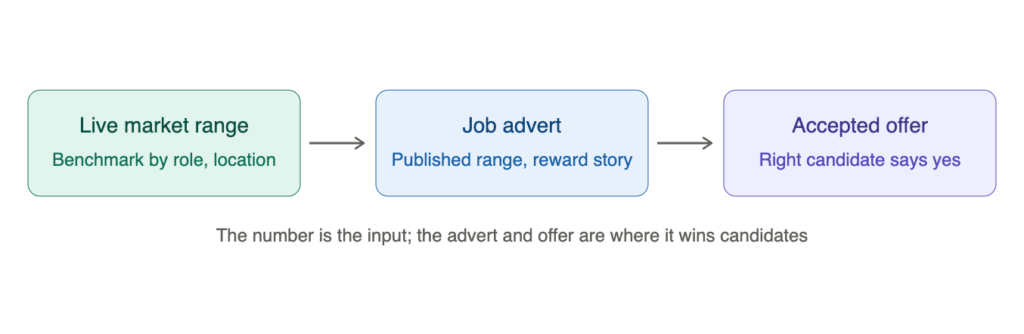
How Salary Benchmarking Helps to Attract Better Candidates At a Glance
- Salary benchmarking attracts better candidates only when the benchmarked range is reflected in the job ad and employment offer.
- The salary range you publish is itself benchmarking data: every candidate reads it and compares it against the other ads in their feed.
- Total reward beats base pay alone for attraction. When you can’t win on salary, you compete on retirement contributions, flexibility, progression, and other benefits.
- Benchmarking shows which roles lag the market, so you can direct more budget towards the openings that are hardest to fill.
- Live job advert data shows what competitors are advertising right now, which is the signal that matters when you’re setting an offer.
What is Salary Benchmarking?
Salary benchmarking is the process of comparing your organisation’s pay and benefits against external market data to check whether your rates are fair, competitive, and defensible. It tells you where your offer sits: ahead of the market, mid-market, or below, so you can make a deliberate choice about where to position it, with evidence to back that decision up.
It’s worth separating this from a pay review. Benchmarking is the evidence; a pay review is the internal process of deciding what to do about it. Most organisations run them together, but benchmarking can, and should, happen independently whenever you’re setting an offer or opening a hard-to-fill role.
To attract the right candidate, salary benchmarking answers one question: Will a strong candidate read the number on this job post and want to apply?
How Does Salary Benchmarking Work?
Salary benchmarking works by matching your role to similar roles in the market, then pulling salary data for those roles from a trusted source. You define the job by its actual duties and level, not just its title, because the same title can mean very different jobs across two employers.
You then filter for things that influence compensation, mainly location, industry, and the specific skills the role needs. The output is a range, typically a lower quartile, median, and upper quartile, showing the spread of what employers pay.
Where you position your offer within that range is your decision to make, with data to back it up. The fresher your data, and the closer your role match, the easier it is to defend that decision when a hiring manager questions the budget or a candidate pushes back on the number.
How to Turn Salary Benchmarking Data into Offers Candidates Accept
A benchmark earns its keep from the moment a candidate decides whether to apply until they accept your employment offer. The moves below are how you turn salary benchmarking data into offers that candidates accept:
- Shape the Offer Around the Whole Package, not Just Base Pay
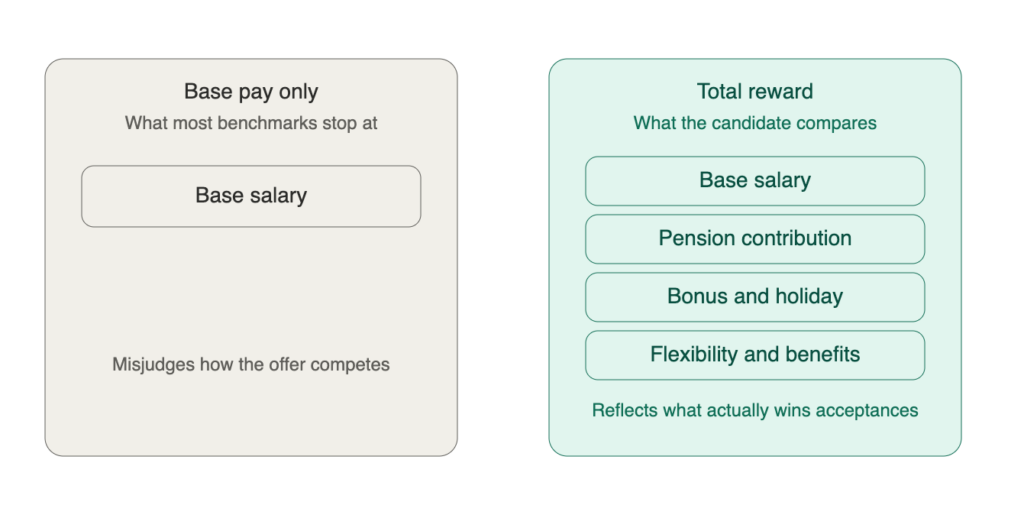
Candidates compare total reward, so benchmark the whole package, or you’ll misjudge how your offer lands. Two offers at the same salary are rarely equal once you count retirement contributions, bonus, paid time off, flexibility, and the cost of the commute.
A $48,000 role with a strong retirement match and hybrid working can beat a $50,000 role that demands five days on-site. A strong candidate does that math in their head before they even apply. The number on the job ad opens the door; the rest of the package is often what gets the acceptance.
- Advertise the Salary Range and Back it With Evidence
Publishing the salary range in the job ad is now close to table stakes, and that published range is the first piece of benchmarking a candidate sees from you. A vague “competitive salary” reads as something to hide, and strong candidates skip past it.
A specific, market-aligned range signals that you’ve done the work and you know what the role is worth, which builds trust before the first conversation. Ongig’s job description software helps teams include a clear, compliant range and reward details in the posting, rather than leaving it as an afterthought.
- Translate Salary Benchmarking Data into a Language Candidates Believe
A range on its own is just a number. If your number sits oddly against what a candidate sees elsewhere, explain why in plain terms: a genuine skills premium, a higher cost-of-living market, a progression path that lifts pay within the first year.
But don’t oversell it. The fastest way to lose a good candidate is to tell a reward story the first interview quietly contradicts. Ongig’s guide on how to write a job description is a useful steer on turning that detail into candidate-facing language people actually read.
- Benchmark the Reward Levers You Can Move When Base Pay is Fixed
When the salary is capped, benchmark the levers you can still move, because that’s where a fixed-budget offer is won or lost. US companies are planning average salary budget increases of 3.4% in 2026, according to The Conference Board’s 40th annual Salary Increase Budgets survey. So you rarely outbid a rival on base alone.
You can still reallocate the budget, though. A stronger retirement match, a clearer bonus structure, extra paid time off, or flexibility that costs little but matters a lot to the right person. In retail and other high-volume sectors, employee discounts and a recognisable employer brand do real work here, often more than a small bump in base pay would.
- Dedicate More Effort and Budget to Roles Where You Lag Most
If you spread your attention evenly across every open role, you end up overpaying where you’re already competitive, and underpaying where you’re losing people. Benchmarking during recruitment tells you which roles sit behind the market and which are fine, so you can allocate more budget and effort to roles that are hard to fill.
A team-lead role lagging the market by 8% will leak candidates, while an admin role sitting right at the median won’t. Yet, 83% of US employers spread their salary increase budget evenly across the organization rather than directing resources toward high-demand skills or critical gaps. That even split quietly starves the openings where candidates are hardest to win.
How Live Job Advert Data Sharpens a Salary Strategy
A survey tells you what a role paid when the data was collected; a live job ad gives you the current pay. That gap matters most when you’re setting an individual offer this week rather than running an annual review. Traditional surveys benchmark what was; advertised data benchmarks what is.
The trade-off is worth noting: advertised data shows what employers are offering to attract people, not what current employees actually earn, and it carries no formal leveling. For active hiring, that live view is usually the more relevant one, because you’re competing against the postings a candidate is reading today.
The practical payoff is that you stop benchmarking base pay in isolation. You can pull a current range by role and location across more than 1,000 locations using live job advert data, then weigh base-pay-only against the fuller total-reward picture a candidate is actually comparing. The contrast below is the one that quietly decides most offers.
A Worked Example: Hiring a Regional Operations Manager
Say you’re hiring a regional operations manager in two places: New York City and your wider national footprint. One survey average covers both, and that single number is how you overpay in one market while losing candidates in the other.
The live data says otherwise. According to Glassdoor, a regional operations manager in New York City averages $133,235, with a typical range of $105,323 to $171,087 (25th to 75th percentile). Nationally, the same role averages $123,905, with a range of $98,293 to $158,695.
That’s roughly a $10,000 gap at the midpoint, and the bottom of New York’s range lands above the national median. So you treat them as two offers, not one.
For the national market, you can set a base near the $124,000 midpoint, lead with a strong benefits package and a clear path to a senior operations role, and publish that range on the ad. For New York, the $124,000 figure would read as low and quietly screen you out. You move the base toward the upper end of the range and lead the ad on the package and progression path.
Similar roles, with two different offers, and each built from what its own market actually pays. You fill both without overpaying in either, because the number on each ad matches the market the candidate is judging you against.
The same logic applies in the UK. If you’re hiring across multiple locations there, HR DataHub lets you pull live job advert data filtered by role and location. Instead of working from one blended average you can see what each market is actually offering and price each role to fit it.
Common Mistakes When Benchmarking to Attract Candidates
The most common benchmarking problems trace back to a handful of avoidable errors. They include:
- Benchmarking the title, not the job: Two roles with the same title can be very different work, so match on duties and level, or your range will be off before you start.
- Treating the benchmark as a once-a-year task: Markets move within months. A range you set last year may already be behind, especially for in-demand roles or location-sensitive roles.
- Hiding the number: ‘Competitive salary’ reads as evasive, while a specific, market-aligned range will attract the right applicants.
- Benchmarking base pay only: Candidates compare total reward, so a base-only view misjudges how your offer actually competes.
- Spreading the budget evenly: Equal raises across every role feel fair, but quietly starve the few openings where you are genuinely losing candidates.
Frequently asked questions
Why is salary benchmarking important for hiring?
Salary benchmarking is important for hiring because it tells you whether your offer is competitive before you post the job, not after a candidate rejects it. It grounds the advertised range in market evidence, which attracts the right applicants and gives you a defensible answer when a hiring manager or a candidate questions the number.
How often should you benchmark salaries?
You should benchmark salaries at least once a year for a full pay review, and again whenever you open a role in a fast-moving or hard-to-fill market. If you’re hiring in a location where pay is shifting quickly, a live market view is more useful than an annual survey figure that may already be stale.
How do companies benchmark salaries?
Companies benchmark salaries by matching each role to comparable roles in the market, then pulling pay data filtered by location, industry, and required skills. They use salary surveys, live job advert data, or both, then place their offer based on how competitively they need to hire for that specific role.
Can salary benchmarking help with retention as well as attraction?
Salary benchmarking helps with retention, as well as attraction, because the same market view that sets a competitive offer also flags where existing pay has fallen behind. Spotting a lagging role before someone resigns is cheaper than countering an outside offer after they’ve handed in their notice, and it keeps your internal pay defensible.
Attract Better Candidates With Real Salary Data
The number on your job ad is doing more work than most hiring teams realise. It tells a candidate whether you’ve done your homework, whether the role is worth their time, and whether the rest of the conversation is worth having.
If you’re hiring in the UK, HR DataHub gives you live job advert data filterable by role, location, and skill, so the number you put on the job ad reflects what the market is paying this week, not last year’s survey. Start a free trial today, and see how it fits your roles.
David Whitfield is the CEO and co-founder of HR DataHub, a salary benchmarking tool that draws data from over 30 million live job postings to help HR teams make confident, data-driven pay decisions. With more than 20 years of experience in HR and Reward, he is passionate about empowering organisations to make smart, defensible decisions more quickly and easily than ever before.
